Best Desk Organizers for Deep Work Routines
As an Amazon Associate, I earn from qualifying purchases. This article may contain affiliate links, which means we may receive a commission at no extra cost to you.
When you want to sink into deep work—long stretches of focused, uninterrupted productivity—the right desk organizer can be the difference between sustained flow and scattered effort. This guide looks at simple, paper-first organizers: weekly pads, undated planners, and spiral desk notepads designed to reduce friction, prioritize tasks, and keep your attention where it matters. These are not flashy desk trinkets; they are practical planning tools people reach for during focused work routines when screen-based to-do lists become distractions.
Below you’ll find a short buying primer followed by detailed breakdowns of five highly usable desk planners. I did not test these products personally; the recommendations are based on product features, typical user needs, and common use cases for sustained focus sessions.
Buying Guide
How to choose a desk organizer for deep work
Focus-first desk organizers share a few practical traits: a clear hierarchy for tasks, minimal visual clutter, and easy-to-grab placement on the desk. When evaluating planners for deep work, pay attention to the following considerations:
– Layout and focus zones: A planner with dedicated sections—for “Top Priorities,” project lists, timed hourly slots, or a small notes area—helps you decide what to work on during a focused block. Look for simple dashboards that surface 3–6 focus items; too many sections can dilute attention.
– Size and orientation: If you work with reference materials or a laptop, an 8.5"×11" or A4 pad sits comfortably beside your keyboard and is easy to glance at. Spiral desk pads can be flipped quickly to a fresh page; glued pads stay neat but are less flexible.
– Undated vs. dated: Undated planners are ideal for irregular schedules and deep work sprints—no wasted pages when you skip a day. Dated planners can help if you need strict cadence and accountability.
– Durability and paper feel: A heavier paper stock resists ink bleed and supports frequent note-taking during long sessions. Spiral bindings allow the pad to lie flat; glued or tear-off pads maintain a tidy desk.
– ADHD-friendly design: For people who struggle with attention, simple contrast, large checkboxes, and a small number of prioritized items can reduce decision fatigue and increase task completion.
– Portability and storage: If you move between workstations or study spaces, lightweight pads and compact spiral notebooks are easier to carry.
Common trade-offs: more structured planners offer guidance but can feel restrictive; very open templates are flexible but require more discipline. Decide whether you want a planner that prompts you or one that simply captures your priorities.
With these points in mind, the following product sections explain who each pad is best for, real-life use scenarios, and practical pros and cons to help you pick the right organizer for deep work.
Weekly Productivity Planner – 8.5" x 11" Dashboard Desk Notepad Has 6 Focus Areas to List Tasks for Goals, Projects, Clients, Academic or Meal-Organize Your Daily Work Efficiently, 54 Weeks, Green

Best For:
Project-focused professionals, students juggling multiple domains, and anyone who needs a simple weekly dashboard to prioritize 3–6 focus areas.
If your deep work routine benefits from a clearly sectioned page, this Weekly Productivity Planner offers a simple dashboard with six focus areas so you can split attention between top priorities, ongoing projects, client tasks, academic work, and even meal planning. The 8.5"×11" size makes it desk-friendly: it sits beside a laptop without crowding the keyboard and is large enough to jot down time-blocks, short notes, and checkable tasks. With 54 weeks of pages, the pad is meant to live on your desk for long stretches, encouraging weekly planning sessions rather than daily micro-resets.
Why it works for deep work: the dashboard approach reduces decision fatigue. Instead of opening a blank document or scrolling through a long digital list, you get a predictable structure that nudges you to pick a few mission-critical tasks. The printed sections help you separate different domains of responsibility—so when you enter a focused session, you’re looking only at the relevant focus area.
Real-life usage examples include blocking morning hours for three “Top Priorities,” using the project area for subtasks to tackle during a two-hour sprint, and keeping a small client list visible for quick reference between sessions. Students can use the academic column to split readings and assignments across study blocks, while parents may appreciate the meal-organize area to avoid decision fatigue during work breaks.
How it compares: unlike undated pads that are more free-form, this planner’s dashboard is more directive. It won’t replace a digital calendar for time-of-day reminders, but it complements digital tools by offering a tactile focal point. The heavier, desk-oriented sizing trades portability for readability.
Who should buy: people who want an on-desk visual cue to prioritize weekly work, project-based professionals who benefit from domain separation, and students who like an at-a-glance weekly layout.
Who may skip it: minimalists who prefer single-line to-do lists or people who need granular hourly scheduling might find this format too broad.
Practical buying considerations: check whether the paper weight supports your preferred pens and whether the binding or glue allows easy tear-off when you need to archive a week. This pad is best paired with a slim desk tray or clipboard to keep it visible during long sessions.
Ready to bring clarity to your deep work sessions? Check the latest price on Amazon.
Pros
- Clear dashboard with six purposeful sections
- Large 8.5"×11" desk-friendly format
- Long 54-week supply keeps you planning consistently
Cons
- Less portable than pocket-sized planners
- Not ideal for detailed hourly scheduling
Ready to bring clarity to your deep work sessions? Check the latest price on Amazon.
Undated Weekly Organizer & To Do List Notepad – Minimalist A4 52-Sheet Desk Planner for Work School & Family, ADHD Friendly Calendar for Deep Focus & Goal Tracking

Best For:
People who prefer flexible, undated planning—freelancers, students, and those who want low-visual-distraction layouts for focus.
For people who prefer a clean, undated canvas to build a habit of focused work, this Minimalist A4 Undated Weekly Organizer offers a lightweight, flexible approach. The undated layout removes the pressure of daily use and prevents wasted pages when life gets busy—an important feature for those who rely on concentrated blocks rather than every-day consistency. With 52 sheets, the pad gives you roughly a year’s worth of weekly guidance if you use it regularly.
Deep work-friendly features include roomy to-do columns, a compact notes area for context, and simple checkboxes that satisfy the closure of completing tasks. The minimalist design intentionally avoids bright colors and cluttered prompts, which helps reduce visual noise when you’re trying to maintain flow. Because it’s A4, the planner offers more writing surface than an 8.5"×11" without becoming unwieldy.
Common real-life scenarios: a freelancer could sketch a weekly billable-hours plan and prioritize three client tasks for each focus block. A college student might list readings and divide them into two focused study sessions per day. ADHD-friendly aspects—large checkboxes and an uncluttered layout—make it easier to pick one next action and get started without overthinking.
Compared to heavier, branded planners, this pad is purposefully spare. It doesn’t dictate how you plan your day, but that’s its advantage: it supports multiple methods—time blocking, Pomodoro sprints, or task-batching—without imposing a system.
Who should buy: people who value flexibility and low visual distraction; those who alternate between intense weeks and lighter ones; and anyone with ADHD or attention challenges who benefits from reduced options.
Who may skip it: people who want built-in prompts, daily affirmations, or pre-structured time slots should consider a more guided planner.
Practical buying tips: pair this pad with sticky tabs or a simple tracker to mark where you left off. If you write a lot, check the paper weight to prevent bleed-through.
If you’re ready to simplify your weekly routine and protect your deep work windows, check the latest price on Amazon.
Pros
- Undated design avoids wasted pages
- Minimalist layout reduces visual distraction
- A4 size gives ample writing room
Cons
- Less guidance for users who want structure
- Paper weight may vary—check pen compatibility
If you’re ready to simplify your weekly routine and protect your deep work windows, check the latest price on Amazon.
ZICOTO Beautiful Daily Planner And Notebook With Hourly Schedule – Aesthetic Spiral To do List Notepad to Easily Organize Your Work Tasks And Appointments – The Perfect Office Supplies For Women

Best For:
Professionals who time-block daily work, creatives needing scheduled deep work sessions, and anyone who appreciates an attractive planner to motivate use.
If your deep work sessions require a mix of daily structure and aesthetic appeal, this ZICOTO Daily Planner blends hourly scheduling with a spiral-bound notebook format. Hourly slots make it easy to block focus periods and appointments, which is useful when your day contains fixed meetings as well as protected focus time. The spiral binding lets the planner lie flat on the desk—handy when you’re writing during a sprint—and makes it straightforward to flip to a new page at the start of each day.
The planner’s design leans toward the aesthetic: attractive covers and soft color palettes can make the practice of planning more pleasant. That matters—small positive cues can increase the odds you’ll open the planner and commit to a block of deep work. Functionally, hourly schedules help you translate broader weekly goals into realistic daily actions. You can allocate two or three focused hours in the morning and reserve afternoons for lighter tasks or meetings.
Real-life use cases span professionals with mixed schedules, creatives who need time-boxed writing or design sessions, and working parents who coordinate appointments along with concentrated work blocks. The hourly grid is especially good for people who use the calendar-first approach: set your digital calendar for meetings and use the planner to carve out intentional, undisturbed work time.
How it compares: compared with simple weekly pads, this daily, hourly format adds more structure. That can be a strength if you need time-based boundaries, but it can feel constraining if you prefer loose block scheduling. The spiral makes it more portable than glued pads, but it’s larger than pocket notebooks.
Who should buy: those who need daily time blocking, professionals with mixed meeting and focus needs, and people who enjoy an attractive, user-friendly design that encourages consistent use.
Who may skip it: if you run on an irregular schedule or prefer undated flexibility, a weekly undated pad might be a better fit.
Buying considerations: check how many days are included, whether the hourly range matches your working hours, and whether the cover is sturdy enough for travel.
Looking for a planner that blends beauty with structure? Check the latest price on Amazon.
Pros
- Hourly schedule for precise time-blocking
- Spiral binding lies flat for easy writing
- Aesthetic design encourages consistent use
Cons
- More structured—less flexible for irregular workflows
- Larger size may be less portable than pocket notebooks
Looking for a planner that blends beauty with structure? Check the latest price on Amazon.
ZERONE CENTRE Productivity Weekly Planner – 54 Sheets Dashboard Spiral Deskpad Has 6 Focus Areas to List Tasks for Goals, Projects, Clients, Academic, or Shopping-Organize Your Daily Work Efficiently

Best For:
Multitasking professionals, students, and project-focused people who want a durable weekly dashboard that lies flat and flips easily.
The ZERONE CENTRE Productivity Weekly Planner shares a familiar dashboard approach—six focus areas presented on a spiral deskpad—designed to keep the week’s priorities visible and actionable. Spiral binding is the key physical difference: the pad lies flat and each sheet can be turned without tearing the rest, making it convenient for quick daily reviews or multi-week project tracking. The 54-sheet count gives you more than a year of weekly planning if you skip some weeks or use the planner intermittently.
What stands out for deep work is the explicit separation of domains. This pad encourages you to designate a handful of top items for the week while keeping project-level subtasks nearby. That layout is particularly useful for knowledge workers who alternate deep work sprints with meeting-heavy days: when an uninterrupted block appears, you can immediately pick the one project task that advances your biggest goal.
Practical use cases include: a consultant allocating two deep work blocks per week to high-impact deliverables; a grad student splitting thesis work into weekly milestones and daily writing sprints; or a small-business owner organizing client tasks, inventory lists, and marketing priorities in a single view. The pad’s spiral binding makes it easier to keep the current week open while stacking previous weeks for quick reference.
Compared to glued pads or undated sheets, the spiral deskpad provides a balance of stability and flexibility. It’s more robust than thin tear-off pads and more portable than a hardcover planner.
Who should buy: people who like a clear weekly dashboard with durable spiral binding—project managers, students, and multitasking professionals who appreciate quick flip-through access.
Who may skip it: if you need strict hourly tracking or prefer a minimal undated layout, look elsewhere.
Buying tips: confirm the pad’s paper quality if you use fountain pens or markers. Also consider a clipboard or desk stand to keep the planner angled for easier glances during long sessions.
Ready to keep your weekly priorities front and center during focus sessions? Check the latest price on Amazon.
Pros
- Durable spiral binding that lies flat
- Six-domain dashboard for clear weekly priorities
- 54 sheets provide long-term planning continuity
Cons
- Not ideal for detailed hourly scheduling
- Desk-sized—less ideal for pocket portability
Ready to keep your weekly priorities front and center during focus sessions? Check the latest price on Amazon.
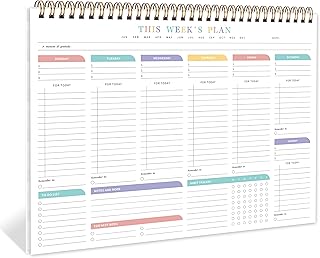
TREES Weekly To Do List Pad with 52 Undated Sheets(8.5"×11")- Weekly Desk Notepad with Spiral Binding for Women & Man, Office, School and Home Personal Organizer
Best For:
People who prefer a simple, undated weekly checklist—remote workers, teachers, and busy parents who need a forgiving planning tool.
The TREES Weekly To Do List Pad focuses on straightforward, undated weekly planning with spiral binding and a familiar 8.5"×11" footprint. The undated format gives you permission to skip weeks without wasting sheets, while the spiral binding allows the pad to sit flat during long writing sessions and makes flipping to a fresh page effortless. The layout emphasizes checkable tasks and short weekly goals—an excellent fit for people who want to translate big-picture goals into bite-sized, actionable items for focused sprints.
Why this pad helps deep work: its simple columns and visible checkboxes reduce friction at the moment you decide what to work on. Instead of toggling between apps, you have a tactile cue that collects next actions and small milestones, which is especially helpful during the start of a focus block when the hardest part is picking one task and getting started.
Use-case examples: a remote worker can draft a weekly work plan and highlight three deep work tasks for the mornings; a teacher might outline lesson prep and grade batches during dedicated time windows; a busy parent could segregate household tasks and work priorities so focused blocks are protected from small distractions. Because it’s undated and compact, this pad is forgiving—miss a week, and you don’t lose anything.
Compared with full-featured planners, the TREES pad is minimalist by design. It doesn’t offer hourly schedules or elaborate prompts, but that lightweight approach reduces decision overhead and encourages action.
Who should buy: those who want a simple, undated weekly checklist with the stability of spiral binding—ideal for task-focused routines and people who prefer tactile planning.
Who may skip it: if you need prompts for habit tracking, gratitude, or detailed time blocking, choose a more structured planner.
Buying considerations: check the paper thickness for pen compatibility, and consider using a magnetic clip to keep the current page visible on a metal desk. Pair with a simple pen holder to keep your planning ritual consistent.
If you want a no-nonsense weekly pad that supports focused sprints and checkable progress, check the latest price on Amazon.
Pros
- Undated weekly format avoids wasted pages
- Spiral binding lies flat for easy writing
- Compact 8.5"×11" desk-friendly size
Cons
- Minimal structure—no hourly slots or habit prompts
- Paper quality may vary—check pen compatibility
If you want a no-nonsense weekly pad that supports focused sprints and checkable progress, check the latest price on Amazon.
Final Verdict
Choosing the right desk organizer for deep work comes down to how much structure you need, how visible you want your priorities to be, and whether you prefer undated flexibility or time-based prompts. The Weekly Productivity Planner and ZERONE CENTRE pads work well for people who want a clear dashboard and a durable desk presence. The Undated A4 pad and TREES Weekly To Do List Pad give you breathing room and reduce pressure when your schedule is unpredictable. The ZICOTO Daily Planner is ideal if you need hourly time blocking and appreciate an attractive, easy-to-use spiral notebook.
When selecting your planner, consider paper weight for your preferred pens, whether you need hourly versus weekly layouts, and how portable you want the tool to be. A tactile desk pad can complement your digital calendar: use the planner to choose the next best action and the calendar to hold time for that work. For most deep work routines, the goal is the same—reduce friction at the moment you start.
Pick the planner that matches your rhythm, set a small weekly ritual to update it (5–10 minutes), and guard the focus blocks you plan. Check the latest price on Amazon.
Conclusion
These Desk organizers people use during focused deep work routines picks are trending now and offer great value and variety. Check the links above for latest prices and reviews.
As an Amazon Associate, I earn from qualifying purchases.
Tags:
desk organizer, weekly planner, deep work, productivity pad, undated planner, time blocking, desk notepad
