Top Study Books & Tools Students Buy Before Exams
As an Amazon Associate, I earn from qualifying purchases. This article may contain affiliate links, which means we may receive a commission at no extra cost to you.
It’s a familiar pattern: as exam season approaches, students flood online stores hunting for anything that might give them an edge. Amazon’s sales trends reflect that urgency—buyers pick books and tools designed to boost recall, structure revision time, and calm exam-day nerves. If you’re preparing for midterms, finals, professional board exams, or simply want to study more effectively, this guide collects the most useful and well-reviewed items that students are adding to their carts before tests.
Before we dive in, a quick note on transparency: As an Amazon Associate, I earn from qualifying purchases. This article may contain affiliate links, which means we may receive a commission at no extra cost to you.
This article focuses on practical, research-backed study strategies and the products that help you apply them. You’ll find books that explain memory techniques, layered learning frameworks to structure study sessions, simple organization guides for life admin (that reduce stress), and fun notebooks to keep you engaged during long revision periods. Each product section explains who benefits most, realistic ways to use it, and the trade-offs to consider.
Buying Guide
Choosing study aids can feel overwhelming because different students need different things. Below are the main criteria to consider before you buy:
1) Purpose and timeframe: Are you looking for a fast revision method for an imminent exam, or a long-term habit-change resource? Quick techniques (like active recall routines) are ideal for last-minute boosts, while layered learning frameworks and study-skill manuals pay off over a semester.
2) Learning style: Visual learners benefit from diagrams, mind maps, and books that include charts or step-by-step frameworks. Auditory learners might prefer resources that pair well with recorded summaries or read-aloud features. Kinesthetic learners should seek interactive workbooks and notebooks that encourage writing, re-ordering notes, or using flashcards.
3) Practicality and portability: If you study between classes or commute, small paperbacks and compact notebooks are easier to carry than bulky reference tomes. Look for clear formatting, concise chapters, and actionable lists that you can apply quickly.
4) Evidence and usability: Favor products that cite memory science or present repeatable systems (spaced repetition, active recall, interleaving). Usability matters—templates, checklists, or sample schedules can be more valuable than abstract theory.
5) Emotional and organizational support: Exam stress is real. A product that helps reduce administrative friction (checklists for paperwork, “what to do if you fail” plans) or includes mindset strategies is often worth its weight in calm.
6) Price vs. value: Don’t chase the cheapest option; instead weigh how often you’ll use it. A concise, practical book you use all semester is better value than a fancy textbook you skim once.
7) Compatibility with your workflow: If you rely on digital flashcard apps, pick books that translate easily into short prompts. If you prefer pen-and-paper, choose notebooks and workbooks with good paper quality and layouts designed for revision.
With those points in mind, read the product breakdowns that follow. Each section dives into real-life use cases, who benefits most, and practical pros and cons to help you pick the best tool for the next exam season.
Layered Learning: Master Any Subject Faster, Crush Every Exam, and Retain Information Forever

Best For:
Students and professionals who need a repeatable, time-efficient study workflow—especially those balancing multiple courses or jobs.
Layered Learning offers a structured framework designed to help students move from surface familiarity to deep mastery without getting overwhelmed. The core idea is deceptively simple: study in layers—overview, active practice, spaced review, and synthesis—so that you don’t waste time re-reading without retention. For students who feel like they’re “cramming” but still forgetting key ideas, layered learning provides a step-by-step method to change that pattern.
What it is: a compact, strategy-focused guide that breaks learning into repeatable phases. It mixes practical checklists with concise explanations of why each layer matters. Instead of long theoretical chapters, the book is organized around actionable routines: how to create a one-page topic map, how to design practice questions, and how to set intervals for review.
Who it’s for: This is ideal for undergraduate and graduate students juggling several courses, test-prep candidates for professional exams, and lifelong learners tackling dense subjects. If you’re balancing work and study, the layered approach helps prioritize what to do when time is short.
Key benefits: The layering system reduces wasted time (no more passive re-reading), enforces active recall, and makes spaced repetition practical without specialized apps. Compared to standard study guides that give lists of tips, this book gives a repeatable workflow—useful for busy schedules.
Practical use cases: Start a new topic by creating a one-page overview during week one of the course. Use the second layer to write self-test questions and answer them without notes. Schedule short review sessions (10–20 minutes) over the following weeks to enforce spacing. For final exam prep, the synthesis layer helps you create a quick “one-sheet” for last-minute review.
Observations and considerations: Readers often report that the book feels like a coach rather than a textbook—few fluff pages, mostly templates and timelines. If you prefer deep theory about memory science, this may feel light; if you want a practical system you can start using immediately, it’s a good fit. It pairs well with flashcard tools and note-taking apps but is also fully usable on paper.
If you struggle with procrastination, Layered Learning’s stepwise structure can reduce decision fatigue by telling you exactly what to do next. It’s not a magic bullet—discipline is still required—but it offers a clear roadmap that many students find transforms last-minute panic into controlled, effective study sessions. Check the latest price on Amazon.
Pros
- Clear, actionable multi-step system
- Reduces wasted time from passive re-reading
- Easy to implement with digital or paper notes
Cons
- Less focus on deep memory theory
- Requires discipline to follow the layers consistently
Check the latest price on Amazon.
Memory for Exams: How to Remember What You Study (Student Focus Series Book 4)

Best For:
Students facing memorization-heavy exams (medical, law, languages, history) and learners who want compact, practiceable memory techniques.
Memory for Exams focuses on memory techniques tailored to the pressures and timelines of student life. Where some study books emphasize schedules and time management, this title drills into how memory works in practice and gives portable techniques you can use when revising facts, formulas, or timelines.
What it is: a concise, technique-driven companion for building recall. Expect mnemonic devices, chunking strategies, links between meaning and memory, and practical tips for transferring short-term cramming into longer-term retention. The book includes short exercises that can be practiced between classes or during study breaks.
Who it’s for: Best for students preparing for content-heavy exams—medical, language vocabulary, law facts, history dates, or any subject that requires memorization of discrete items. It’s also useful for anyone learning a new language or revising for certification tests.
Key benefits: Emphasizes portable techniques (like mnemonic anchors, the memory palace in bite-sized form, and imagery-based association) that don’t require fancy tools. Compared to general study-skill books, it’s more narrowly focused on memory—helpful when your main problem is forgetting details rather than managing time.
Practical use cases: Use the book the week before an exam to convert lecture notes into memory-friendly chunks. Try a quick “five-minute memory palace” to lock in a sequence of steps or formulas. Convert a long list into grouped items using chunking strategies while commuting or during quick breaks.
Observations and considerations: Many students appreciate the short, exercise-based chapters that make it easy to test a method quickly. If you prefer a holistic study system that includes scheduling and productivity habits, pair this with a broader study-plan book. Some readers note that while mnemonic tricks are powerful, they require practice to become fast and natural—don’t expect instant mastery after one read.
This book is a targeted tool: excellent when memorization is the bottleneck. It’s especially useful in the final stretch before exams, or anytime you must retain dense factual material for the long term. Check the latest price on Amazon.
Pros
- Focused, practical memory techniques
- Short exercises work between study sessions
- Good for dense factual material
Cons
- Narrow focus—less on time management
- Techniques need deliberate practice to be fast
Check the latest price on Amazon.
Putting Things in Order to Help My Loved Ones When I’m Gone

Best For:
Independent students, international students, or anyone who needs a single place to log important documents and emergency instructions.
At first glance, a guide about organizing your affairs might not seem like an obvious exam-season buy. Yet students often juggle leases, loan paperwork, medical information, and personal documents—especially those living away from home for the first time. This book is a quietly practical tool that helps you document important details so that administrative worries don’t derail study time.
What it is: a structured workbook to record essential documents, contacts, account information, and end-of-life wishes in a clear, accessible format. It’s written for anyone who wants to leave practical instructions for loved ones, but its worksheet-style approach is useful for students organizing housing contracts, scholarship paperwork, and health information.
Who it’s for: Particularly helpful for older students, those living independently for the first time, and international students who need a clear system to manage visas, insurance, and family contacts. It also benefits those juggling part-time jobs and busy schedules—clear organization reduces the cognitive load and frees mental bandwidth for studying.
Key benefits: Reduces anxiety by collecting scattered information in one place. Compared to general planners, this workbook emphasizes legal and logistical clarity: where to find documents, who to contact, and what to do in common emergencies. That practicality matters when a last-minute paperwork issue could interrupt revision time.
Practical use cases: Fill out key sections at the start of a semester—lease dates, scholarship deadlines, and emergency contacts. Use it before travel home during breaks so paperwork and important credentials are in order. For students handling parental responsibilities or part-time job contracts, the book becomes a centralized reference that prevents frantic searches.
Observations and considerations: It’s not a study technique book—its value is indirect. But many students report that reducing administrative stress improves focus and motivation. If you already use a digital system to store documents securely, you may find some redundancy; however, a physical workbook can be easier to share with trusted family members if needed.
If you’re building a low-stress revision environment, practical organization is part of the equation. This workbook helps clear the small but disruptive administrative tasks that often pile up around exam times. Check the latest price on Amazon.
Pros
- Reduces administrative stress with clear templates
- Useful for independent and international students
- Easy to complete and share with family
Cons
- Indirect effect on study performance
- May duplicate secure digital document systems
Check the latest price on Amazon.
Things I’ll Forget Before the Exam: Funny Student Notebook for School, College & Revision Notes | 6×9", 100 Pages | Gift for Exams, Study Sessions & … and anyone studying under pressure

Best For:
Tactile learners and students who want a portable, focused place to capture last-minute facts and checklists.
This lighthearted but practical notebook is designed to keep you organized and a little less stressed during revision. With a clever cover and a compact 6×9" size, it’s meant for quick note-taking, making study lists, and recording last-minute facts you worry you’ll forget. Sometimes a small, dedicated notebook is the best weapon against scattered notes and panic.
What it is: a portable, themed notebook with 100 pages, organized for short entries—ideal for jotting formulas, mnemonics, deadlines, and tiny checklists. The humorous title helps normalize the anxiety around exams and can be a gift that says “you’ve got this” to a stressed friend.
Who it’s for: Students of all levels who prefer pen-and-paper organization. Particularly useful for learners who find distraction on devices a problem or who like to compile a quick “brain dump” the night before an exam.
Key benefits: Portability and focus. Compared to loose, scattered scrap paper or large journals, a small notebook keeps revision notes in one place and is easy to flip through during last-minute review sessions. The act of writing also supports memory consolidation, so this is more than just organization—it’s a cognitive tool.
Practical use cases: Use as a nightly capture for things you’re afraid of forgetting—formulas, dates, vocabulary, quick diagrams. Create a one-page cheat-sheet (for personal review) and use the rest of the notebook to track flashcard topics, practice questions, and exam logistics like room numbers and times.
Observations and considerations: This won’t replace a structured study plan, but it complements one by offering a low-friction way to collect and rehearse high-priority items. The notebook’s simplicity is its strength: no complicated templates, just space to write. If you prefer digital note syncing across devices, this may feel limiting—but for tactile learners, it’s an inexpensive, effective tool.
For students who underestimate the power of a single, tidy notebook during stressful revision weeks, this product is a small but meaningful upgrade. Check the latest price on Amazon.
Pros
- Compact and portable for quick reviews
- Encourages writing—helps memory retention
- Affordable, simple and low-friction
Cons
- Not a comprehensive study planner
- No digital backup unless you scan pages
Check the latest price on Amazon.
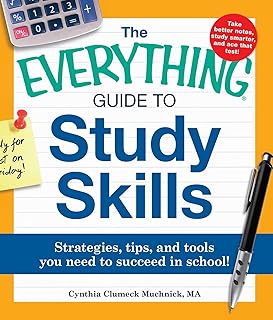
The Everything Guide to Study Skills: Strategies, tips, and tools you need to succeed in school! (Everything® Series)
Best For:
High school and college students who want a broad, practical reference to build consistent study habits and exam strategies.
The Everything Guide to Study Skills is a classic, broad-coverage manual for students who want an all-in-one resource. Unlike narrowly focused memory or method books, this guide covers time management, test-taking strategies, note-taking styles, stress reduction techniques, and study planning. It’s the kind of reference you turn to when you need both strategy and practical checklists.
What it is: a comprehensive handbook that compiles widely used study techniques into accessible chapters. It’s geared toward high school and college students but is also helpful for adult learners returning to education. Each chapter introduces a strategy, explains why it works, and offers step-by-step guidance for implementation.
Who it’s for: Ideal for students who want a single stop for improving overall study habits—especially those who are new to college-level expectations or returning learners who need to re-establish effective routines.
Key benefits: Breadth and clarity. Compared to narrowly focused books, this guide provides a menu of tools so you can pick what fits your circumstances: skimming vs. deep-reading tactics, time-blocking schedules, active reading strategies, and exam-day tips. For students uncertain where to start, the book’s structure makes it easy to try one technique at a time.
Practical use cases: Use early in a semester to set up a study system—experiment with different note-taking approaches, try varied revision rhythms, and build a personalized plan. Before exams, use the test-taking chapter for strategies on pacing, question triage, and anxiety management.
Observations and considerations: Because it covers many topics, some sections read at a high level rather than offering deeply specialized instructions. If you need a deep dive into memory science or a specific exam strategy, supplement this guide with a focused title (like Memory for Exams or Layered Learning). Many readers appreciate having a single, well-organized reference to return to throughout the academic year.
If you want a grounding in study fundamentals and a practical place to begin improving habits, this Everything guide is a dependable option. Check the latest price on Amazon.
Pros
- Covers a wide range of study skills
- Good for beginners and returning students
- Practical checklists and tips
Cons
- Less depth on specialized memory techniques
- Some chapters are brief and introductory
Check the latest price on Amazon.
Final Verdict
Exam season drives last-minute buys, but the smartest purchases are the ones that change how you study, not just what you own. Layered Learning and Memory for Exams are complementary: the former builds a repeatable workflow to manage time and material, while the latter drills into the cognitive techniques needed to lock in facts. The Everything Guide to Study Skills is a reliable all-purpose handbook for students who want a comprehensive starting point, and the small, practical tools—an organizational workbook and a compact notebook—help reduce stress and keep revision notes focused.
Who should prioritize which product? If memorization is your primary challenge, pick Memory for Exams. If you’re juggling multiple courses and need a consistent system, Layered Learning is likely to produce the most change. If your study environment is chaotic with paperwork and deadlines, the organizational workbook will remove friction. For tactile learners who benefit from writing and concise capture, the 6×9" notebook is a low-cost, effective companion. Finally, if you’re building study skills from the ground up, the Everything Guide gives a broader toolkit.
Buying considerations: combine one systemic guide (Layered Learning or Everything Guide) with one practical tool (notebook or organizational workbook). Use memory techniques daily and relegate heavy rereading to a minimum. Remember that no book replaces deliberate practice—these resources are accelerators that require consistent application.
If you’re buying for a friend or stocking up before exams, choose items that match their immediate needs: memorization, planning, or stress reduction. Thoughtful picks now can save hours of panic later.
Check the latest price on Amazon.
Conclusion
These Amazon finds students are buying before exams picks are trending now and offer great value and variety. Check the links above for latest prices and reviews.
As an Amazon Associate, I earn from qualifying purchases.
Tags:
study books, exam preparation, memory techniques, study skills, student organization, revision tips, study guide
