Top Office Notebooks & Pads People Recommend
As an Amazon Associate, I earn from qualifying purchases. This article may contain affiliate links, which means we may receive a commission at no extra cost to you.
If you’ve been scrolling productivity threads or browsing office-stationery boards lately, a few practical paper products keep popping up: focused to-do pads, structured meeting notebooks, versatile ruled writing pads, and the reusable Rocketbook. This guide rounds up the most recommended items so you can cut through the noise and choose what suits your daily flow. Before we dive in, a quick note: As an Amazon Associate, I earn from qualifying purchases. This article may contain affiliate links, which means we may receive a commission at no extra cost to you.
Why focus on paper in a digital age? Because tactile tools still help many people plan, prioritize and remember — and the right pad or notebook can reduce friction, keep meetings on track, and make idea capture faster. Below you’ll find a buyer-focused look at five popular office staples, real-life scenarios where they shine, practical pros and cons, and buying considerations to help you pick one (or two).
Buying Guide
How to choose the right office notebook or pad
Start with your workflow. Do you need rapid task capture, structured meeting notes, cheap refillable pads, or something you can digitize and reuse? Consider paper format (lined, dot grid, narrow-ruled), size (pocket vs letter vs executive), and whether you’ll want to archive pages.
Key features to weigh
– Layout: To-do lists and action-item sections reduce decision friction. Meeting notebooks with designated fields (attendees, decisions, action items) save time later.
– Reusability & digitization: Reusable notebooks like Rocketbook pair with apps to send notes to cloud accounts; they’re eco-friendlier but require compatible pens and occasional cleaning.
– Perforation & portability: Perforated pages are handy for handing off notes; pocket-friendly sizes travel easily.
– Price & refills: Cheap writing pads are great for bulk notes but aren’t meant as long-term archives.
Who should buy paper-first tools? Writers, project managers, students, meeting-heavy professionals, and anybody who benefits from visual lists or habit tracking. Who may not need them? If you exclusively use a task manager or collaboration software and never reach for pen and paper, a physical pad might just be another item on your desk.
Practical buying considerations
– Check page count and whether pages are dated or undated (undated gives flexibility).
– Look at binding (glue vs spiral) for lay-flat use.
– If you plan to digitize, ensure the notebook is compatible with your preferred apps.
With these basics in mind, let’s look at five well-regarded options that keep coming up in online recommendations.
Taja To Do List Notepad – To Do List Notebook for Work with 52 Sheets, 9.8" x 6.5", Undated Daily Planner Perfect for Daily Tasks and Goal Setting, Notepad Suitable for Office, Home & School – Greenery Sway

Best For:
People who want a focused daily task structure without committing to dated planners—ideal for busy professionals, parents, and students.
If constant task lists and daily priorities are your Achilles’ heel, a properly formatted to-do notepad can change how your day unfolds. The Taja To Do List Notepad is a simple, undated daily planner designed for clarity: each sheet offers space for your top priorities, secondary tasks, notes, and a small goal or habit tracker. The 9.8" x 6.5" size hits a sweet spot — larger than pocket pads but still small enough to sit beside a laptop or fit in an overstuffed bag.
Main benefits are immediate: the structure reduces decision fatigue (you don’t have to design your list each morning), undated pages mean you won’t waste pages when schedules shift, and 52 sheets give you a week of focused lists per pad if you use one per work week. This pad is particularly helpful for people who juggle recurring small tasks or use a daily review to keep weekly goals aligned.
Real-life use cases include busy professionals running a mix of email, project work, and quick admin tasks; parents carving out focused work blocks; students breaking down study sessions by priority; or anyone who benefits from a visible, single-day focus. The Taja pad is also handy during sprints or product-focused weeks when you want every day’s top three tasks in view.
Compared with a standard ruled notepad, this to-do pad imposes a light structure that can boost completion rates. It won’t replace a full planner if you need monthly calendars or complex project tracking, but it pairs excellently with digital calendars and task apps — use the pad for day-to-day execution and your app for deadlines and reminders.
Buying considerations: paper weight and ink bleed matter if you use marker pens; check the glue binding quality if you prefer tearing pages out cleanly. Also, if you prefer reusable systems, a paper pad isn’t eco-friendly long-term but excels at quick capture and visibility.
Who should buy: productivity-minded people who want a no-fuss, daily structure without commitment to dates. Who might skip it: those who never use paper or need full planners with month-at-a-glance layouts.
Pros: structured daily layout, undated flexibility, handy size for desk or bag, useful for single-day focus.
Cons: single-use paper (not reusable), limited pages compared to a notebook, not a replacement for long-term planning.
Check the latest price on Amazon.
Pros
- Pre-formatted daily structure reduces decision fatigue
- Undated pages for flexible use
- Compact but roomy 9.8" x 6.5" size
Cons
- Single-use paper (not reusable)
- Limited to daily task capture—no monthly calendars
Find the Taja To Do List Notepad on Amazon and see if a structured daily pad fits your workflow: https://www.amazon.com/dp/B0C1GW4GD4?tag=theideaofart-20
Taja Meeting Notebook for Work Organization – Work notebook with action items, Meeting Minutes Planner Notebook, Perfect Office Supplies for Men & Women – Green

Best For:
Managers, team leads, consultants, and anyone who wants structured meeting notes with action-item tracking.
Meetings can be productive or they can feel like time-sinks. A meeting-specific notebook nudges you toward the former by offering templates for attendees, agenda items, decisions, and clear action items. The Taja Meeting Notebook organizes meeting minutes so nothing falls through the cracks: it has designated fields for meeting objectives, notes, decisions made, and who is responsible for follow-ups. That built-in accountability is the notebook’s strongest feature.
Main benefits include faster post-meeting follow-ups, more consistent documentation, and a single place to store meeting outcomes. The layout reduces the mental load of remembering who said what or what next steps were assigned, which is especially valuable in fast-paced teams or cross-functional projects. For project managers, team leads, consultants, or freelancers attending multiple client calls per week, the Taja meeting format can save time and reduce confusion.
Real-life use cases: a product manager running daily stand-ups can use the action-item field to track blockers and owners; a consultant can keep client meeting records organized by project; HR professionals conducting interviews can record interview highlights and follow-up tasks. Compared with freeform notebooks, this planner-style book enforces a habit of assigning ownership and capturing decisions.
Buying considerations: check for binding quality (spiral vs glued) if you prefer a notebook that lies flat during meetings. Page thickness matters if you use darker inks or fountain pens. If you digitize meeting notes, consider pairing this notebook with a simple scanning app or use it primarily as the authoritative paper record.
Who should buy: meeting-heavy professionals who need consistent documentation and clear action items. Who may not need it: people who exclusively take meeting notes in corporate wikis or those who never lead or run meetings.
Pros: built-in action-item fields, consistent meeting structure, ideal for follow-up and accountability.
Cons: structured format may feel restrictive for freeform brainstorming, not reusable.
Check the latest price on Amazon.
Pros
- Designed specifically for meeting minutes and action items
- Encourages accountability with assigned owners
- Helps standardize meeting documentation
Cons
- Less suited for freeform brainstorming
- Not reusable—single-use pages
See the Taja Meeting Notebook on Amazon and decide if structured meeting pages will improve your follow-ups: https://www.amazon.com/dp/B0CR65Z6JD?tag=theideaofart-20
Amazon Basics Narrow Ruled Writing Pads, Perforated, 5" x 8", Multicolor, 6-Pack of 50 Sheets

Best For:
Anyone needing an affordable, multipack supply of everyday writing pads—great for offices, classrooms, and quick notes.
For bulk note-taking, quick scribbles, and affordable desk refills, narrow-ruled writing pads are a perennial favorite. Amazon Basics’ 5" x 8" narrow-ruled pads come in a 6-pack with 50 perforated sheets each — a practical supply for offices, classrooms, or home use. They don’t promise structure or sophistication; they promise reliable, inexpensive paper that’s ready whenever you are.
The main benefits are cost, quantity, and simplicity. If you often find yourself reaching for scraps of paper or need pads for meeting notes, phone messages, or quick to-dos, having a stack of these on hand reduces friction. Perforated pages allow clean handoffs, and the narrow ruling helps keep handwriting tidy in small spaces.
Real-life use cases include reception desks logging messages, students working through problems, writers doing rough drafts or outlines, and teams creating a low-stakes “idea pad” for brainstorming sessions. Compared with pricier notebooks, these pads are ideal for ephemeral notes rather than a long-term archive. They also outperform random loose paper because of their consistent size and tear-off convenience.
Buying considerations: the paper is thin compared to premium notebooks, so expect some show-through with heavy inks. The glued top binding is fine for single-sheet removal but doesn’t allow full lay-flat writing like spiral pads. If you need archival quality, choose a heavier notebook; if you need volume and affordability, these pads deliver.
Who should buy: offices, students, teachers, or anyone who needs an economical, multipack of everyday writing pads. Who may not need them: professionals who require premium paper for archival journaling or people who prefer bound notebooks.
Pros: inexpensive bulk supply, perforated pages for clean removal, compact 5" x 8" size.
Cons: thinner paper (show-through possible), glued binding doesn’t lay flat.
Check the latest price on Amazon.
Pros
- Economical 6-pack supply
- Perforated pages for easy removal
- Compact and travel-friendly size
Cons
- Thinner paper with potential show-through
- Glue binding won’t lay completely flat
Grab the Amazon Basics Narrow Ruled Writing Pads on Amazon for an affordable everyday note solution: https://www.amazon.com/dp/B07TQ8567K?tag=theideaofart-20
Rocketbook Core Reusable Smart Notebook, Lined Pages For School, Work and Creative Projects, Letter Size 8.5×11, Gray – Premium

Best For:
Students, designers, and professionals who want handwritten notes that can be digitized and organized in the cloud.
If you’re trying to balance the tactile benefits of handwriting with a need for searchable, cloud-backed notes, the Rocketbook Core is one of the most-discussed options. The Core (previously known under different model names) blends traditional lined pages with a special washable surface and works with erasable pens so pages can be wiped clean when you’re done. Paired with the Rocketbook app, you can quickly scan pages and send them to cloud services like Google Drive, Dropbox, or email — a major time saver for people who collect meeting notes or lecture highlights.
Benefits include near-instant digitization, a reusable surface that reduces waste, and layout options that mimic familiar notebook formats. For students and professionals who amass lots of notes but dislike bulky archives, Rocketbook offers an elegant compromise: keep the tactile experience, then offload digitally and recycle the page for the next use.
Use cases: students capturing lecture notes and organizing them in cloud folders; designers saving sketches but syncing them to clients; product teams consolidating meeting notes into shared drives; and anyone who wants a paper feel without long-term storage of physical notebooks. Compared with traditional notebooks, Rocketbook reduces physical clutter and simplifies searching, but it requires compatible erasable pens and a bit of habit change to scan and organize pages regularly.
Buying considerations: plan for consumables — Rocketbook works best with specific erasable pens (sold separately or bundled) and occasional cleaning supplies. The scanning quality depends on lighting and your phone camera, so expect a minor learning curve. If you need permanent paper archives without digitization, a regular notebook might be simpler.
Who should buy: tech-savvy note-takers who want to digitize handwriting and cut down on paper waste. Who may not need it: people who prefer simple single-use notebooks or who never digitize notes.
Pros: reusable pages reduce waste, seamless cloud integration via the app, good for digitizing notes and sketches.
Cons: requires compatible pens and scanning habit, some learning curve for best results.
Check the latest price on Amazon.
Pros
- Reusable pages reduce paper waste
- App integration for cloud storage and sharing
- Preserves handwriting while enabling digital search
Cons
- Requires compatible erasable pens and regular scanning
- Slight learning curve for optimal scans
Explore the Rocketbook Core on Amazon and see if a reusable smart notebook fits your paper-to-cloud workflow: https://www.amazon.com/dp/B0DP3HRDC2?tag=theideaofart-20
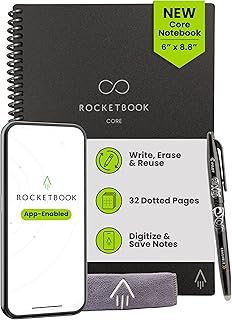
Rocketbook Core Reusable Smart Notebook, Dot Grid Pages For School, Work and Creative Projects, Executive Size 6×8.8, Black – Premium
Best For:
Creative professionals, bullet journalers, and people who sketch or map ideas and want reusable, digitizable pages.
For sketching, bullet journaling, and more freeform layouts, the Rocketbook Core in executive size with dot-grid pages is a frequent recommendation for creative professionals. The dot grid gives guide points without imposing lines, ideal for diagrams, mockups, and bullet-list systems. Like the letter-sized Rocketbook, this model uses a washable surface and works with erasable pens; paired with the Rocketbook app you can digitize and store pages quickly.
Advantages include portability — the executive size is easy to tuck into bags — and the dot-grid flexibility, which is great for designers, architects, and people who like structured-but-open pages. Dot grid is also popular among bullet journalers who want neat columns and trackers without solid rulings. Reusability lowers the long-term paper burden if you iterate frequently on sketches or drafts.
Real-world scenarios: a UX designer sketching wireframes on the subway, a project lead mapping sprint workflows and exporting them to a shared folder, a student creating math diagrams and saving them to coursework folders. Compared with bound dotted notebooks, this Rocketbook swaps permanence for reusability and cloud convenience — perfect if you iterate on ideas and don’t need physical archives.
Buying considerations: as with other Rocketbook models, budget for compatible erasable pens and accept a scanning step in your workflow. The smaller page area means larger diagrams require multiple pages; if you do full-size sketches, consider the letter-size Rocketbook instead.
Who should buy: creative professionals, bullet journalers, and anyone who wants reusable dot-grid pages in a compact size. Who may not need it: those who want permanent keepsakes of their notebooks or who don’t want to scan and manage digital files.
Pros: dot-grid flexibility for sketches and bullet systems, reusable pages, easy cloud backup with the app.
Cons: smaller page size limits large sketches, requires erasable pens and scanning routine.
Check the latest price on Amazon.
Pros
- Dot-grid layout ideal for sketches and bullet journaling
- Compact executive size for portability
- Reusable pages with app cloud backups
Cons
- Smaller page area for large sketches
- Requires compatible pens and scanning habit
Check the Rocketbook Core (dot grid, executive) on Amazon and decide if a compact reusable notebook suits your creative work: https://www.amazon.com/dp/B0DP3HRB3Y?tag=theideaofart-20
Final Verdict
Paper tools are far from obsolete — they’re complementary. If you need quick daily focus, the Taja To Do List Notepad gives structure without commitment. For meeting-driven work, the Taja Meeting Notebook enforces accountability and simplifies follow-ups. If you need economical volume for everyday notes, the Amazon Basics writing pads are hard to beat. And if you want to bridge handwriting and cloud storage, Rocketbook’s reusable letter and executive options offer a compelling hybrid.
Choose based on your workflow: pick a to-do pad for daily task management, a meeting notebook if you run or operate in many meetings, bulk pads for transient notes, and a Rocketbook if you digitize and want to cut paper waste. None of these replace digital calendars and project tools entirely — but each reduces friction in different parts of your day.
If you’re still undecided, start with one item that addresses your biggest pain point (missed follow-ups, scattered daily tasks, or cluttered paper) and evaluate how it changes your routine over a few weeks.
Conclusion
These Office products people keep recommending online lately picks are trending now and offer great value and variety. Check the links above for latest prices and reviews.
As an Amazon Associate, I earn from qualifying purchases.
Tags:
office notepads, Rocketbook, to-do list notepad, meeting notebook, Amazon Basics writing pads, reusable notebook, productivity tools
