Top Office Gadgets for Realistic Productivity Resets
As an Amazon Associate, I earn from qualifying purchases. This article may contain affiliate links, which means we may receive a commission at no extra cost to you.
As an Amazon Associate, I earn from qualifying purchases. This article may contain affiliate links, which means we may receive a commission at no extra cost to you. If you work in a creative field — whether you’re writing, designing, coding, or producing video — realistic productivity resets are a practical ritual that helps you move from scattered to focused without burning out. These resets are short, repeatable rituals (5–60 minutes) you can use when attention drifts or when a high-priority task needs uninterrupted time. Over the years I’ve researched what creators, designers, and focused professionals actually reach for during those resets: reliable timers that nudge you without jarring you, visual organizers that keep ideas in sight, short evidence-based prompts to structure a session, and reusable systems for planning and capturing progress.
This guide walks through five thoughtfully selected products that are popular among creators and remote workers. I’ll explain who each is best for, realistic use cases, how they compare to standard alternatives (phone timers, sticky notes, paper notebooks), and practical buying considerations to help you choose the right gear for your workflow.
Buying Guide
What to look for when choosing productivity reset gadgets
Duration flexibility: A core requirement for creators is adjustable session lengths. Look for timers or apps that offer a variety of preset durations (5, 10, 25, 30, 60 minutes) and custom countdowns. This lets you use micro-resets (5–10 minutes) for quick recovery and deeper blocks (25–60 minutes) for deep work.
Alert styles: Not all alerts are created equal. Silent and vibrate modes are essential in shared spaces or during meetings; gentle sound options are helpful when you need a clear audible boundary. If you’re sensitive to noise, pick a device with adjustable volume and vibration.
Visual cues: For creatives who respond to visuals, a bright timer cube or a visible countdown on your desk can be more effective than a phone alarm. Visual timers reduce decision friction — you see time passing without checking a screen.
Work surface and capture: A desktop glass whiteboard with integrated organization helps you capture fleeting ideas without losing your desk’s look. It’s preferable to scattered sticky notes, and when paired with a wireless charger it centralizes your tools.
Tactile prompts and rituals: Physical cards or a productivity deck can seed structured sessions (e.g., goals, obstacles, rewards). They provide cognitive scaffolding that apps and lists often don’t. If you struggle to decide how to structure a session, evidence-based prompt cards often beat a blank screen.
Sustainability and reuse: Reusable planners like a Rocketbook let you maintain tactile note-taking without endless paper. They’re especially useful if you want searchable, cloud-synced archives.
Compatibility and placement: Check the footprint of any tabletop gear — bulky items can clutter creative space. Also verify battery type, charging options, and whether the product includes wall anchors or stands for different desk setups.
Who should prioritize which feature
– Remote creators working in shared spaces: prioritize silent/vibrate alerts and a visual timer.
– Designers and makers who brainstorm physically: a glass whiteboard desk pad is ideal.
– People who need structure but lack routine: pick a productivity deck or guided prompts.
– Sustainability-minded users who still want pen-and-paper feel: reusable planners like Rocketbook.
Finally, think of these gadgets as tools to shape behavior rather than magic pills. The right mix depends on whether you need gentle nudges or rigorous boundaries. Below are five products that cover those needs in different ways.
Printers Jack Productivity Cube Timer (Orange)

Best For:
Writers, designers, students, and creators who prefer a tactile, visible timer that avoids phone distractions
If you want a visible, low-friction way to start and commit to a timed session, the Printers Jack Productivity Cube Timer (orange) is a compact visual Pomodoro-style option that’s popular with creators who prefer tactile, non-phone timers. The cube’s six faces are labeled with presets — this model includes common session lengths (3/5/10/25/30/60 minutes) plus a custom countdown. Flip the cube to the face you want and the countdown begins. That simple physical action creates a tiny ritual: flipping the cube signals the brain that you’re switching modes.
What sets this cube apart from a phone timer is the combination of visual presence, adjustable sounds, and a vibration option. For creatives working in co-working spaces or with distracting households, the mute & vibration modes are more considerate than loud beeps. The adjustable sound alert lets you choose a chime that feels firm without being jarring. The orange color makes it easy to find in a cluttered desk area and serves as a small visual nudge that time is being tracked.
Real-life use cases: Use a 25-minute session for a concentrated writing sprint, 10 minutes for inbox triage, or 5 minutes as a micro-reset to stretch and refocus between longer tasks. Designers often place the cube in their peripheral vision while wireframing; the visible countdown keeps interruptions lower without requiring constant time-checks. Students and people with ADHD report that the cube’s physicality makes starting tasks less overwhelming than opening an app.
Buying considerations: Compare this cube against similar preset timers (many models look and feel similar). If you rely heavily on precise digital logging of sessions, a smartphone app with analytics might be better. If you frequently work in total silence, confirm that the vibration is strong enough for your needs. Battery life is usually adequate for daily use but check whether the model uses replaceable batteries or has a rechargeable option.
Who should buy it: Creators who want a no-fuss, physical cue to begin focused work, people who prefer to avoid phone distractions, or anyone who benefits from visible time boundaries. Who might skip it: users who need detailed session analytics or prefer app-integrated, cross-device timers.
Pros: tactile, visible, multiple presets and custom countdown, mute/vibrate/sound options. Cons: limited analytics, depends on battery type. CTA: Check the latest price on Amazon.
Pros
- Simple flip-to-start ritual reduces startup friction
- Visual presence keeps time in peripheral view
- Mute, vibration, and adjustable sound options
Cons
- No integrated session analytics or app syncing
- May require battery replacements depending on model
Check the latest price on Amazon.
SELEAD Desktop Glass Whiteboard with Wireless Charger Station

Best For:
Designers, hybrid workers, and creators who want a tidy, multipurpose desk surface for quick capture and charging
A clean, dedicated surface to capture fleeting ideas can transform how creators organize short productivity resets. The SELEAD Desktop Glass Whiteboard with Wireless Charger Station blends three functions into one: a dry erase board surface that works as a computer pad and keyboard stand, built-in organization space for pens and small accessories, and a wireless charger for Qi-compatible phones. It’s an elegant alternative to sticky-note chaos and cramped notebooks.
Why the hybrid surface matters: during a 10–30 minute reset you often need to sketch an idea, note an action item, and keep your phone charged without grabbing it. The SELEAD desktop glass pad gives you a low-friction place to write quick notes, diagram a flow, or outline a storyboard with dry-erase markers. Because it doubles as a keyboard tray and mousepad, it integrates into your daily setup rather than being another item to shuffle around.
Real-life usage: Use the glass whiteboard to brainstorm thumbnails for a video during a 25-minute Pomodoro, capture a quick research list during a focused 10-minute break, or write a daily goal at the top right corner before starting creative time. The wireless charger keeps your phone face-up so you can use silent vibration alerts from a timer while it charges. For teams that share a desk, the whiteboard’s clean surface makes it easy to leave short handover notes.
Buying considerations: Glass surfaces are easy to clean but check the board’s felt backing and thickness if you want a softer wrist rest while typing. Ensure your phone supports Qi charging and that the charger’s placement fits your desk layout. If you prefer paper permanence, pair this with a quick photo-capture workflow to archive notes to a notes app.
Who should buy it: Designers, remote workers, and creators who need a tidy physical space for quick capture and an integrated charger. Who may not need it: people who already use large wall whiteboards or prefer entirely digital capture systems.
Pros: multipurpose surface (whiteboard + keyboard stand + charger), reduces desk clutter, ideal for quick capture. Cons: not a substitute for long-form note archiving, requires Qi-compatible phone for charging. CTA: Check the latest price on Amazon.
Pros
- Combines dry-erase capture with a keyboard stand
- Built-in wireless charging reduces cable clutter
- Sleek glass surface is easy to clean and looks professional
Cons
- Not a long-term archive — you’ll need to photograph notes to save them
- Qi charging requires compatible devices
Check the latest price on Amazon.
Productivity Deck – Deep Work Toolkit (48 Evidence-Based Cards)

Best For:
Entrepreneurs, students, and professionals who need guided, quick prompts to start focused sessions
If structure is the sticking point for your reset rituals, the Productivity Deck’s 48 evidence-based cards give you short, practical prompts that reduce decision fatigue. Each card offers concise, action-oriented guidance — think prompts for goal-setting, obstacles to watch for, reward ideas, and micro-habits to support deep work. This isn’t a replacement for a planner; it’s a set of mini-coaching nudges to help you shape a meaningful session quickly.
Why cards work: physical prompts externalize the planning step. Instead of staring at a blank screen wondering where to start, you pull a card and get a focused instruction: a 25-minute writing blueprint, a prioritization checklist, or a concentration strategy like “single task until timer rings.” For creators who get paralyzed by choices, these cards shorten the path between intention and action.
Real-world scenarios: An entrepreneur might draw a card before a 60-minute strategy block to force a single focus; a student could use a 10-minute card for targeted flashcard review; a podcaster could use a production checklist card before an editing sprint. Teams can use the deck in short co-creation sprints to align expectations and create a shared ritual before a brainstorm.
Comparison and buying notes: Compared with apps and templated to-do lists, a physical deck is tactile and social: you can pass a card to a colleague or stick one visibly on your monitor. If you prefer data-driven tracking, pair the deck with a simple logging app to record which prompts yielded results. Cards are low-tech, but that’s the point: they reduce friction and provide repeatable structure.
Who should buy it: People who stall at the planning stage, teams looking for consistent short-session rituals, and anyone who benefits from externalized prompts. Who might skip it: highly routine workers who already have a structured SOP or those who prefer purely digital workflows.
Pros: evidence-backed prompts, reduces decision fatigue, great for team rituals. Cons: not a tracking tool, physical cards can wear over time. CTA: Check the latest price on Amazon.
Pros
- Tangible, evidence-based prompts that speed decision-making
- Works well for solo and team rituals
- Portable and easy to integrate into any workflow
Cons
- No analytics — you’ll need to track outcomes separately
- Cards may show wear with heavy use
Check the latest price on Amazon.
TK3 Pomodoro Timer Cube (Black)
Best For:
Editors, minimalists, and remote workers who want a discreet, versatile physical timer with multiple alert modes
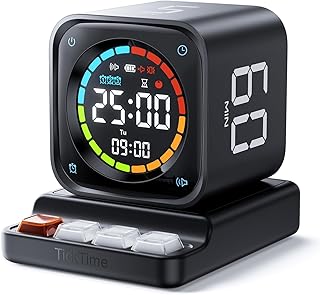
The TK3 Pomodoro Timer Cube (black) is a close cousin to the Printers Jack timer but brings its own balance of presets and customizability that appeals to creators who need both discretion and flexibility. It offers common preset durations (5/10/30/60 minutes), a custom countdown, stopwatch, clock, and multiple alarm styles including silent, vibrate, and sound. For many people, the TK3 represents an incremental improvement if you want more precise control over session types without opening an app.
Why some users prefer the TK3: its triple-mode alert system is particularly useful in mixed environments — silent mode for libraries and focused studios, vibration for shared home offices, and audible alerts when you’re working alone and need a clear notification. The stopwatch and clock functionality also make it useful as a lightweight desk clock outside of focused sessions.
Real-life usage: Video editors use a 30-minute preset for concentrated cuts, then switch to a 10-minute break to clear their heads; content creators might use a 60-minute preset for batch recording; and students often rely on the stopwatch mode for timed practice exams. The cube’s black finish is subtle and professional, fitting better on minimalist desks than brighter models.
Buying considerations: If you already own a similar cube, compare features: does the TK3’s vibration feel stronger? Does it offer a rechargeable battery vs disposable? If you need analytics or app logs, consider pairing with a simple habit-tracking app. If you change locations often, evaluate the cube’s durability and feel in transit.
Who should buy it: Creators who want a discreet yet flexible physical timer that blends into a minimalist desk and offers multiple alert modes. Who may pass: users who want full digital integration or session analytics.
Pros: flexible presets and modes, stopwatch and clock functions, discreet black design. Cons: no app integration, potential battery/recharge questions depending on version. CTA: Check the latest price on Amazon.
Pros
- Multiple timing modes including stopwatch and clock
- Silent, vibrate, and sound alerts for different environments
- Subtle design that fits professional desks
Cons
- Lacks app syncing and analytics
- Check battery/recharge specifics before buying
Check the latest price on Amazon.
Rocketbook Fusion Reusable Productivity Planner (Letter Size)

Best For:
Writers, designers, and sustainability-minded creators who prefer handwriting with cloud archiving
For creators who love handwriting but want the benefits of digital search and minimal waste, the Rocketbook Fusion is a strong reusable planner option. The letter-size (8.5 x 11) layout includes sections for goals, monthly and weekly calendars, daily to-do lists, lined and dotted notes pages — effectively combining a planner, notebook, and idea capture surface in one sleek reusable book. Use Pilot FriXion pens to write, then wipe pages clean with a damp cloth when you’re ready to reset. The Rocketbook app lets you scan pages to cloud services (Google Drive, Dropbox, Evernote, iCloud) so you won’t lose ideas.
Why it helps creators: Creative work often benefits from tactile ideation: sketching a layout, jotting a rough script, or mapping a flow. The Rocketbook preserves that physical experience while solving the perennial problem of paper clutter and lost notes. During a 25–60 minute reset, you can plan outcomes in the daily to-do section, capture quick sketches on dotted pages, and photograph the results to archive or share with collaborators.
Real-world examples: A freelance designer might draft client feedback and then upload the annotated page to a shared folder; a writer can outline a chapter during a 60-minute block and scan the page into a draft folder; a product manager might keep sprint goals on the monthly section and wipe them clean for the next planning cycle. The ability to reuse pages reduces ongoing stationery cost and fits sustainability-minded workflows.
Buying considerations: The Rocketbook requires compatible pens (Pilot FriXion) for erasability — standard pens won’t work. If you rely heavily on fine-grain archival, confirm that your scan workflow is solid and that you back up scanned pages to reliable cloud services. The letter size is excellent for broad sketches but consider whether a smaller size fits your commute better.
Who should buy it: Creators who value handwriting, want reusable paper, and need cloud archiving. Who may not need it: people who fully prefer typed notes or have no interest in scanning and archiving handwritten pages.
Pros: reusable planner with cloud syncing, multiple layouts for planning and notes, sustainable and erasable pages. Cons: requires special erasable pens, scanning workflow adds one more step. CTA: Check the latest price on Amazon.
Pros
- Reusable pages reduce paper waste
- Integrated planner layouts with cloud-scan features
- Large letter size is great for sketches and notes
Cons
- Requires Pilot FriXion erasable pens
- Scanning adds an extra step to archive notes
Check the latest price on Amazon.
Final Verdict
Creating a practical, repeatable productivity reset is often more about the ritual than the gear, but the right tools make the ritual easier to adopt and sustain. The five products above — two tactile timer cubes, a multipurpose glass whiteboard with wireless charging, a guided productivity deck, and a reusable Rocketbook planner — cover the full arc of a realistic reset: decide quickly (deck), set a visible time boundary (cube), capture ideas (whiteboard or Rocketbook), and repeat the cycle. If you need a single starting point, a visual timer cube plus a small capture surface (glass pad or Rocketbook) is a lightweight combo that transforms vague intention into actual focused minutes. Teams can add the Productivity Deck to align short-session rituals and make resets communal.
Buying tips in one line: prioritize alert modes and session flexibility for timers, Qi compatibility for desk chargers, evidence-based prompts for guided cards, and erasable pen compatibility for reusable planners. Take a small habit-first approach: pick one gadget and pair it with a simple rule (e.g., one 25-minute Pomodoro per major task), then scale your toolkit as the habit sticks.
If you’re ready to upgrade your reset ritual, pick the product that solves your biggest current friction: inability to start (Productivity Deck), constant distractions (Pomodoro cube), messy capture (SELEAD glass board), or paper clutter (Rocketbook). Check the latest price on Amazon.
Conclusion
These Office gadgets creators use during realistic productivity resets picks are trending now and offer great value and variety. Check the links above for latest prices and reviews.
As an Amazon Associate, I earn from qualifying purchases.
Tags:
productivity gadgets, pomodoro timer, desk accessories, creators tools, productivity deck, reusable planner, glass whiteboard
