Top ADHD Cleaning Planners for Tidy Homes
As an Amazon Associate, I earn from qualifying purchases. This article may contain affiliate links, which means we may receive a commission at no extra cost to you.
As an Amazon Associate, I earn from qualifying purchases. This article may contain affiliate links, which means we may receive a commission at no extra cost to you.
Keeping a home tidy can feel like an uphill battle when your brain prefers novelty, gets easily distracted, or struggles with executive function. That’s where purpose-built cleaning planners come in. The planners below are designed with ADHD and attention differences in mind: undated layouts to remove pressure, short bite-sized tasks to avoid overwhelm, visual chore charts for quick wins, and habit trackers that turn repetition into momentum.
I researched product specs, layouts, and user feedback to assemble a shortlist of planners that creators, busy households, and people managing ADHD tendencies have found practical. Each pick highlights real-life use cases, who will benefit most, and the trade-offs you should consider before buying.
Buying Guide
Choosing the right cleaning planner for maintaining tidy spaces is more than aesthetic—it’s about fit, flexibility, and friction reduction. Here are practical things to consider before you buy.
Format and flexibility: Undated daily/weekly/monthly layouts are essential if you want to start anytime and skip days without wasting pages. If you like modularity, look for removable pages or ring-binder formats so you can reorder or replace sections.
Visibility and permanence: Dry-erase sleeves or laminated chore boards let you reuse a layout for recurring tasks; paper pages work well for tracking progress over time. Consider whether you want a disposable monthly record (paper) or a reusable checklist (dry-erase).
Task design: ADHD-friendly planners break big chores into 10–20 minute micro-tasks, use checkboxes for instant feedback, and include visual chore charts or color-coding. Habit trackers and reward spaces help reinforce consistency.
Portability and size: A compact planner fits in a bag or kitchen drawer; larger formats give you room for family charts and DIY templates. If you plan to share the planner with partners or roommates, choose a layout with separate columns or multiple checklists.
Durability and extras: Look for thick paper if you use gel pens, a sturdy cover if it will be carried around, and extras like stickers, templates for home improvement, or pre-written routines to reduce decision fatigue.
Compare with digital alternatives: Apps and reminders offer alarms and automation but can feel ephemeral. Physical planners are tactile, reduce screen triggers, and provide visible reminders in the home. Some people use both: the planner for routines and the phone for timed reminders.
Who this guide is for: anyone seeking a low-friction system to keep shared or personal spaces tidy—especially people with ADHD, busy creators, parents coordinating household chores, and small households trying to build reliable routines. If you prefer fully automated solutions (subscription services or professional cleaning), a planner may be less necessary.
Common buying considerations: choose undated when you want flexibility, pick a dry-erase sleeve if you need reusability, and prefer ring binders if you expect to customize sections. Check page count and layout samples when available, and prioritize clear, short-task design over decorative flourishes.
PGJ ADHD Cleaning Planner for Adults – Undated Daily, Weekly & Monthly Cleaning Schedule & Checklist – Household Chores Organizer Notebook for Home Management, Routine Tracking Family Cleaning Tasks

Best For:
Adults and small households who want an undated, easy-to-follow paper planner for daily, weekly, and monthly cleaning tasks.
If you want a straightforward, no-frills planner that concentrates on clarity and repeatable routines, the PGJ ADHD Cleaning Planner aims to deliver exactly that. This undated planner provides daily, weekly, and monthly cleaning sections laid out to reduce decision fatigue—there are pre-written suggestions plus blank checklists so you can adapt tasks to your home. The emphasis here is on micro-tasks: instead of “clean kitchen,” the layout encourages breaking that down into bite-sized actions (wipe counters, sweep floor, empty dishwasher) that are easier to start and finish.
One of the practical benefits of this model is its undated format. People with unpredictable schedules or those who are building a new habit frequently appreciate not being penalized for missed days. The notebook-style layout makes it simple to flip back and see the last completed week or month, which is useful when you want to track progress without digital clutter. The planner’s size fits comfortably on a kitchen counter or in a shoulder bag—handy for creators who move between workspaces and home.
Real-life use cases include a solo freelancer who needs a visible, low-effort chore list to interrupt work for short cleaning sprints, a couple dividing household chores into shared checkboxes, or a parent introducing teens to basic responsibilities using clear weekly tasks. Compared with apps, this planner offers a physical cue in your living space that helps reduce out-of-sight, out-of-mind problems.
Buying considerations: check page count and whether the layout favors more daily or monthly space depending on your needs. If you prefer reusable boards, a separate dry-erase option may suit you better. The PGJ planner is valuable for people who want an analog, understandable system without extra bells and whistles.
Who should buy: people who prefer tactile planners, those building cleaning momentum from small wins, and households that want a simple shared checklist. Who may not need it: users already invested in digital task managers with smart reminders, or households preferring professional cleaning schedules.
Pros: Clear undated layout for flexibility; micro-task focus to reduce overwhelm; portable size for kitchen or bag. Cons: Paper format isn’t reusable like a dry-erase board; may need extra pages if you want long-term archiving.
Check the latest price on Amazon.
Pros
- Undated layout reduces pressure and wasted pages
- Micro-task driven format makes starting easier
- Portable size fits counters and bags
Cons
- Paper format is single-use (not dry-erase)
- May have limited long-term tracking without additional storage
Ready to simplify your cleaning routine? Check the latest price on Amazon.
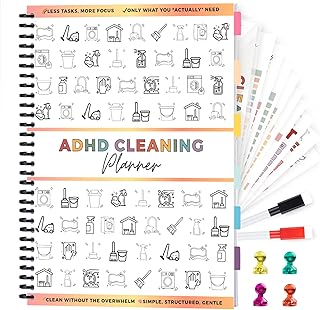
ADHD Cleaning Planner, Dry-Erase Sleeve + Paper Pages, Removable Ring Binder, Daily,Weekly,Monthly Plans, Cleaning Schedule and Checklist, ADHD Planner for Adults Women
Best For:
People seeking a hybrid system—reusable daily checklists with a paper archive—especially households sharing chores or creators juggling tasks.
This ADHD cleaning planner blends paper permanence with a reusable dry-erase surface—an attractive compromise for anyone who likes the feel of a notebook but wants repeatable checklists. The removable ring binder design allows you to shuffle sections, add printouts, or pull pages for photocopying. A dry-erase sleeve included with the planner means high-frequency tasks (daily counters, quick wipe lists) can be reused each week while you keep a paper record of important notes or monthly summaries.
A major benefit here is customization. If you co-manage a household, the binder can hold multiple chore charts side-by-side—one for personal routines, one for shared family tasks. The dry-erase sleeve handles the rinse-and-repeat chores without creating paper waste or requiring you to cross out items every time. For creatives who change systems often, the removable pages let you experiment with different layouts: move a morning routine in front when needed, then tuck it away once it’s established.
Use-case examples: a small business owner who needs to schedule quick maintenance between client calls, a roommate group who wants a visible reusable board for weekly responsibilities, or someone trying to map seasonal deep-clean tasks into a binder with templates. Compared with single-format planners, this product reduces friction for people who value both reusable checklists and an archive for tracking trends over months.
Buying considerations: ensure the ring size fits the number of pages you plan to use and check the dry-erase sleeve quality—some sleeves ghost with certain markers. If you prefer a fully paper archival system, this hybrid may feel unnecessary; if you dislike erasing, a fully paper planner might be preferable.
Who should buy: people who want flexibility, reuse for common tasks, and the ability to customize sections. Who may not need it: anyone who strictly prefers digital apps or only wants a single-use paper notebook.
Pros: Reusable dry-erase sleeve plus paper archive; removable ring binder for customization; ideal for shared or changing routines. Cons: Dry-erase sleeve may ghost over time; slightly bulkier than a simple notebook.
Check the latest price on Amazon.
Pros
- Dry-erase sleeve for repeatable tasks
- Removable ring binder for customizable sections
- Good balance of reuse and record-keeping
Cons
- Dry-erase sleeve can ghost depending on markers
- Bulkier than a simple notebook
Like the idea of reusable checklists and a paper archive? Check the latest price on Amazon.
ADHD Cleaning Planner for Adults Women, Cleaning Schedule and Checklist Notebook, Cleaning and Organizing Planner, Daily Weekly Monthly Schedule Household Cleaning Checklist Planner

Best For:
Adults who want a habit-oriented, structured paper planner with room-specific templates and short-task prompts.
This cleaning and organizing planner takes a practical, habit-centered approach that resonates with many adults managing ADHD. Its layout emphasizes repeatable routines and habit tracking alongside the usual daily, weekly, and monthly cleaning checklists. Instead of dense text blocks, you’ll find checkboxes, short prompts, and habit trackers that reward consistency—small design choices that reduce the decision-making needed to get started.
What stands out is the planner’s balance between structure and breathing room. It gives suggested chore templates for rooms (kitchen, bathroom, living area) while leaving space for personalization. This makes it helpful for people who want a scaffolded approach: follow the suggestions until the routine sticks, then adapt the lanes to match your home. The planner’s notebook format is lightweight and suited for those who like to keep a visible to-do list on a counter or desk.
Practical scenarios include a busy parent introducing one new chore a week to children, a content creator who uses 15-minute cleaning sprints between shoots, or someone who wants to track progress over a quarter with habit trackers. Compared with digital apps that ping you, this planner is a passive visual nudge that sits in the home and reduces notification overload.
Buying considerations: check whether the planner provides enough weekly space if you plan to track multiple people, and whether the habit tracker aligns with your goals (some trackers are daily-focused, others weekly). If you prefer a reusable solution, consider a hybrid or dry-erase model.
Who should buy: adults and women who prefer a scaffolded, habit-focused paper planner to build cleaning momentum. Who may not need it: households that rely entirely on app reminders or prefer professional services.
Pros: Habit-focused layout encourages consistency; room templates reduce planning time; lightweight and visible. Cons: Paper format lacks reusability; limited space for multi-person schedules.
Check the latest price on Amazon.
Pros
- Strong focus on habit tracking
- Room templates make planning faster
- Lightweight and easy to display
Cons
- Not reusable like dry-erase boards
- Limited space for coordinating large households
Want a habit-focused approach to cleaning? Check the latest price on Amazon.
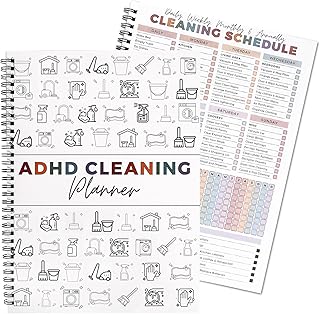
Adhd Cleaning Planner for Adults and Teens Adhd Cleaning and Organizing Planner Cleaning Schedule and Checklist Notebook List Daily Weekly Monthly for Home Chore Chart Adhd Daily Planner
Best For:
Families, parents teaching teens chores, and roommates who want a visible shared chore chart.
This planner is pitched as a family-friendly tool with layouts suitable for both adults and teens. The language and visuals are kept simple, which helps reduce friction when introducing chores to younger family members. It often includes dedicated chore charts or columns that let you assign tasks and check them off—great for households where responsibilities are shared and visibility matters.
A practical strength is the balance between instruction and flexibility. For teens who are learning to manage time, the planner’s daily and weekly prompts can teach a step-by-step approach to tasks: break the bedroom tidy-up into make bed, put away laundry, clear desk. For adults, the planner provides the overarching schedule and a place to monitor who did what that week. Having a common paper reference in a family space reduces the need for repeated verbal reminders.
Common use cases: a family establishing a rotating chore system, a parent using the planner to teach a teen time management, or a shared household where roommates split cleaning responsibilities. Compared to standard single-user planners, this option’s family-friendly layout and clear chore columns make it easier to track delegation and accountability.
Buying considerations: confirm whether the planner includes reward or incentive sections (useful for motivating teens), and check page quantity if you plan to keep weekly records. If your household prefers digital syncing or apps that log contributions, a paper planner will not provide that level of automation.
Who should buy: families with teens, roommates dividing chores, and households that benefit from visible shared responsibility charts. Who may not need it: single adults who prefer minimalist one-person planners or those relying solely on digital tools.
Pros: Family- and teen-friendly layout; good for teaching routines; clear chore columns for delegation. Cons: Lacks digital syncing and automation; may require additional reward planning for motivation.
Check the latest price on Amazon.
Pros
- Designed for both adults and teens
- Clear chore delegation columns
- Helps teach step-by-step routines
Cons
- No digital syncing or logging
- May need extra reward incentives for some teens
Looking for a family-friendly chore planner? Check the latest price on Amazon.
ADHD Cleaning Planner for Adults & Teens – Undated Daily Weekly Monthly Yearly Cleaning Schedule and Checklist Organizer with Chore Chart, Habit Tracker, and DIY Home Improvement Templates

Best For:
Homeowners and creators who need a combined routine and project planner with yearly templates and habit trackers.
This planner aims to be an all-in-one organizer: undated daily, weekly, monthly, and even yearly layouts alongside chore charts, habit trackers, and DIY home improvement templates. Its broader scope makes it useful for people who want to combine routine maintenance with project planning—think seasonal deep cleans, small repairs, or home improvement tasks that need materials and steps.
The undated design gives flexibility, while the yearly pages help you map recurring tasks like HVAC checks, gutter cleaning, or seasonal decluttering. DIY templates are a welcome inclusion for creators or homeowners who juggle small renovation projects: they provide space for materials lists, step breakdowns, and timelines so that home projects don’t derail day-to-day routines. Habit trackers and daily checklists then help translate those big projects into regular micro-actions.
Real-life scenarios include a homeowner managing both weekly chores and a weekend tile-regrouting project, a content creator scheduling filming days around cleaning windows and staging rooms, or a teen learning how to plan a small bedroom refresh without getting overwhelmed. Compared with minimalist planners, this one’s strength is breadth: it’s designed for people who want a centralized place for everything home-related.
Buying considerations: because it includes yearly planning, the layout can feel dense—if you prefer minimalism, the many templates might be more than you need. Check paper quality if you plan to use pens and markers for project notes. Also consider whether you want a binder-style setup for adding receipts, paint samples, or contractor contacts.
Who should buy: homeowners, creators, and households juggling both routine maintenance and periodic projects. Who may not need it: people who want a slim daily-only checklist or those relying solely on professional contractors.
Pros: Comprehensive planning including yearly and DIY templates; undated flexibility for starting anytime; good for mixing routines with projects. Cons: More complex layout can feel overwhelming if you only want a simple checklist; bulkier than single-purpose planners.
Check the latest price on Amazon.
Pros
- Covers daily to yearly planning in one book
- Includes DIY project templates
- Undated flexibility for starting any time
Cons
- Can feel dense for minimalists
- Bulkier than single-purpose planners
Need a planner that handles routines and projects? Check the latest price on Amazon.
Final Verdict
Maintaining tidy spaces is rarely about perfection—it’s about reducing friction, building small wins, and creating visible cues that support your daily life. If you prefer something tactile and visible in your home, these ADHD-focused cleaning planners give you a range of options: a simple undated notebook for single users, a hybrid dry-erase plus binder for reusable checklists, a habit-focused planner for building consistency, a family-friendly chore chart for shared responsibility, and a comprehensive organizer for homeowners juggling projects.
Choose the PGJ undated notebook if you want a straightforward, portable option. Pick the hybrid dry-erase binder if you value reuse and flexible customization. Opt for the habit-centric notebook if you want to track daily momentum, the family planner if you’re teaching or delegating chores, or the comprehensive planner if you also manage small home projects. Consider page layout, reusability (dry-erase vs. paper), and the number of people using the planner before buying.
No single planner solves every problem, but the right one reduces decision fatigue and makes starting less intimidating. If you’re unsure, a hybrid model is often the best compromise—reusable for weekly tasks and paper for monthly records. Whichever you choose, use short timed sprints (10–20 minutes), clear checkboxes, and visible placement in a shared space to get the most out of your planner.
Check the latest price on Amazon.
Conclusion
These Products creators use for maintaining tidy spaces picks are trending now and offer great value and variety. Check the links above for latest prices and reviews.
As an Amazon Associate, I earn from qualifying purchases.
Tags:
ADHD cleaning planner, cleaning schedule, chore chart, household organizer, habit tracker, undated planner, home management
