Eco Home Products for Focused Work Routines
As an Amazon Associate, I earn from qualifying purchases. This article may contain affiliate links, which means we may receive a commission at no extra cost to you.
As an Amazon Associate, I earn from qualifying purchases. This article may contain affiliate links, which means we may receive a commission at no extra cost to you. Building a focused work routine at home is about more than willpower; it’s also about the environment you create. Small, sustainable tools — from a tactile logbook that helps you plan your day to a ceramic diffuser that lifts your mood without single-use plastic — can make focus feel easier and more natural.
This guide groups practical, eco-minded products that people commonly use during focused work sessions. I researched product specs, customer feedback, and practical use cases to highlight what each item does, who benefits most, and realistic scenarios where these tools matter. Whether you prefer analog planning, scent-based cues, or structured timing systems, there’s a thoughtful option here to fit into a green-minded home office routine.
Buying Guide
Why choose eco-minded products for focused work? The short answer: they reduce waste, offer design that lasts, and often bring a quieter, more intentional aesthetic to your workspace. When you pick a reusable or sustainably made item, that little decision compounds over months of daily use — fewer single-use plastics, less clutter, and often a product built to deliver a better tactile or sensory experience.
Key things to consider when buying:
– Material and durability: Look for reusable, refillable, or recyclable materials (ceramic, glass, metal, FSC paper). A well-made item reduces replacement waste and often feels better to use.
– Simplicity and habit design: The best productivity tools cut friction. A compact notepad, a preset Pomodoro cube, or a small reed diffuser that doesn’t need daily attention helps form habits without overload.
– Sensory impact: Subtle scent or tactile feedback can signal transitions between work and breaks. Choose mild, natural fragrance blends or plain tools to avoid overstimulation.
– Compatibility with your routine: If you use a standing desk, a heavy logbook might be less convenient than a slim notepad. If you’re scent-sensitive, a diffuser or essential oil should be mild and placed thoughtfully.
– Accessibility: People with ADHD, sensory differences, or frequent interruptions benefit from tactile and timed aids like vibration timers, reusable checklists, and short, repeatable rituals.
Alternatives and trade-offs: Digital apps offer convenience and portability, but analog tools reduce screen fatigue and often support deeper focus through physical interaction. Essential oil diffusers introduce natural scent cues but are not a substitute for good lighting, ergonomic seating, or scheduled breaks. Pomodoro timers are a low-cost, high-impact habit-former compared with complex time-tracking software.
Read the product sections below for focused descriptions, realistic use cases, pros and cons, and who each item is best for. Each section ends with a friendly CTA.
Work-from-Home Routine & Productivity Tracker: Logbook for Building Focus, Energy & Daily Success

Best For:
Remote workers, freelancers, and students who prefer analog planning and want to track energy, focus, and daily priorities.
What it is and who it’s for: This Work-from-Home Routine & Productivity Tracker is an analog logbook aimed at people who want a simple, intentional way to structure their day without relying entirely on digital tools. It’s designed for remote workers, freelancers, and students who prefer to plan with pen and paper — using prompts that help prioritize tasks, manage energy, and reflect on daily wins.
Main benefits: The logbook’s layout encourages micro-routines: setting top priorities, time-blocking for focused work, and noting energy levels and short reflections to spot patterns. Unlike a generic notebook, this tracker nudges you to track energy and focus over time, which helps you identify when you’re most productive and what tasks to schedule accordingly. The physical act of writing can help encode commitments and reduce the “tab overload” of digital task lists.
Real-life usage examples: Use it to plan a morning sprint: list three priority tasks, schedule two 25–50 minute focus blocks, and record a short midday energy check-in. Over a week, you’ll see patterns — the afternoons where your energy dips, or the tasks that repeatedly get postponed. For freelancers juggling multiple clients, the logbook is a compact hub for daily notes, quick time estimates, and a place to reflect on boundaries like stopping work at a set time.
Why this product is valuable: Compared with standard blank notebooks or generic planners, this product is purpose-built for remote work rhythms. It offers structure without being overly prescriptive: there’s room for free notes, but the guided prompts reduce decision fatigue. The tactile, reusable nature of a durable logbook means you’re less likely to start yet another digital to-do that gets buried in notifications. For eco-focused buyers, choosing a long-lasting paper product over disposable planners reduces clutter and repeated purchases.
Buying considerations and observations: Look at the size and binding — if you like carrying a slim notebook between rooms, choose a compact format; if you keep a single desk log, a larger, sturdier option works better. Some users prefer undated pages for flexibility, while others want a dated daily structure; check the product details for that preference. If you’re prone to perfectionism, pick a tracker that balances prompts with blank space to avoid feeling constrained.
Who should buy it: Remote professionals, writers, students, and anyone who benefits from visual, daily structure without screen time. It’s especially useful for people tracking energy patterns, deep-work blocks, or habit formation.
Who may not need it: If you already use a digital system that reliably syncs across devices and you rarely sit at a desk, a physical logbook may add more steps than value.
Check the latest price on Amazon.
Pros
- Guided prompts reduce decision fatigue and encourage daily reflection
- Good for tracking energy patterns and building consistent work rhythms
- Tactile planning reduces screen time and tab overload
Cons
- Paper format may not suit people who need cloud sync or portability
- If undated, some users may forget to use it consistently
Check the latest price on Amazon.
Taja To Do List Notepad – To Do List Notebook for Work with 52 Sheets, 9.8" x 6.5", Undated Daily Planner Perfect for Daily Tasks and Goal Setting, Notepad Suitable for Office, Home & School – Greenery Sway

Best For:
People who want a simple, visible daily checklist — ideal for desk use, quick sprints, and anyone who prefers paper over apps.
What it is and who it’s for: The Taja To Do List Notepad is a compact, undated desktop notepad with 52 tear-off sheets designed for short daily task lists. It’s ideal for people who want a minimalist, low-friction way to capture priorities, check off completed tasks, and keep a visible list on the desk — no apps, no syncing, just paper. The Greenery Sway colorway brings a calm, natural look to the workspace.
Main benefits: The notepad excels at quick capture and visible reminders. It removes the multi-step friction of opening an app, creating a task, and then forgetting to check it. Because each sheet is single-use, the act of shredding or filing a finished page provides a small closure ritual that many users find satisfying and helpful for momentum. The size is portable enough to tuck in a bag or keep at your desk without taking up much space.
Real-life usage examples: Place a sheet beside your laptop and list the day’s three most important tasks to complete in your first two hours. Use it for household work sessions: meal planning, quick admin tasks, or chore sprints. For parents working at home, the pad can be a shared family list where everyone adds short, time-limited tasks. Students may use it to break study sessions into manageable checkpoints.
Why this product is valuable: Compared with bulkier planners, a notepad reduces commitment pressure—each new sheet is a fresh start. It’s a low-cost way to create visible focus anchors, reduce digital distractions, and practice the simple habit of prioritizing. For eco-minded consumers, choosing a notepad with responsibly sourced paper is worth checking in the product details; even if not recycled, the single-sheet format encourages concise planning and less paper use than sprawling planners that you rarely finish.
Buying considerations and observations: Check the paper weight if you prefer fountain pens or heavy inks, and look at the adhesive or tear format so sheets detach cleanly. Undated pads are flexible but offer less calendar context; pair with a digital calendar if time-specific scheduling matters. If you want reusable planning, a refillable planner might be a better fit.
Who should buy it: Anyone who benefits from visible, bite-sized task lists — busy professionals, parents, students, and people who find satisfaction in physically checking off tasks.
Who may not need it: If you rely on shared digital task lists for team coordination or need cross-device syncing, a paper pad won’t replace that functionality.
Check the latest price on Amazon.
Pros
- Low-friction, single-sheet approach encourages daily use
- Compact and portable desk-friendly size
- Visual checklist aids momentum and quick prioritization
Cons
- Not suitable for collaborative or cross-device task management
- Single-use sheets create ongoing consumption of paper
Check the latest price on Amazon.
Blueme Focus Diffuser | Eucalyptus & Lime | 5.92 Fl Oz – Refillable Wellness Diffuser, Contains Essential Oil, Sustainable, Hand Finished, Premium, Luxury Ceramic, Natural Rattan Reeds, | Small

Best For:
People seeking a low-maintenance, refillable scent solution to support focus—ideal for small home offices and scent-aware design lovers.
What it is and who it’s for: The Blueme Focus Diffuser is a refillable reed diffuser that pairs a eucalyptus and lime essential oil blend with a hand-finished ceramic vessel and natural rattan reeds. It’s aimed at people who appreciate gentle, continuous scent to support focus and a calm atmosphere, without the need for electricity or single-use plastic cartridges.
Main benefits: Reed diffusers offer a low-maintenance way to scent a workspace. The eucalyptus and lime combination typically provides a clean, invigorating note that many people find clarifies the mind and reduces the sense of stagnation in a small home office. Because it’s refillable and uses natural reeds, this diffuser can be a more sustainable choice than disposable plug-in or single-use spray bottles. The ceramic vessel also adds an aesthetic touch to a desk or shelf, bringing a sense of calm and intentional design to your work corner.
Real-life usage examples: Place the diffuser on a bookshelf or side table away from direct drafts so it releases scent evenly throughout a focused morning session. Use it to create a scent cue: start a workday by turning on your laptop and positioning the diffuser in your peripheral vision to signal ‘work mode.’ During creative work, a few deep inhales of eucalyptus-lime can help reset attention after long periods of screen time. Because it doesn’t need charging or outlets, it’s great for minimal, nomadic setups like occasional co-working spaces or small home offices.
Why this product is valuable: Compared with sachets or aerosol fresheners, a refillable reed diffuser delivers consistent scent without impulsive sprays. It complements tactile planning tools and timers by providing a sensory layer that signals boundaries between work and break. For eco-conscious buyers, the refillable nature and ceramic material reduce single-use waste and often last far longer than disposable fragrance options.
Buying considerations and observations: Consider scent sensitivity — essential oil blends can be potent to some people, so start with a small number of reeds or place the diffuser slightly farther from your workspace. Placement matters: avoid direct sunlight or unstable surfaces, and rotate reeds occasionally for even diffusion. If you share a workspace, verify that coworkers or household members are comfortable with fragrance.
Who should buy it: People who want a subtle, non-electric scent solution to support focus and mood in small home offices. It’s well-suited for those who prefer sustainable, refillable home goods and a calm aesthetic.
Who may not need it: If you work in a scent-free office, have asthma or strong fragrance sensitivity, or prefer no olfactory cues, this diffuser may not be appropriate.
Check the latest price on Amazon.
Pros
- Refillable design reduces single-use waste
- Eucalyptus and lime blend offers a clean, invigorating scent
- Hand-finished ceramic adds durable, decorative value
Cons
- Not suitable for scent-sensitive individuals or shared scent-free spaces
- Scent intensity may vary depending on room size and reed placement
Check the latest price on Amazon.
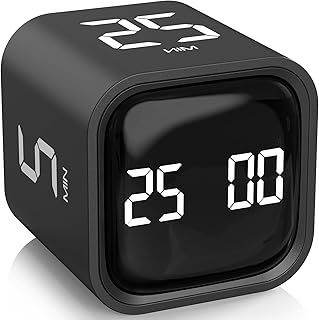
Rotating Pomodoro Timer 5, 25, 10 50 Minutes Preset, Desk Productivity Flip Timer, ADHD Tool Cube Countdown Stopwatch, Vibration/High/Low Volume/Custom Modes, for Work, Study, Back to School, Kitchen
Best For:
Students, remote workers, and people with ADHD who benefit from tactile start/stop cues and preset focus intervals.
What it is and who it’s for: This Rotating Pomodoro Timer is a compact, tactile cube timer with preset intervals (including 5, 10, 25, 50 minutes) and multiple alert modes — vibration, high and low volume, and custom settings. It’s designed for people who want a clear, offline way to structure focused work sessions and breaks, especially those who respond well to tactile cues — students, professionals with ADHD, or anyone trying the Pomodoro technique for the first time.
Main benefits: The presets remove the mental overhead of programming a timer, and tactile rotation makes starting a session almost reflexive. Vibration mode is a thoughtful inclusion for open offices or shared home spaces where sound might be disruptive. The variety of modes and custom settings lets you tailor alerts to your environment and sensitivity: loud for noisy backgrounds, vibration for discretion.
Real-life usage examples: Use the 25-minute preset for classic Pomodoro sprints with a 5-minute break, switching to 50-minute deep work blocks for writing or coding stretches that need longer flow. For people who become overwhelmed by constant ticking, vibration mode provides a subtle nudge without repeated audio alarms. In a hybrid schedule, keep the cube by your laptop; flipping it to a preset is faster than opening a phone app and reduces the temptation to check notifications.
Why this product is valuable: Compared with smartphone timers or complex time-tracking apps, a physical Pomodoro cube keeps timing visible and tactile, cutting down on screen time and decision friction. It’s small and portable, making it easy to move between desk, kitchen (for cooking timers), and study spaces. For people who struggle with focus due to attention differences, the physical action of rotating the timer and the predictable structure it provides can anchor a productive routine.
Buying considerations and observations: Check the size and weight if you like the timer to stay put; lightweight cubes are portable but may slide on slick surfaces. Battery type and replacement method are considerations for long-term use — look into the power source if uninterrupted daily usage matters. If vibration mode is crucial, verify robustness from product details and user feedback.
Who should buy it: Students, remote workers, people with ADHD, or anyone wanting a low-tech, reliable way to structure work and break cycles.
Who may not need it: If you prefer fully digital workflows with automatic time logging and analytics, a hardware timer won’t replace those software features.
Check the latest price on Amazon.
Pros
- Preset intervals make starting sessions fast and frictionless
- Multiple alert modes, including vibration, suit shared spaces
- Tactile operation reduces screen temptation
Cons
- May not replace digital time-tracking analytics for detailed logs
- Lightweight models can slide on smooth surfaces
Check the latest price on Amazon.
Clear Focus — A 100% Pure Essential Oil Blend, Cool-Citrus Herbal Blend that Keeps The Mood Alert and Focused, Fresh—Never Tense, Essential Oils for Diffusers for Home

Best For:
People who want a concentrated, natural scent cue for focus — good for diffusers, inhalers, or reed systems.
What it is and who it’s for: Clear Focus is a pure essential oil blend that combines cool citrus and herbal notes intended to support alertness and mental clarity when used in diffusers or personal inhalers. It’s targeted at people who want a clean, non-stimulating scent cue to pair with focused work sessions — especially those who appreciate natural aromatherapy as part of an intentional work routine.
Main benefits: Essential oil blends are concentrated, so a few drops can scent a room for hours depending on your diffuser and room size. Clear citrus-herbal profiles typically uplift without overstimulating, making them useful during morning planning sessions or afternoon dips. When combined with a consistent ritual — for example, starting a diffuser when you begin a work block — the scent becomes a Pavlovian cue that helps your brain shift into focus mode.
Real-life usage examples: Add a drop or two to your ultrasonic diffuser for background scent during a four-hour focused session (adjust drops by room size). For a portable scent cue, place a drop on a cloth or in a personal inhaler to get a quick clarity reset between meetings. Pair the oil with a reed diffuser or with the Blueme Focus diffuser mentioned above to build a layered sensory routine: tactile planning + timed focus + scent cue.
Why this product is valuable: Compared with synthetic room sprays or overly sweet fragrances, a 100% pure essential oil blend tends to be more subtle and natural-smelling. It offers a flexible way to introduce scent without electrical consumption if you use reed diffusers, or with low energy in an ultrasonic diffuser. For eco-minded users, concentrated oils reduce packaging and shipping per use compared with disposable air fresheners.
Buying considerations and observations: Always dilute essential oils as recommended and perform a patch test if you’re sensitive. Essential oils are potent — start with fewer drops and increase as needed. If you share a workspace, check tolerance with others before regular use. Store oils in dark glass bottles away from heat and light to preserve their properties.
Who should buy it: Anyone looking for a natural scent cue to support focus — from remote workers to students and creatives. Especially useful when combined with a diffuser or reed system.
Who may not need it: If you work in a scent-free environment, have respiratory sensitivities, or prefer no olfactory distractions, skip aromatic products.
Check the latest price on Amazon.
Pros
- 100% pure blend offers a natural, non-synthetic scent
- Concentrated — a little goes a long way
- Versatile for diffusers, reed systems, or personal inhalers
Cons
- Not suitable for those with fragrance sensitivity or certain respiratory conditions
- Requires careful dilution and storage
Check the latest price on Amazon.
Final Verdict
Creating a focused, eco-conscious home work routine doesn’t require expensive gadgets — it’s about choosing a few reliable, low-friction tools that align with your habits and values. The logbook and notepad give you tangible, low-screen ways to prioritize and close tasks. The diffuser and essential oil blend add a gentle sensory cue that can deepen routine habits, and the Pomodoro cube provides a tactile timing anchor to turn intentions into action.
Pick the logbook or the notepad if you want to shift away from screen-based lists and create a visible anchor for your day. Choose the Blueme diffuser and the Clear Focus oil if you appreciate subtle scent cues and prefer refillable, aesthetic options over disposable air fresheners. Add the rotating Pomodoro timer if you want structure and a physical start/stop mechanism that keeps you on task.
If you struggle with scent sensitivity, prioritize the tactile and visual tools first. If you need fully synchronized time tracking or team task management, consider pairing these analog tools with a lightweight app for records and collaboration. Ultimately, the best setup is the one you’ll actually use: start small, pick one or two items that speak to your workflow, and observe how a few intentional, eco-minded changes improve your focus and the feel of your home workspace.
Check the latest price on Amazon.
Conclusion
These Eco home products people use during focused work routines picks are trending now and offer great value and variety. Check the links above for latest prices and reviews.
As an Amazon Associate, I earn from qualifying purchases.
Tags:
eco home office, focus products, work from home essentials, sustainable office supplies, productivity tools, essential oils for focus, pomodoro timer
