Desk Gadgets Creators Use for Deep Work
As an Amazon Associate, I earn from qualifying purchases. This article may contain affiliate links, which means we may receive a commission at no extra cost to you.
As an Amazon Associate, I earn from qualifying purchases. This article may contain affiliate links, which means we may receive a commission at no extra cost to you.
If you spend long stretches writing, designing, coding, or editing, the difference between a productive session and a distracted one often comes down to the tools on your desk. Creators—whether freelance writers, visual designers, podcasters, or software engineers—tend to assemble small, tactile gadgets that nudge attention, reduce friction, and make deep work feel repeatable. The right combo can help you start faster, stay on task longer, and finish with clearer notes and fewer interruptions.
This guide pulls together five highly practical desk gadgets that creators commonly rely on: a reusable smart planner to capture ideas and send them to the cloud, a compact tactile fidget for micro-breaks, a preset Pomodoro timer that removes the need to check your phone, a sculptural desk toy that reduces stress without screen time, and a focused 90-day journal built around time blocking. I’ve organized each pick with realistic use cases, pros and cons, and buying considerations so you can choose what fits your workflow and workspace.
Buying Guide
Why pick dedicated desk gadgets for deep work?
When you want sustained concentration, ecosystem fit matters: a tool that complements your workflow is more effective than a flashy gadget you rarely use. The core qualities to prioritize are low friction (easy to start), repeatability (works the same way every session), and non-disruptiveness (helps you focus without creating new distractions). Below are practical considerations to weigh when choosing from the products featured in this article.
1) Physical vs. Digital: The long-standing debate between paper and apps comes down to two trade-offs. Paper (notebooks, journals) creates an intentional break from screens and supports reflection; it’s tactile and often better for planning complex projects. Digital tools offer instant syncing, search, and reminders. Reusable hybrid options—smart notebooks that scan to the cloud—give you the best of both worlds: the tactile process of handwriting with the convenience of digital storage. If you like to sketch workflows or make checklists by hand but also want searchable backups, choose a smart reusable planner.
2) Timers and Habits: Simple timers beat smartphone alarms when they remove temptation. A physical Pomodoro timer (with preset intervals and a tactile control) reduces the urge to check notifications because you’re not reaching for your phone. Look for vibration and volume modes so you can use it in shared spaces. Journals that use time blocking and habit trackers encourage deliberate practice and make results visible—valuable for measuring productivity gains across weeks.
3) Fidgeting that helps: Not all fidget tools are equal. Quiet, tactile gadgets (low-volume clickers, smooth sculptures) are better in shared workspaces. If you need movement to process complex problems, pick a device that’s satisfying but not loud enough to distract teammates. LED or light-up fidgets add a little novelty, but consider whether light is distracting in your environment.
4) Aesthetics and desk real estate: Creators often keep their desks visually calm. Choose compact designs or multi-use items (e.g., a decorative desk sculpture that doubles as a stress-relief toy). If you work in a small space, prioritize stackable or flat tools that tuck away easily.
5) Long-term cost and sustainability: For notebooks, check whether you need special erasable pens and how easy it is to replace them. For electronic gadgets, check battery life and charging methods. Reusable tools usually have a lower long-term cost compared with disposable planners and single-use notebooks.
6) Who should buy these gadgets: If you frequently enter flow states for 30–90 minutes and want to make those sessions more consistent, these tools help. If you are easily pulled into notifications or find it hard to start a session, a physical Pomodoro timer plus a simple tactile fidget can be transformational. If you prefer to keep everything digital, focus on hybrid options that scan or sync quickly.
In the sections that follow, each product is presented with practical examples of how creators use it day-to-day, who it’s best for, and realistic pros and cons based on features and common user reports. These are meant to help you mix and match tools so your desk supports deep work rather than competing with it.
Rocketbook Fusion Reusable Undated Productivity Planner, Letter Size 8.5×11, Gray – Goals, Monthly and Weekly Calendar, Daily To-do List, Lined and Dotted Notes Pages

Best For:
Writers, designers, and creators who prefer handwriting but want digital backups; people who do iterative sketching and need a reusable, organized planner.
A smart, reusable planner that bridges analog habit and digital organization. The Rocketbook Fusion is a letter-sized productivity planner with sections for long-term goals, monthly and weekly calendars, daily to-do lists, and mixed pages for lined and dotted notes. It’s designed for creators who want the tactile process of handwriting combined with the convenience of easy cloud backup. Using erasable pens such as Pilot FriXion, you can write freely and either scan pages with the Rocketbook smartphone app to send notes to cloud services (Google Drive, Dropbox, Evernote, email, and more) or wipe pages clean and reuse them.
Why it works for creators: Writing by hand engages memory and clarifies thinking. The Fusion organizes different planning horizons—goal setting, month-at-a-glance, week planning, and daily tasks—on a single reusable pad so you’re not flipping between several notebooks. For designers sketching interface ideas, podcasters outlining episode scripts, or authors mapping chapters, the mix of lined and dotted pages gives flexibility for both structure and free-form notes.
Real-life use cases: Use the monthly calendar to block creative sprints or release deadlines; the weekly spread for content outlines and meeting slots; and the daily pages for focused to-dos. Sketch a wireframe on the dotted page, snap a scan, and upload it to your project folder. Wipe the page and the surface is ready for the next iteration—great for fast, iterative brainstorming sessions.
How it stacks up to alternatives: Compared with conventional paper planners, the Fusion cuts waste and keeps your desk tidy since pages are reusable. Compared to fully digital planners, it retains the memory benefits of handwriting and avoids switching attention to a screen. If you need archival permanence for certain notes, you’ll want to scan and save them rather than rely only on the erasable pages.
Who should buy this planner: Creators who prefer handwriting their plans but want searchable digital backups—writers, project managers, product designers, and students who switch between sketching and structured planning. It’s especially useful if you value a single consolidated layout for multiple planning horizons.
Who might skip it: If you never use paper or rely entirely on cloud-based task managers and calendars, a purely digital solution will probably suit you better.
Buying considerations: You’ll need erasable pens compatible with the pages and a smartphone for scanning. If archiving is important, plan a quick scanning routine (daily or weekly) so important notes aren’t lost when you erase pages.
Check the latest price on Amazon.
Pros
- Combines handwriting with cloud backup for searchable notes
- Multiple planning horizons (monthly, weekly, daily) in one reusable book
- Reduces paper waste and keeps desk clutter low
- Flexible lined and dotted pages for structured lists and sketches
Cons
- Requires erasable pens (sold separately) to get full functionality
- Not a permanent archive unless you scan pages first
Check the latest price on Amazon.
4-Key Keyboard Clicker Fidget Gadget with LED Lights, Stress Relief Tool for Office Desk & Focus, Satisfying Tactile Feedback Keychain for Adults (Black & White 2-Pack)

Best For:
People who need a portable, tactile outlet for nervous energy—remote workers, students, and creators who prefer compact fidgets.
Small, tactile, and designed for discreet micro-breaks, this 4-key keyboard clicker fidget comes as a two-pack and offers a satisfying tactile click similar to mechanical keys. The compact design fits on a keychain or rests on your desk for quick fidgeting between intense focus sessions. Soft-click feedback helps channel nervous energy into a repetitive action that doesn’t require visual attention—useful when you want to keep your eyes on the screen while your hands have something to do. The included LED lights add an optional visual element for low-light desks or as a simple mood accent.
Why it’s useful for creators: Many makers report that low-effort physical movement—like clicking a button or rolling a smooth object—helps them regulate attention without breaking flow entirely. Compared with bulky fidget toys, this keyboard clicker is pocketable and less likely to roll away or clutter your workspace. Designers who build pixel-dense interfaces, editors scanning pages, and coders debugging long sessions have all found quiet tactile feedback helpful for staying mentally anchored.
Real-life use cases: Keep one clipped to your bag or lanyard during client meetings, or place it beside your keyboard to occupy restless fingers during a tough edit. In a studio or open-plan office, use the clicker during thinking pauses to avoid getting up and losing momentum. The LED lights can act as a soft indicator while you’re working late—subtle enough not to distract coworkers.
How it compares to alternatives: Unlike noisy clickers or spinning desk toys, this gadget balances tactile satisfaction with compactness. It’s quieter than metal clickers and less visually intrusive than light-up cubes. If you prefer discrete stimulation that doesn’t demand a surface or space, it’s a good middle ground.
Who should buy it: Creators who fidget but need a compact, portable solution—journalists, students, remote workers, and people with ADHD who benefit from a small, repeatable stimulus.
Who might skip it: If you work in very quiet shared spaces where even small clicks bother others, or you prefer silent sensory input like squeezing a stress ball, consider quieter options.
Buying considerations: Check how loud the clicks are in your environment and whether the LED feature requires batteries—if you prefer no electronics, prioritize the tactile-only option.
Check the latest price on Amazon.
Pros
- Compact and portable—fits on a keychain
- Satisfying tactile feedback helps regulate attention
- Two-pack gives you one for work and one for your bag
Cons
- Clicks can be audible in very quiet shared spaces
- LED lights may require batteries and might be unnecessary for some users
Check the latest price on Amazon.
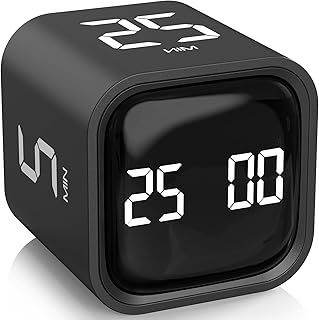
Rotating Pomodoro Timer 5, 25, 10 50 Minutes Preset, Desk Productivity Flip Timer, ADHD Tool Cube Countdown Stopwatch, Vibration/High/Low Volume/Custom Modes, for Work, Study, Back to School, Kitchen
Best For:
Writers, students, and creatives who want a tactile, phone-free Pomodoro experience and clear timeboxing tools.
A tactile, preset Pomodoro-style timer built for focus sessions. This rotating cube gives you quick access to common intervals—5, 10, 25, and 50 minutes—so you can start a timed deep work block without unlocking your phone. It offers multiple alert modes, including vibration and adjustable volume, and supports custom modes if you prefer different splits. The cube design is intuitive: rotate to the desired time and the countdown begins, keeping you anchored to a single session without reaching for apps or notifications.
Why creators like it: The act of rotating a physical object to start a session is a small ritual that reduces start friction. For creators who use Pomodoro or other timed sprints (music producers, writers, visual artists), this timer formalizes the session and signals to yourself—and others—that you’re in focus mode. Multiple sound/vibration modes make it suitable for shared spaces or café work.
Real-life use cases: Use the 25-minute preset for focused writing bursts, the 5- or 10-minute presets for quick edits or warm-ups, and the 50-minute preset for longer conceptual work like coding or story development. In a co-working space, switch to vibration or low volume to avoid disturbing neighbors. The custom mode is handy for people who follow different techniques (e.g., 90/30 splits) or for timed review sessions before meetings.
How it compares to phone apps and smart speakers: Phone timers are flexible but invite distraction; smart speakers are convenient but can be interrupted by other requests. This dedicated physical timer reduces those risks and creates a consistent ritual. It’s also easier to glance at during a session than checking a lock screen.
Who should buy it: Creators who want to protect phone-free focus blocks—students studying for exams, writers building a daily cadence, or developers enforcing regular breaks. It’s also good for people with ADHD who benefit from clear external structure.
Who might skip it: If you rely heavily on integrated digital calendars and shared team timers, a physical cube may feel redundant.
Buying considerations: Check battery life and whether the unit is rechargeable. Consider how loud the alerts are and whether vibration is strong enough for your workplace.
Check the latest price on Amazon.
Pros
- Quick, one-motion start—no phone required
- Multiple presets and custom mode accommodate different workflows
- Vibration and adjustable volume make it usable in shared spaces
Cons
- Requires batteries or charging; check battery life
- Might feel redundant if you already use a synced digital timer
Check the latest price on Amazon.
Desk Sculpture Decor Stress Relief Office Gift

Best For:
People who want a subtle, low-noise tactile outlet and a tasteful desk accent—designers, writers, and professionals in shared offices.
A decorative desk sculpture that doubles as a stress-relief tool and visual anchor for focused work. This type of desktop accessory is designed to be both tactile and aesthetic—something you can flip through with your fingers during thinking pauses, rotate to change your line of sight, or simply use as a calming visual on a clutter-free desk. The goal is to provide a short, non-digital break that resets attention without pulling you into social media or your phone.
Why creators keep one on their desk: Deep work benefits from small rituals that separate task-focused time from idle browsing. A sculptural object gives your hands something low-effort to do while your mind processes a tough problem. It’s also a subtle desk personalization that can make long sessions feel less sterile and more human. Creatives often place such sculptures near their monitors as a mini-status cue to themselves: when the object is turned face down or rotated, it’s a visual reminder that you’re working.
Real-life use cases: During a difficult edit, roll the sculpture quietly to relieve tense hands. During brainstorming, use it as a sensory pivot—touch something physical when ideas feel stuck. Keep one in the meeting room to help participants focus during intensive planning sessions. It also makes a low-key gift for a colleague who works long hours and could use a non-electronic way to decompress.
How it compares to common alternatives: Unlike stress balls that require squeezing or noisy fidget spinners, a desk sculpture is typically quieter and more visually pleasing. It’s less interactive than complex kinetic toys but more elegant for a professional environment. For people who want movement without sound or light, a sculpture is often preferable.
Who should buy it: Creators who appreciate tactile, low-noise stress relief and prefer non-electronic desk accents—illustrators, editors, architects, and people who spend long stretches at a desk.
Who might skip it: If your workspace is extremely small or if you prefer silent, hidden fidgets (like under-desk foot rollers), a sculptural piece could take up unnecessary room.
Buying considerations: Consider size relative to your desk, the material finish (metal, wood, or resin) if you want a specific aesthetic, and whether the piece is intended purely for decoration or regular tactile use.
Check the latest price on Amazon.
Pros
- Aesthetic and calming without electronics
- Quiet tactile relief for short thinking breaks
- Doubles as a tasteful desk accent or gift
Cons
- Takes desk space and may not suit very small setups
- Not as interactive as mechanical fidgets for heavy sensory seekers
Check the latest price on Amazon.
Deep Work Daily Focus Journal: A 90-Day Time Blocking Planner for Mental Clarity, Distraction-Free Productivity, and High-Performance Habit Tracking (Midnight Minimalist Edition)

Best For:
Creators committed to building focused routines over 90 days—writers, developers, entrepreneurs, and anyone practicing deliberate creative habits.
A purpose-built 90-day journal focused on time blocking, distraction reduction, and habit tracking. The Deep Work Daily Focus Journal is laid out to help creators plan focused work sessions, set daily targets, and reflect on progress over a three-month cycle. The Midnight Minimalist edition keeps a low-contrast, distraction-free design so your tasks and notes stand out without decorative clutter.
Why it’s suited to creators: The journal is designed around concentrated practice. Time blocking sections encourage scheduling uninterrupted blocks for creative work, while habit trackers and brief reflection prompts encourage accountability and gradual improvement. For creators aiming to build a reliable routine—daily writing, daily code katas, or consistent podcast production—this journal turns vague intentions into trackable entries that make progress visible.
Real-life use cases: Use the morning section to map your most important three tasks and a single time-blocked session. Track whether you hit your focused block and note the main interruption types (email, social, meetings) to identify patterns. Use the weekly review to plan next week’s creative goals and adjust time blocks based on real-world results. Over 90 days, the journal shows trends—great for quarterly planning or habit resets.
How it compares to other planners: Compared to generic planners, this journal is laser-focused on uninterrupted work and habit formation. Compared to digital habit apps, it provides a written ritual and space for reflection—often more effective for behavior change. If you prefer a full-year planner, a 90-day focus might feel limited, but the shorter horizon encourages experimentation and iteration.
Who should buy it: Creators who want a structured, written habit-building system and prefer time-blocking over list-based to-dos—writers, product teams, and solo founders aiming to build a sustainable creative routine.
Who might skip it: If you prefer continuous digital tracking or need a multi-year planner, a 90-day format might require you to buy replacements frequently.
Buying considerations: Make sure you’re ready to commit to daily entries for the format to pay off. Look at paper weight and binding if you plan to carry it daily, and consider the minimalist edition if you prefer low-contrast layouts for reduced visual noise.
Check the latest price on Amazon.
Pros
- Structured time-blocking and habit tracking for measurable progress
- 90-day format encourages focused experimentation
- Minimalist layout reduces visual distractions
Cons
- Requires daily discipline to get full value
- Limited to 90 days—will need replacement for long-term planning
Check the latest price on Amazon.
Final Verdict
Creating a desk that supports deep work is as much about rituals as it is about gear. The five items in this guide—an erasable smart planner, a compact tactile clicker, a preset Pomodoro cube, a calming desk sculpture, and a 90-day focused journal—each fulfill different roles in a creator’s workflow. The planner and journal give you structured places to capture ideas and measure habits; the Pomodoro cube enforces phone-free sessions; and the fidget and sculpture offer low-effort sensory outlets that prevent impulsive distractions.
If you’re building a portable deep work kit, prioritize low-friction items that fit your environment. Creators who juggle meetings and deep sessions will find the Pomodoro cube and the Rocketbook Fusion particularly helpful. People who need quiet, visual calm should consider the desk sculpture and the minimalist Deep Work journal. And if you often carry your tools between home, co-working spaces, and cafés, the small keyboard clicker is a pocketable, discreet outlet.
None of these tools are magic—they support habits you still need to create. But used together they reduce start-up friction, preserve momentum, and make interruptions easier to spot and fix. Pick two complementary items to start (one planning/reflective tool plus one focus enforcer) and iterate from there as you learn what helps you reach deeper focus more consistently. Check the latest price on Amazon.
Conclusion
These Desk gadgets creators use during focused deep work routines picks are trending now and offer great value and variety. Check the links above for latest prices and reviews.
As an Amazon Associate, I earn from qualifying purchases.
Tags:
deep work gadgets, desk productivity tools, Pomodoro timer, Rocketbook planner, focus journal, fidget gadgets, creator desk setup
