Best Portable Monitors for Creators on the Go
As an Amazon Associate, I earn from qualifying purchases. This article may contain affiliate links, which means we may receive a commission at no extra cost to you.
As an Amazon Associate, I earn from qualifying purchases. This article may contain affiliate links, which means we may receive a commission at no extra cost to you.
If your workday moves between a home studio, a coffee shop, and a co-working space, a lightweight portable monitor can change how you create. Portable monitors give content creators — photographers, video editors, streamers, designers and writers — quick, reliable second screens that slide into a laptop bag. They’re not meant to replace a calibrated desktop monitor for critical color work, but they solve a real problem: limited screen real estate when you need to preview timelines, reference files, or keep chat and monitoring windows visible while you work on a primary laptop.
This guide walks through five compact displays frequently chosen by creators who value travel-ready builds, simple plug-and-play setup, and good image quality for everyday editing and multitasking. I’ll cover who each model suits best, real-life scenarios where they shine, the practical trade-offs compared to full-size desktop monitors, and what to check before you buy.
Buying Guide
Why creators pick portable monitors: the right portable screen balances image quality, connectivity, and portability. Before choosing, focus on these key areas:
– Size and portability: 15.6-inch models are the sweet spot — large enough for useful workspace, small enough to carry. If you prioritize packing light, a 14" extender can tuck closer to your laptop hinge for a more compact load.
– Resolution and panel type: Full HD (1920×1080) IPS panels are common because they deliver wide viewing angles and stable colors at a reasonable price. For color-critical work, look for a monitor that quotes higher color gamut coverage or mentions factory calibration — though most budget portables are fine for layout, review, and editing previews.
– Connectivity: USB-C with DisplayPort Alternate Mode provides video and power over one cable — ideal for minimal setups. HDMI adds compatibility with cameras, game consoles, and streaming boxes. If your laptop lacks USB-C video, plan for an adapter.
– Stand and case: Built-in kickstands or smart covers make a massive real-world difference. A flimsy stand forces awkward angles; a sturdy kickstand or folio cover keeps the screen stable on a café table.
– Additional features: Built-in speakers, HDR support, and 60Hz vs higher refresh rates matter depending on use. Gamers and streamers may prefer higher refresh; creators focusing on editing need cleaner color and a steady display.
– Power options: Some portables draw power from the host device; others need their own power supply. Traveling creators should know whether they need an extra power brick or a single USB-C cable will do.
How they compare to standard monitors: A desktop monitor typically wins on color accuracy, larger sizes, and ergonomic adjustability. Portable monitors trade those gains for mobility and convenience. They’re best as secondary screens for timeline views, reference palettes, chat windows, and previewing edits.
Buying considerations from real users: people often stress compatibility (get the right cables), case quality (avoid flimsy folios), and warranty/aftercare. If you plan to color grade professionally, pair a portable with a calibrated desktop display.
Who should buy a portable monitor: creators who travel, remote workers who bounce between desks, streamers needing extra overlays, and students who multitask. Who might skip it: color-critical professionals who rely exclusively on color-accurate desktop panels, or anyone who never works outside their primary workstation.
Below are five well-reviewed portable monitors that balance price, performance, and portability. Each section highlights realistic use cases, pros and cons, and the people who’ll get the most from them.
ASUS ZenScreen 15.6” Portable Monitor for Laptop (MB169CK) – Dual USB-C, Mini-HDMI, Plug & Play External Screen for Travel Dual Setup, Full HD, IPS, Anti-Glare Surface, 360° Kickstand, 3yr Warranty

Best For:
Traveling creators and freelancers who need a reliable, easy-to-connect second screen for previews, editing timelines, and multitasking on the go.
The ASUS ZenScreen MB169CK aims to be a dependable travel companion for creators who want a no-nonsense second screen that integrates cleanly with modern laptops. It’s a 15.6-inch Full HD (1920×1080) IPS display with an anti-glare surface and a 360° kickstand that supports landscape and portrait setups. Where it stands out is a focus on practical build and reliable connectivity: dual USB-C ports and a mini-HDMI option mean you can connect a MacBook, Windows laptop, or even a camera for field monitoring without wrestling with adapters.
This monitor’s IPS panel provides consistent viewing angles, which matters when you’re sharing a quick proof or aligning a shot on location. The anti-glare coating reduces reflections in bright co-working spaces and outdoor cafés, so you’re less likely to chase glare when comparing images or scrubbing a timeline. The 360° kickstand gives you flexible pitching options on uneven surfaces; you won’t depend on external props to get the right viewing angle.
Compared with a standard desktop monitor, the ZenScreen trims back in color calibration and ergonomic adjustability. It’s not a replacement for a hardware-calibrated studio display, but it’s a practical second screen for reviewing edits, keeping notes or palettes visible, or using reference files while you work on the main laptop. The included 3-year warranty is a useful reassurance for users who travel frequently and need a reliable replacement window if something goes wrong.
Real-life use cases: a photographer tethering to a laptop for on-location review, a video editor keeping the timeline open while grading on a main screen, or a developer who wants code on one display and documentation on the other. A content creator who streams can put chat and monitoring tools on the ZenScreen while using the primary machine for gameplay or recording.
Who this is best for: creators who value plug-and-play setup, travel freelancers who need a rugged, glare-resistant panel, and anyone who uses USB-C laptops for simple multi-screen workflows. Who may skip it: professionals needing precise, factory-calibrated color for final grading or print work.
Practical buying considerations: confirm your laptop supports USB-C DisplayPort Alt Mode if you want single-cable video and power. Ask whether the mini-HDMI port supports your camera’s output if you plan to use it as a field monitor. Expect solid day-to-day performance without the fine-grain color fidelity of a studio monitor.
Check the latest price on Amazon.
Pros
- Solid IPS viewing angles and anti-glare surface for bright environments
- Dual USB-C and mini-HDMI increase device compatibility
- 360° kickstand and compact build make it travel-friendly
Cons
- Not a factory-calibrated studio display for color-critical work
- Smaller bezels and thin profile can feel less stable than a desktop monitor
Check the latest price on Amazon.
MNN Portable Monitor 15.6inch FHD 1080P 60Hz USB C HDMI Gaming Ultra-Slim IPS Display w/Smart Cover & Speakers,HDR Plug&Play, External Monitor for Laptop PC Phone Mac (15.6” 1080P)

Best For:
Multimedia creators and casual gamers who want HDR previews, built-in audio, and broad compatibility for travel and on-the-go production.
The MNN 15.6" portable monitor balances entertainment and productivity. With a Full HD IPS panel, HDR support, built-in speakers, and both USB-C and HDMI ports, it’s positioned as an all-purpose secondary display for creators who split time between creative work and casual gaming or streaming. The inclusion of a smart cover helps protect the screen while providing a simple stand solution that works in coffee shops, on planes, or at home.
For creators, HDR adds some pop when previewing footage or photos that were graded with expanded dynamic range in mind. Built-in speakers aren’t a substitute for studio monitors or headphones, but they’re handy for quick checks on audio sync or for listening to reference material in a pinch. The 60Hz refresh rate is standard, which is fine for editing, browsing, and non-competitive gaming; anything beyond 60Hz starts to matter more for fast-paced gameplay or motion-critical review.
Compared to a traditional desktop monitor, the MNN unit prioritizes portability and convenience over deep color accuracy. However, it’s typically enough for layout work, social-media content creation, and running preview displays while you edit on a more color-accurate main screen. The smart cover helps protect the display during travel and doubles as a functional stand for stable viewing angles.
Real-life scenarios where it shines: a travel vlogger previewing clips from a mirrorless camera via HDMI, an editor using the monitor for timeline and reference panels while grading on a laptop, or a streamer placing chat and alert panels on the MNN while gaming on their main machine. It’s also suitable for hybrid students and designers working from different locations.
Who this is best for: creators who want an affordable, feature-rich portable display with speakers and HDR for lively previews. Who may skip it: color-critical editors who require factory calibration or higher-than-FHD resolution for pixel-level inspection.
Practical buying considerations: check HDR performance expectations — many portable HDR implementations increase contrast and saturation but won’t match an HDR desktop monitor. Also verify the included smart cover’s durability if you’ll be traveling frequently.
Check the latest price on Amazon.
Pros
- HDR support and built-in speakers for lively previews
- Smart cover doubles as a protective stand
- USB-C and HDMI make it broadly compatible
Cons
- HDR on budget portables tends to be limited compared with full HDR monitors
- Not optimized for pro-level color grading
Check the latest price on Amazon.
Anyuse Portable Monitor 15.6 Inch 1080P USB-C HDMI Ultra-Slim Travel Monitor with Kickstand, for Laptop, PC, Mac Phone, PS, Xbox, Swich IPS Ultra-Thin Zero Frame Gaming

Best For:
Streamers and hybrid creators who want a slim, zero-frame monitor that handles both production tasks and console connections.
Anyuse’s 15.6-inch portable monitor aims at creators who need an ultra-slim secondary screen that also plays well with consoles. The zero-frame design maximizes viewing area and the built-in kickstand provides quick setup without carrying an extra case. With USB-C and HDMI inputs, this model connects to laptops, phones, and gaming consoles like PS and Xbox — useful for creators who juggle game capture, streaming, and editing.
For content creators, the Anyuse monitor is a practical multi-role display: use it for timeline viewing and reference windows during editing sessions, plug it into a console for capture or streaming overlay monitoring, or carry it for client reviews during on-location shoots. The IPS panel ensures consistent color and wide viewing angles for collaborative review — you and a client can stand or sit around the screen without the image washing out.
Compared to a standard desktop monitor, the Anyuse trades some ergonomic and color-targeting features for mobility and versatility. Where it’s better than many alternatives is in a combination of slim profile, zero-frame aesthetic, and console compatibility. That makes it attractive to creators who also produce gaming-related content or who need a dual-purpose monitor for entertainment and work.
Real-use examples include a streamer who places the monitor beside their primary display for chat and alerts, a photographer using HDMI to preview images from a camera body, or a traveling editor who wants a clean secondary workspace for reference assets. Users report the kickstand and slimness as standout benefits when packing into a messenger bag or camera pack.
Who this is best for: creators who need a multi-purpose monitor that doubles as a portable gaming/monitoring screen and a travel-friendly production aid. Who may skip it: those seeking deep color accuracy for print or high-end grading.
Practical buying considerations: if you plan to use it with consoles, confirm the HDMI bandwidth and any latency specs. Also check whether the included kickstand provides the tilt range you need for long editing sessions.
Check the latest price on Amazon.
Pros
- Ultra-slim, zero-frame design maximizes viewing area
- Good console compatibility via HDMI
- Built-in kickstand simplifies on-location setup
Cons
- Limited ergonomic adjustments for long desktop use
- Not a substitute for a calibrated studio monitor
Check the latest price on Amazon.
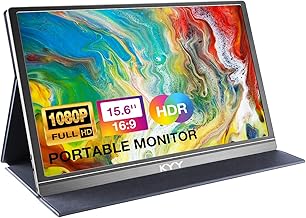
KYY Portable Monitor 15.6inch 1080P FHD USB-C, HDMI Computer Display HDR IPS Gaming Monitor w/Premium Smart Cover & Screen Protector, Speakers, for Laptop PC MAC Phone PS4 Xbox Switch
Best For:
Creators who prioritize travel durability and extras like a smart cover and screen protector, and who want an all-around secondary display for previews and monitoring.
The KYY 15.6-inch portable monitor is a popular mid-range option that often appears in creator setups because it blends useful extras with a practical price point. It features a Full HD IPS panel, HDR support, USB-C and HDMI inputs, and a premium smart cover plus a screen protector, which together improve durability for travel. Built-in speakers add convenience for quick audio checks or casual playback.
What makes the KYY interesting for creators is the attention to travel-ready details: a sturdy smart cover that doubles as a stand, a screen protector for scratch resistance, and a panel that balances contrast and color vibrancy for everyday editing and preview work. Compared to a full-size monitor, it gives up adjustable stands and the highest color fidelity but wins for portability and immediate convenience.
Creators report that the KYY serves well as a timeline or reference display — handy when you want your primary laptop screen reserved for the main editing window and use the KYY for scopes, chat, or reference images. HDR support can enhance previews for HDR-aware footage, but it’s usually best to check final grades on a calibrated display before export.
Realistic use cases: a wedding photographer who wants to run quick client previews on location, a video editor who keeps monitoring tools on the KYY while grading on a laptop, or a game-content creator who uses the monitor to display chat and stream health while gaming on the main setup.
Who this is best for: creators who want a travel-ready portable monitor with protective accessories included and broad device compatibility. Who may skip it: professionals who need hardware calibration and bigger panels for detailed color work.
Practical buying considerations: look for clear specs on HDR implementation and whether the included power options support single-cable operation with your laptop. The included screen protector is a nice perk if you frequently load the monitor into a bag with gear.
Check the latest price on Amazon.
Pros
- Premium smart cover and screen protector included
- Built-in speakers and HDR support for lively previews
- USB-C and HDMI compatibility
Cons
- HDR and color accuracy are limited compared to studio displays
- Stand options are basic for extended desktop work
Check the latest price on Amazon.
Laptop Screen Extender 14", Ultra Thin 0.27” FHD 1080P Portable Monitor for Laptop 13-17.3", Plug n Play Extra Monitor Extender, Eye Care Second Screen for MacBook/Windows/Android/Switch/PS5

Best For:
Writers, students, and creators who want a compact, eye-friendly screen that pairs closely with their laptop for improved productivity without bulk.
This 14-inch laptop screen extender is aimed at users who want an ultra-compact second screen that pairs closely with a laptop’s footprint. At 0.27 inches thick, it’s thinner than many 15.6-inch portables and is designed to mount or sit adjacent to your laptop to create a near-seamless dual-screen laptop experience. The Full HD IPS panel and eye-care features (like blue-light reduction or flicker-free modes) make it a sensible choice for long editing sessions where eye comfort matters.
Unlike larger portable monitors, an extender is often used as a direct companion to a single laptop — expand your window management without big size penalties. For creators who work in tight café spaces or prefer a compact bag, the 14" size keeps the setup nimble while still offering enough pixels for dual-window workflows. The plug-and-play nature removes complexity: many users report a painless setup with USB-C or the included adapters.
Compared to a standard 15.6" portable, the 14" extender trades screen area for portability and the convenience of fitting closer to your laptop bezel. It won’t fully replace a desktop monitor for color-critical work, but it improves productivity significantly for multitaskers, writers, and developers who want more screen real estate without a bulky addition.
Common use cases include a content writer keeping research on the extender while drafting on the main screen, a photo editor dragging reference images to the second display, or a student using lecture slides on one screen while taking notes on the main laptop. Eye-care modes help during long editing or writing sessions.
Who this is best for: creators and professionals who prioritize compactness and eye comfort, and those who want a near-laptop-sized second display that tucks into a bag easily. Who may skip it: users who need larger workspace for detailed image editing or multi-app layouts.
Practical buying considerations: ensure your laptop has the right ports or that you’re prepared to use a small adapter. If you plan on using the extender for photo grading, consider supplementing it with a calibrated monitor at your main workstation.
Check the latest price on Amazon.
Pros
- Ultra-thin form factor that pairs closely with laptops
- Eye-care features reduce strain during long sessions
- Plug-and-play setup simplifies use across devices
Cons
- Smaller screen area may feel limiting for multi-window editing
- Not designed for professional color grading
Check the latest price on Amazon.
Final Verdict
Portable monitors are a practical, often transformative accessory for creators who work flexibly. They deliver extra workspace for timelines, chat windows, reference images, and live previews without forcing you to stay tied to a single desk. Among the five options above, pick based on how you work: choose the ASUS ZenScreen for a travel-focused, glare-resistant second screen with established brand support; the MNN model if you want HDR and built-in audio for lively previews; Anyuse for a slim, zero-frame design that’s also console-friendly; the KYY for a travel-ready package with protective extras included; or the 14" laptop screen extender if you prioritize compactness and eye-care for long sessions.
A few final tips before you buy: confirm your device supports USB-C DisplayPort Alt Mode if you want single-cable video and power; keep a short HDMI cable and a small dongle kit in your bag for broader compatibility; and consider carrying a lightweight folding stand or the supplied smart cover to improve ergonomics while working in cafes or on flights. For color-critical work, use a portable monitor mainly for previews and reference, and finalize grades on a calibrated desktop display.
Portable displays won’t replace a full desktop setup for every creator, but they close a productivity gap that makes remote and flexible routines smoother. If you travel often, switch workspaces regularly, or stream and multitask, a portable monitor is one of the most useful upgrades you can carry.
Check the latest price on Amazon.
Conclusion
These Portable monitors creators use during flexible office routines picks are trending now and offer great value and variety. Check the links above for latest prices and reviews.
As an Amazon Associate, I earn from qualifying purchases.
Tags:
portable monitor, external monitor, USB-C monitor, travel monitor, 15.6-inch portable monitor, monitor for creators, portable display
