Best Educational Music Toys for Toddlers – Top Picks
As an Amazon Associate, I earn from qualifying purchases. This article may contain affiliate links, which means we may receive a commission at no extra cost to you.
As an Amazon Associate, I earn from qualifying purchases. This article may contain affiliate links, which means we may receive a commission at no extra cost to you.
Music is one of the most powerful learning tools for young children. From simple rhythms that build motor coordination to sing-alongs that expand vocabulary, the right musical toy can become a daily learning habit rather than just background noise. In this guide I’ve gathered five thoughtfully designed educational music toys for toddlers and preschoolers — options that prioritize development, durability, and play value. Whether you’re shopping for a gift, classroom addition, or a starter set for a budding little musician, these picks cover a range of ages, play styles, and budgets. Below you’ll find practical descriptions, who each toy is best for, realistic use cases, plus pros and cons to help you choose with confidence.
Buying Guide
What to look for in an educational music toy:
Age-appropriateness and safety: Always check the recommended age range and look for non-toxic finishes, large parts that don’t present choking hazards, and rounded corners. For toddlers, simplicity matters — toys with a few clear functions are better than feature-overloaded devices that frustrate little hands.
Durability and materials: Wooden instruments and thick silicone mats tend to withstand enthusiastic play better than thin plastic toys. If you want a long-lasting item that can be passed down, prioritize solid wood, metal tuning keys for xylophones, and reinforced stitching for fabric pieces.
Acoustic vs. electronic: Acoustic instruments (wooden drums, xylophones, shakers) teach cause and effect and have an authentic sound. Electronic toys offer guided melodies, LED feedback, and educational frameworks (letters, numbers, animal sounds). Consider whether you prefer open-ended acoustic play or structured learning with lights and songs.
Portability and storage: Floor mats and soft instruments are easy to roll up and store, while bench-style and wooden sets may require more dedicated space. If you travel or have limited room, look for foldable or compact options.
Noise and volume control: Musical toys can be loud. Look for volume control or the option to play acoustically without speakers. Some electronic toys include a headphone jack or low-volume mode, which is useful for napping siblings.
Educational value: The best toys pair music with another developmental goal — language (alphabet songs), motor skills (pound-and-tap), sensory integration (texture and lights), or social play (turn-taking). Choose a toy that aligns with your child’s next learning step rather than just novelty features.
Maintenance: Removable parts that are easy to clean and battery compartments with secure screws are practical features. For floor mats, check whether they are washable or wipeable.
Budget and longevity: If you want something that grows with the child, opt for toys with multiple play modes or adjustable difficulty. Basic shakers and tambourines are affordable, while larger interactive pianos or Montessori sets cost more but often offer more developmental bang for your buck.
With those criteria in mind, the selections below include a balance of acoustic and electronic options, Montessori-inspired instruments, and playful tech-forward pianos suited for toddlers up to preschool age.
LOVEVERY | The Music Set | 6 Montessori Musical Instruments & Rhythm Book | Educational Toys for Toddlers & Preschoolers | Simple Songs and Play Guide | Ages 18 Months to 4+ Years

Best For:
Families and educators who prefer Montessori-style, open-ended acoustic instruments for ages 18 months to 4+ and want to encourage caregiver-led music time.
The LOVEVERY Music Set is a Montessori-inspired ensemble designed to introduce young children to rhythm, pitch, and cooperative play without overwhelming them. The set typically includes six small instruments — such as a wooden egg shaker, a small tambourine, a tone bell, a castanet-style clacker, a hand drum or rhythm block, and a simple rhythm book with songs and play ideas. Each piece is sized deliberately for small hands and finished with smooth edges and non-toxic paint. The included rhythm book explains simple songs and offers guided play prompts that caregivers can use to support language development, listening skills, and turn-taking.
This set stands out from many mass-market plastic instruments because it’s rooted in Montessori principles: open-ended, tactile, and designed to be used alongside guided routines. Where many battery-powered musical toys teach through repetitive canned phrases, this collection encourages caregivers to sing, imitate, and model rhythm — key practices for early learning. The instruments are compact, so they’re easy to pack for daycare visits or family outings, and they work well in multi-child settings where children share and coordinate beats.
Use-case scenarios: At nap-to-play transitions, a parent can lead a short two-minute rhythm circle to settle the child and introduce vocabulary (fast/slow, loud/soft). In a toddler music class, the set serves as a group station for turn-taking and call-and-response activities. For at-home sensory play, the different textures and timbres give toddlers safe exploration opportunities.
Practical observations: Expect authentic acoustic tones — not electronic effects — and straightforward play mechanics. Because the instruments are simple, they won’t “teach” letters or numbers, but they will build the foundation for musicality and attention span. Families used to plastic, battery-powered toys may notice the quieter, more natural tones. These are ideal for parents who prioritize developmental design and longevity over flashy features.
Who should buy: Parents, caregivers, and early childhood educators seeking a well-crafted, developmentally intentional starter music kit that encourages caregiver interaction and open-ended play.
Who may not need it: If you want a toy that plays sing-along songs, lights up, or offers built-in alphabet or counting lessons, this acoustic set may feel too minimalistic.
Check the latest price on Amazon.
Pros
- High-quality, Montessori-inspired acoustic instruments
- Encourages caregiver-child interaction and open-ended play
- Compact and durable for group use and travel
Cons
- No electronic guided melodies or volume control
- May feel minimal for parents seeking flashy features
Check the latest price on Amazon.
LeapFrog Spin and Sing Alphabet Zoo

Best For:
Toddlers and preschoolers who are beginning to learn letters and letter sounds and families who appreciate structured, song-based learning.
The LeapFrog Spin and Sing Alphabet Zoo is a classic electronic toy that blends music, movement, and letter recognition in a kid-friendly format. It features a spinning wheel of colorful animal characters, letter prompts, and a selection of songs and sound effects designed to teach the alphabet, animal names, and basic phonics. The toy’s interactive surface encourages little fingers to spin, press, and explore, while the entertaining songs reinforce letter sounds and naming in short, repeatable segments.
Compared with basic acoustic instruments, the Spin and Sing focuses more explicitly on early literacy through music. The toy’s sing-along songs (a LeapFrog specialty) provide predictable repetition that helps toddlers remember letters and associate them with animals and sounds. It’s a good bridge toy for children who are ready to go beyond rhythm and want the music to support a specific learning objective like letter recognition.
Use-case scenarios: Place it near a reading nook for short, supervised sessions that blend song and story. In a preschool classroom, it works as a station where children rotate through hands-on literacy activities. For car trips or waiting rooms, its contained size and cheerful responses can keep a toddler engaged for short bursts.
Practical observations: Electronic toys like this one are attention-grabbing and effective for rote learning, but they can be louder and more repetitive than acoustic alternatives. Check for volume control or an auto-shutoff feature if noise is a concern. Batteries are required; make sure you have spares for uninterrupted play.
Who should buy: Caregivers who want a proven, structured musical toy that targets the alphabet and phonics and is ideal for short, guided learning moments.
Who may not need it: Families seeking more open-ended, acoustic music exploration or parents sensitive to repetitive electronic songs may prefer wooden instruments or a multi-mode piano instead.
Check the latest price on Amazon.
Pros
- Clear, catchy songs that reinforce the alphabet
- Interactive spinning and pressing for fine motor practice
- Compact and kid-friendly design
Cons
- Repetitive electronic sounds may become annoying to adults
- Requires batteries and may lack volume control
Check the latest price on Amazon.
Hape Pound & Tap Bench with Slide Out Xylophone – Award Winning Durable Wooden Musical Pounding Toy for Toddlers

Best For:
Active toddlers who enjoy pounding, banging, and cause-and-effect play; great for homes and preschools looking for durable wooden toys.
The Hape Pound & Tap Bench is a well-known staple for toddlers that blends cause-and-effect exploration with musical reward. This wooden bench features holes for pounding pegs, which roll down to trigger a slide-out xylophone that plays tuned notes. The two-in-one design encourages gross motor development (pounding with a mallet) and fine motor refinement (manipulating pegs), while the xylophone introduces pitched notes and melody.
Compared to single-purpose toys, the Pound & Tap Bench packs more developmental value into one durable wooden unit. Its classic design is simple: toddlers learn that actions have predictable sound outcomes, which supports both cognitive growth and early music skills. The materials are typically premium — unfinished or lightly finished wood, securely attached components, and a sturdy base — so it stands up well to vigorous play and multiple children.
Use-case scenarios: In morning routines, a short pounding session can be a ritual that builds coordination and energy release. In small-group play, kids can take turns pounding and then experimenting with the xylophone notes. For sensory play, the tool provides tactile feedback and satisfying acoustic tones without digital effects.
Practical observations: Expect robust construction and an authentic wooden xylophone sound rather than synthesized tones. The toy’s size is small enough for living rooms or playrooms but may not be ideal for very small apartments where storage space is limited. Keep in mind the mallet and pegs are parts to supervise with very young toddlers.
Who should buy: Parents who want a Montessori-friendly, long-lasting wooden toy that supports motor skills and early musical exploration.
Who may not need it: Families who prefer electronic guided melodies or who need ultra-compact, travel-ready toys may find it less suitable.
Check the latest price on Amazon.
Pros
- Durable, award-winning wooden construction
- Combines gross and fine motor development with music
- Authentic xylophone tones and satisfying tactile feedback
Cons
- Contains small removable pieces that require supervision
- Takes up more floor space than a handheld toy
Check the latest price on Amazon.
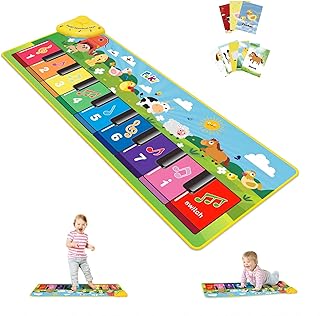
FOKI Floor Piano Mat for Toddlers, Sensory Educational Dancing Musical Keyboard Carpet Toy, Animal Sounds Touch Playmat Blanket, for 1 to 5 Years Old Boy and Girl
Best For:
Active toddlers aged 1–5 who enjoy movement-based play and parents who want an engaging, screen-free activity.
The FOKI Floor Piano Mat is a large, interactive musical carpet that transforms the room into a dance-and-play stage. Toddlers step, hop, or press keys on the soft mat to trigger piano notes, animal sounds, and pre-set songs. Because it responds to whole-body movement, the mat combines gross motor activity with auditory feedback, making it an ideal choice for active children and families that want screen-free movement games.
Compared with tabletop or handheld instruments, a floor piano mat adds a physical play dimension: toddlers develop coordination, balance, and rhythm while moving their bodies to create sound. The mat is usually made from soft PVC or fabric with printed keys and electronic sensors. Many models offer multiple play modes (free play, demo songs, record-and-playback), volume control, and age-appropriate melodies.
Use-case scenarios: In rainy-day indoor play, the mat is a great way to burn energy and practice following patterns (step on a series of keys). For early music lessons, caregivers can use the demo songs to teach patterns, counting, and simple melodies. In social settings, two kids can take turns performing short “recitals,” which helps with turn-taking and confidence.
Practical observations: Because the mat is large, consider where you’ll place and store it when not in use. Some kids love stomping on the keys; others prefer seated play. Check for non-slip backing and the option to adjust volume. Cleaning and durability vary by model — choose one with wipeable surfaces and sturdy seams.
Who should buy: Energetic toddlers and families who want an active, full-body musical toy that encourages movement, rhythm, and cooperative play.
Who may not need it: If you have limited floor space, noise-sensitive roommates, or prefer quieter acoustic toys, this mat might be less suitable.
Check the latest price on Amazon.
Pros
- Encourages full-body movement and coordination
- Multiple play modes and animal/piano sounds
- Large, social play surface for group fun
Cons
- Large footprint and requires storage space
- Durability and cleaning can vary by model
Check the latest price on Amazon.
Hape Dynamic Pixel Piano – 3-in-1 Interactive Wooden Piano Toy for Toddlers Age 1-6, Musical Sensory Toy with LED Pixel Art Screen, Guided Melodies & Animal Sounds, Early Learning Educational Gift

Best For:
Parents seeking a multi-mode, visually engaging piano for toddlers and preschoolers who will benefit from guided melodies and hands-on play.
The Hape Dynamic Pixel Piano blends traditional wooden craftsmanship with modern interactive features. It’s a 3-in-1 instrument: a small piano keyboard for free play, guided melody modes that help toddlers learn simple songs, and an LED pixel art screen that offers visual feedback and playful animations. The toy often includes animal sounds, multiple learning modes, and adjustable volume to suit different environments.
This hybrid approach makes the Dynamic Pixel Piano a great middle ground between acoustic purity and high-tech guidance. Unlike basic xylophones or pounding benches, this piano supports independent exploration of melody while offering scaffolding for children who aren’t ready to play songs by ear. The wooden housing keeps the product feeling tactile and sturdy, while the pixel screen keeps engagement high for today’s tech-savvy little ones.
Use-case scenarios: Use the guided melodies during quiet play or nap-to-play transitions to teach melodic patterns. The pixel art screen is especially engaging for visual learners and can be used to gamify practice: follow the lights, press the keys, score points. It also works well in a shared playroom where different children prefer different play modes — one may like animal sounds while another practices guided tunes.
Practical observations: The combination of wood and electronic features typically means a slightly higher price point but also higher perceived value and longer interest span. Battery life, volume control, and robustness of the LED screen are practical considerations — look for models with secure battery compartments and low-energy LED displays.
Who should buy: Families who want a versatile musical toy that grows with the child, combining hands-on piano play with guided lessons and visual feedback.
Who may not need it: If you only want a simple acoustic instrument or are avoiding any electronic screens in toys, a pure wooden xylophone or hand drum may be a better match.
Check the latest price on Amazon.
Pros
- Combines tactile wooden design with interactive LED guidance
- Multiple play modes support a range of developmental stages
- Adjustable volume and guided melodies for learning
Cons
- Higher price point than simple acoustic toys
- Includes electronic parts that may require battery replacement
Check the latest price on Amazon.
Final Verdict
Choosing the right educational music toy depends on your child’s developmental stage, your family’s space and noise tolerance, and whether you prefer acoustic or electronic learning tools. For caregivers seeking a Montessori-style starter set, the LOVEVERY Music Set offers gentle, tactile instruments and guided play prompts. If alphabet learning is your priority, the LeapFrog Spin and Sing trains letter recognition through catchy songs. The Hape Pound & Tap Bench is a classic wooden option that builds both gross and fine motor skills, while the FOKI Floor Piano Mat brings movement and rhythm into full-body play. For a tech-forward, long-lasting option, the Hape Dynamic Pixel Piano merges wooden craftsmanship with LED-guided melodies.
All five options bring legitimate developmental benefits — from sensory integration and motor coordination to language support and music appreciation. When choosing, consider durability, space, and whether you want structured lessons or open-ended sound exploration. If possible, pair musical toys with caregiver-led activities like singing, dancing, and storytelling to maximize learning. Whichever toy you pick, music is a joyful way to support early learning and create lasting parent-child rituals. Check the latest price on Amazon.
Conclusion
These Best Educational Music Toys for Toddlers picks are trending now and offer great value and variety. Check the links above for latest prices and reviews.
As an Amazon Associate, I earn from qualifying purchases.
Tags:
educational music toys, toddlers music instruments, montessori music toys, best toys for toddlers, musical learning toys, toddler piano mat, wooden musical toys
