Best Educational Logic Board Games for Kids & Families
As an Amazon Associate, I earn from qualifying purchases. This article may contain affiliate links, which means we may receive a commission at no extra cost to you.
If you’re looking to move beyond screen time and into games that sharpen reasoning, spatial awareness, and early coding concepts, logic board games are an excellent choice. They turn abstract skills into tangible puzzles kids and adults can solve together — and they’re a fun way to practice problem-solving under low pressure. In this guide I’ll walk through five stand-out logic games that cover a range of ages and abilities, from preschool-friendly traffic puzzles to deeper, programming-style challenges.
Before we jump into the product breakdowns: As an Amazon Associate, I earn from qualifying purchases. This article may contain affiliate links, which means we may receive a commission at no extra cost to you. With that out of the way, let’s look at what makes a logic game worth buying and which titles fit different learners and situations.
Buying Guide
How to choose the best educational logic board game
Age range and difficulty progression: Look for games that clearly state recommended ages and include graduated challenges. A set with beginner to advanced puzzles extends the lifespan of the toy and helps children feel success early while offering tougher problems later.
Learning goals: Decide whether you want spatial reasoning (mazes, tangrams), sequential thinking (coding, step-by-step solutions), or social/collaborative skills (cooperative counting games). Many titles mix elements — for example, a marble maze improves spatial planning while a coding board teaches sequencing.
Solo vs. social play: Some logic games are designed for independent play (solitaire puzzle packs), while others encourage two or more players and teach turn-taking and teamwork. If you want a quiet solo activity for concentration, prioritize single-player puzzle sets. If the aim is family game night and group problem solving, choose cooperative or competitive board games.
Physical durability and components: Look at the quality of pieces—are the tiles, marbles, and cards sturdy? Games for younger kids benefit from larger, more durable parts. Games with lots of small pieces may not be ideal for households with toddlers.
Replay value: Puzzle books or challenge cards give high replay value because you can return to problems later. Games that rely solely on luck or one-off setups may become stale faster.
Accessibility and setup time: Consider how long setup takes and whether the game is easy enough for a child to set up independently. Compact travel-friendly formats are great for road trips.
Price-to-content ratio: You don’t need to choose the most expensive game. Evaluate how many challenge levels, hours of play, and learning outcomes you get for the cost.
Final buying considerations: Read product descriptions carefully for recommended age ranges, number of puzzles/challenges, and whether batteries or extra components are required. Also check return policies in case the game isn’t the right match for your child’s learning level.
ThinkFun Gravity Maze – Falling Marble Logic Game – Challenging STEM Toy for Kids 8-12 – Gravity Marble Maze – Brain-Building Fun – Educational Gift – Boosts Critical Thinking & Problem Solving

Best For:
Solo puzzlers aged 8+ who enjoy hands-on spatial challenges, parents and teachers seeking a compact STEM activity, and anyone wanting an intro to three-dimensional logic puzzles.
ThinkFun Gravity Maze is a tactile logic puzzle that blends marble-run construction with spatial-reasoning challenges. The game comes with a grid board, a collection of towers and directional pieces, a small marble, and a booklet of challenge cards ranging from beginner to expert. Each challenge shows a start and finish tower; your task is to arrange the towers on the grid so the marble follows a continuous path under gravity and lands in the target tower.
This title is structured like a puzzle-packed toolkit rather than a competitive board game — it’s primarily a single-player experience that encourages trial-and-error, planning ahead, and visualizing three-dimensional paths. For many kids, the immediate feedback of watching a marble either succeed or fall off track is more motivating than abstract scoring. Teachers and parents often recommend it as a quiet classroom center or homework break that strengthens logic, planning, and hand–eye coordination.
Real-life usage scenarios include a rainy afternoon activity, a brain-starter before math homework, or a calm solo activity on long car trips (bring a small bag to hold pieces). Unlike simple marble run toys that are free-form, Gravity Maze frames the build with explicit puzzles, which adds structured challenge and clear progression.
Compared with standard alternatives such as plastic marble tracks or basic building blocks, Gravity Maze emphasizes puzzle-solving over free construction and offers a clear difficulty ramp through its challenge cards. It’s well-suited for school-age children who are ready for spatial puzzles but not yet interested in abstract programming concepts.
Who should buy: Families looking for a compact, single-player STEM puzzle for ages roughly 8 and up; educators who want a classroom challenge station; kids who enjoy mazes, physics toys, and constructive problem-solving.
Who may not need it: If you want a multiplayer family board game or large-scale marble-run kits for collaborative building, this focused puzzle set may feel limited. Also, households with toddlers should be cautious because the small marble is a choking hazard.
Practical observations and buying considerations: The plastic towers are reasonably sturdy but can show wear with very heavy use; keep the challenge booklet nearby and consider laminating cards for classroom use. Setup is quick, and the visual wins from a successful run are immediate — great for building confidence in spatial reasoning.
Check the latest price on Amazon.
Pros
- Clear progression of challenge cards from easy to expert
- Tactile and visual feedback makes problem-solving satisfying
- Compact kit that’s great for travel or classroom centers
Cons
- Single-player focus limits family competition
- Small marble and parts not suitable for very young children
Check the latest price on Amazon.
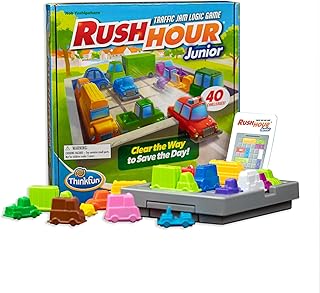
ThinkFun Rush Hour Junior – Classic Traffic Jam Logic Game – New Look for 2024 – STEM Toy for Kids – Engaging Puzzles for Ages 5 and Up – Junior Edition – MESH Accredited
Best For:
Young children (5+) starting with logic puzzles, preschool and early elementary classrooms, and families seeking a portable, low-prep brain game.
ThinkFun Rush Hour Junior reduces the popular Rush Hour concept into a child-friendly format that’s ideal for early reasoning development. The game uses a grid board, a collection of vehicle tiles, and challenge cards that set up traffic-jam puzzles. Players slide the vehicles back and forth to free a target car and drive it out of the grid — exercising sequential thinking and planning while keeping the setup quick and repeatable.
Designed for ages 5 and up, the junior edition typically features larger pieces, simpler challenges, and instructions suited to early readers or parents guiding toddlers. This makes it an effective introduction to cause-and-effect reasoning, planning moves ahead, and learning to reverse mistakes. Because Rush Hour puzzles are fundamentally single-solution sequences, they teach children to think in steps — a foundational skill for later success in math and coding.
Real-life scenarios where Rush Hour Junior shines: a busy-parent grab-and-go activity while preparing dinner, a calm focus center in preschool classrooms, or a travel puzzle in a closed tray for car or plane rides. The compact, flat design means it packs easily and doesn’t take up much shelf space.
Compared with standard alternatives, this junior version trades off complexity for accessibility. Other traffic-jam games aimed at older kids increase grid size or add more vehicles; Rush Hour Junior pares that back to keep initial frustration low and early success frequent. If your child quickly masters the junior levels, look for the full Rush Hour classic to extend the challenge.
Who should buy: Parents of preschoolers and early elementary kids who want a tactile, screen-free logic activity; educators seeking simple classroom puzzles; travel-minded families.
Who may not need it: Older children who outgrow the junior puzzles quickly, or families wanting multiplayer competitive gameplay — Rush Hour is designed primarily for solo problem-solving.
Practical observations and buying considerations: Pieces are kid-friendly and larger than the standard edition, but keep an eye on storage so you don’t lose small vehicle tiles. The challenge booklets are the heart of the replay value; check that the product lists the number of included challenges if longevity matters.
Check the latest price on Amazon.
Pros
- Designed for younger kids with simpler challenges
- Large, easy-to-handle pieces and quick setup
- Great travel and classroom puzzle
Cons
- Limited complexity for older children
- Primarily single-player with no cooperative mode
Check the latest price on Amazon.
Think Fun Cat Crimes Brain Game and Brainteaser for Boys and Girls Age 8 and Up – A Smart Game with a Fun Theme and Hilarious Artwork, (1550)

Best For:
Elementary and middle-school kids who enjoy mysteries, solo puzzlers, and educators seeking a themed critical-thinking activity.
ThinkFun Cat Crimes is a logic deduction puzzle that dresses up classic reasoning exercises with whimsical cat-themed scenarios. Each challenge presents a crime scene: a knocked-over vase, a missing cake, or scattered yarn. Players use a set of character cards and clues to deduce which feline culprit committed the mischief, where they were standing, and what they were playing with. It’s essentially a compact mystery-solving toolkit that teaches deductive logic and process-of-elimination strategies.
The game works like a single-player logic grid puzzle in physical form. Instead of filling out paper clues, kids manipulate cards and tiles to test hypotheses and eliminate impossibilities. The artwork and theme make it approachable for kids who might find abstract logic grids intimidating, while the clue structure still mirrors formal reasoning — teaching careful reading, attention to detail, and sequential deduction.
Use cases include a quiet independent activity for rainy afternoons, a homeschooling logic lesson, or a travel-friendly brainteaser for older kids who want non-electronic challenges. Because each puzzle is self-contained, Cat Crimes is easy to hand to a child who wants a few focused minutes of critical thinking without elaborate setup.
Compared to standard deduction games that can be multiplayer and conversation-driven (like classic whodunits), Cat Crimes is optimized for solo puzzling with a strong scaffold of clues and visuals. This makes it less social but better suited for individual learning increments.
Who should buy: Kids 8 and up who enjoy mysteries, parents looking for a low-prep logic exercise, and teachers wanting a themed reasoning activity for small groups.
Who may not need it: Families wanting an interactive, multiplayer mystery game or those looking for pure cooperative board games. If your child prefers hands-on building rather than deduction, consider spatial puzzle options instead.
Practical observations and buying considerations: The clues are cleverly constructed and provide satisfying “aha” moments when you eliminate options. The cards and tiles are compact, so consider a small storage box for classroom use. If you prize heavy social interaction during game night, add a multiplayer title alongside Cat Crimes.
Check the latest price on Amazon.
Pros
- Fun, engaging theme that motivates logical deduction
- Compact and travel-friendly with clear challenge progression
- Encourages careful reading and elimination strategies
Cons
- Best as a solo activity rather than multiplayer entertainment
- Some children may prefer more tactile or construction-based puzzles
Check the latest price on Amazon.
ThinkFun Math Path Monster – Engaging Cooperative Board Game – Enhances STEM Skills – Fosters Teamwork – Exciting Counting Adventure for Kids and Adults – MESH Accredited

Best For:
Young learners practicing addition/subtraction, classrooms and tutors seeking cooperative math activities, and families wanting a playful way to build number sense.
ThinkFun Math Path Monster takes a different approach from puzzle-in-a-box titles by combining cooperative play with foundational math practice. Players work together to traverse a game board, using cards and simple arithmetic to decide movement and strategies. The cooperative aim reduces competitive pressure and turns mistakes into learning opportunities, which can be especially useful for kids developing number sense, addition and subtraction fluency, and strategic arithmetic thinking.
This game is often used in classrooms and tutoring because it pairs a playful monster theme with deliberate math prompts. The rules encourage discussion about number choices, alternate strategies, and working toward a shared goal — skills that translate to collaborative problem-solving in the real world. Because it’s MESH-accredited, educators can be more confident that the game aligns with educational standards and learning outcomes.
Typical usage scenarios include small-group math centers, family game time designed to reinforce arithmetic, or one-on-one tutoring sessions where the game acts as a formative assessment tool. Unlike solitary puzzle kits, Math Path Monster supports talk-aloud strategies (explain your thinking), which helps teachers gauge comprehension and encourages metacognitive skills.
Compared with standard math flashcards or digital apps, this board-game format reduces screen time and encourages social math dialogue. It’s not a pure logic puzzle in the spatial or coding sense, but it’s an excellent bridge between arithmetic practice and strategic reasoning.
Who should buy: Parents and educators looking for a cooperative, standards-aligned math game for early elementary learners, tutors who prefer formative, discussion-rich activities, and families seeking a low-stress math practice tool.
Who may not need it: Families seeking advanced logic puzzles for older kids or solo brainteasers; if your primary goal is spatial reasoning rather than arithmetic, choose a different title.
Practical observations and buying considerations: Cooperative games rely on group buy-in — be prepared to guide younger players through collaborative choices at first. Check the box for recommended age range and whether the game supports multiple difficulty levels or adaptions for different skill sets.
Check the latest price on Amazon.
Pros
- Cooperative format reduces pressure and fosters teamwork
- Aligns with educational standards for early math
- Encourages discussion and strategic arithmetic thinking
Cons
- Less focused on spatial or coding logic
- Requires group participation for full value
Check the latest price on Amazon.
ThinkFun Code Master Programming Logic Game and STEM Toy – Teaches Programming Skills Through Fun Gameplay

Best For:
Children interested in coding fundamentals, homeschoolers and educators teaching early CS concepts, and solo puzzlers seeking sequential logic challenges.
ThinkFun Code Master is a puzzle-based board game that introduces programming logic without screens. Players use a set of tokenized command tiles to create a path for an avatar to follow on the game board, effectively translating algorithmic thinking into physical moves. Each challenge card sets an objective and constraints, encouraging players to sequence commands, plan several steps ahead, and debug their approaches when outcomes don’t match expectations.
The title sits at the intersection of logic games and early computer science education. Because it emphasizes sequencing, conditional thinking, and optimization, Code Master is an excellent primer for kids who will later study block-based coding platforms or beginner programming languages. The puzzles are single-player but have a progressive difficulty curve that can keep learners engaged over weeks or months.
Real-world use cases include homeschooling lessons on algorithmic thought, classroom centers that introduce CS concepts without a computer lab, and focused independent study sessions for children interested in coding. As a screen-free alternative, Code Master appeals to parents who want coding literacy without more device time.
Compared with digital block-coding apps, Code Master lacks immediate visual animations but compensates by making abstract control flow tangible. It’s less social than multiplayer board games, but its depth makes it a durable educational toy for kids who enjoy puzzling and sequencing.
Who should buy: Young learners (often ages 8+) curious about programming concepts, parents and teachers who want a screen-free CS introduction, and students who enjoy layered puzzle progression.
Who may not need it: Households seeking multiplayer party games or very young children who need more concrete manipulatives. Also, if your child prefers active, hands-on building over abstract sequencing, consider complementary spatial titles.
Practical observations and buying considerations: The game’s durability depends on how often tiles are handled; store command pieces in a labeled bag to avoid loss. Look for editions that include a wide range of challenge cards for longer replay value.
Check the latest price on Amazon.
Pros
- Introduces programming logic without screens
- Progressive difficulty keeps learners challenged
- Durable, focused solo gameplay for deep concentration
Cons
- Single-player format may not appeal to group play
- Abstract sequencing can be less engaging for tactile-only learners
Check the latest price on Amazon.
Final Verdict
Choosing the right logic board game depends on the learning goals you have in mind. If you want a compact spatial puzzle with immediate tactile feedback, ThinkFun Gravity Maze is an excellent pick. For younger kids beginning logic play, Rush Hour Junior offers a gentle but satisfying introduction to sequential planning. If deductive reasoning and themed mysteries sound like your child’s jam, Cat Crimes pairs storytelling with careful elimination strategies. For cooperative arithmetic and classroom use, Math Path Monster turns number practice into social problem-solving. And for early coding concepts delivered in a screen-free format, Code Master teaches sequencing and debugging in a compelling puzzle structure.
Across these picks you’ll find a mix of solo and cooperative formats, clear learning progressions, and solid replay value thanks to included challenge cards. Consider your child’s age, preference for solo vs. group play, and whether you want math, spatial, deduction, or programming-focused learning. Each of the games reviewed here addresses a specific learning niche — pairing the right title with your goals will give you the best educational return.
No matter which game you choose, these logic-focused toys are designed to build transferable reasoning skills that benefit schoolwork and everyday problem solving. Check the latest price on Amazon.
Conclusion
These Best Educational Logic Board Games picks are trending now and offer great value and variety. Check the links above for latest prices and reviews.
As an Amazon Associate, I earn from qualifying purchases.
Tags:
logic board games, educational toys, STEM games for kids, puzzle games, coding games for kids, critical thinking activities, brain games
