Best Educational Flashcards for Adults – Top Picks
As an Amazon Associate, I earn from qualifying purchases. This article may contain affiliate links, which means we may receive a commission at no extra cost to you.
As an Amazon Associate, I earn from qualifying purchases. This article may contain affiliate links, which means we may receive a commission at no extra cost to you.
Learning as an adult looks different than it did in school: you have limited time, specific goals, and a preference for efficient, practical tools. Physical flashcards remain one of the simplest, most effective tools for adult learning—whether you’re building vocabulary for travel and work, supporting speech therapy, managing memory for dementia care, or teaching language to non-verbal learners. This guide reviews five well-regarded flashcard sets that many adults find useful. I researched product descriptions, user feedback, and common use cases to bring forward the practical features that matter: clarity, relevance, portability, and durability. You’ll find sets aimed at Spanish learners, robust bilingual packs, photo-based vocabulary builders, and matching cards geared toward therapy and memory work.
Use the sections below to match a set to your learning goal. Each product review covers who it’s best for, realistic scenarios where it shines, and practical buying considerations so you choose the right tool for your routine.
Buying Guide
Why choose physical flashcards in 2026? Digital apps offer convenience, but tactile cards deliver strong sensory cues and fewer distractions—helpful for deep memorization and therapy sessions. When shopping for adult flashcards, assess these aspects:
– Scope and focus: Do you need broad vocabulary (1,000+ words), a targeted set (nouns, verbs, emotions), or bilingual conjugations? Match the set to your learning stage: beginners often need core vocabulary and phrases, while intermediate learners benefit from conjugation and idiomatic expressions.
– Visual design: Photo-based cards aid recognition and recall, especially for visual learners, non-verbal adults, and those with cognitive impairment. Realistic photos beat abstract clip art for practical vocabulary that matters in everyday life.
– Card quality and size: Sturdy cardstock and rounded corners increase longevity. Pocket-size cards are great for commuting, while larger cards are easier to use in group therapy or classroom settings.
– Organization and extras: Look for numbered cards, topic groupings, and quick-reference guides. Sets that include verbs with conjugations or phrase examples are more useful for language acquisition than noun-only decks.
– Usability in routines: Think about study techniques—spaced repetition, active recall, and quick daily reviews. Physical cards pair well with index boxes, rings, or accordion folders to implement Leitner-style systems.
– Accessibility: For therapy and dementia care, realistic images, high-contrast type, and simple layouts improve comprehension. Smaller, bite-sized sets are better for attention-limited sessions.
– Portability vs comprehensiveness: A 50-card therapy pack is light and immediate; a 1,000-card reference is comprehensive but bulky. Choose based on whether you prioritize mobility or depth.
Finally, consider alternatives: language apps and digital flashcards are useful for automated scheduling and audio, while physical cards excel at hands-on practice and group activities. Combine both for the best of both worlds.
299 Vocabulary Builder Flash Cards, Educational Photo Cards for Home, Speech Therapy Materials, ESL Teaching Materials Includes Emotions, Matching Go Togethers, Nouns, Opposites, Prepositions, Verbs

Best For:
Adults learning basic to intermediate vocabulary, ESL students, speech therapists, caregivers working with memory or communication challenges.
If you need a versatile, picture-rich set that covers a wide cross-section of everyday vocabulary, this 299-card Vocabulary Builder is an attractive option. The set is designed with speech therapy and ESL learners in mind, which means cards are grouped into practical categories—nouns, verbs, prepositions, opposites, emotions, and matching “go together” pairs—so you can design short, goal-oriented sessions without assembling multiple resources.
What stands out is the photographic approach. Instead of stylized drawings, cards use clear, realistic images that help adults make direct associations with objects and actions they encounter in daily life. That’s especially useful for learners who need to transfer classroom knowledge into real-world communication—travelers, workplace learners, or adults returning to study after a long gap. The range of topics also supports structured therapy work: emotion cards can help adults practice labeling feelings in social-skills sessions, while ‘go together’ pairs help reinforce categorization and memory.
The set’s breadth is its strength and its challenge. At nearly 300 cards, it’s comprehensive but requires some planning to avoid overwhelm. Many users pair smaller daily goals (10–20 cards) with a review box to implement spaced repetition. Compared with digital-only alternatives, this set provides a tactile, interruption-free study experience and is easy to use in group settings—no battery, no app permissions, and easier to share in a classroom or therapy circle.
Buying considerations: check card stock and whether the set includes a storage box or band. If you need verb conjugations or in-depth grammar, combine this with a conjugation-focused resource. For adults working on fluency and functional communication, the varied categories in this pack make it a practical multi-purpose toolkit.
Pros
- Large, varied set covering nouns, verbs, emotions and opposites
- Photographic images aid real-world association
- Useful for therapy, classroom, and home practice
- Grouped categories make short focused sessions easy
Cons
- Size can feel overwhelming without a study plan
- Not focused on verb conjugation or grammar explanations
- May require additional storage solution
Check the latest price on Amazon.
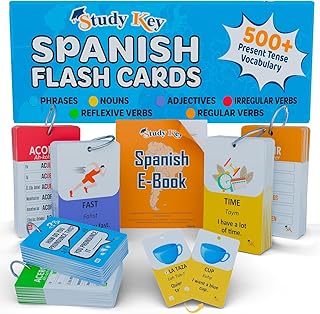
500+ Spanish Vocabulary Flash Cards for Adults & Kids Ages 15+ – Verb Conjugation, Nouns, Adjectives & Phrases to Learn Spanish for Adult Beginners Flashcards
Best For:
Adult beginners to low-intermediate Spanish learners who want verb practice and functional vocabulary; teachers running adult classes.
This 500+ Spanish vocabulary deck aims squarely at adult beginners who want a serious, structured resource to build functional Spanish. Unlike minimalist phrasebooks, this set emphasizes verbs and conjugation patterns alongside nouns, adjectives, and useful phrases—exactly what many adult learners request when they want to move past single-word recognition into usable sentences.
Cards in the set tend to show the Spanish term, an English equivalent, and in many cases a brief conjugation or context cue to illustrate usage. That makes these cards more like a portable classroom reference than a simple picture deck. Many users report this style works well for self-study: when combined with short daily sessions and written practice, learners move from recognition to production more quickly than with picture-only sets.
In realistic use, these cards are suited for commuters (pocket-friendly stacks), classroom warm-ups, and conversation club prep. Pair a small pile of verb cards with speaking drills or role-play to build automaticity. For intermediate learners, this deck can also serve as a review resource to shore up weak areas in verb usage.
Compare with app-based Spanish flashcards: apps often include audio and automated review intervals, but physical decks like this encourage active recall and reduce screen time. If you want audio support, use these cards alongside a language app or short partner sessions.
Buying considerations: examine whether cards are double-sided, the quality of print and cardstock, and whether verbs include regular/irregular conjugation hints. If you’re a complete beginner who prefers images, a photo-based deck or a hybrid set might be easier as a first step. For learners focused on conversation and grammar, this 500+ set is a compact, practical investment.
Pros
- Extensive vocabulary with verb conjugation guidance
- Designed for adult learners with practical phrases
- Portable for study on-the-go
- Good companion to classroom or self-study routines
Cons
- Large size can be overwhelming without a study plan
- Lacks built-in audio for pronunciation help
- May feel text-heavy for visual-only learners
Check the latest price on Amazon.
50 Noun Flashcards, Picture & Word Photo Cards Language Builder Visual Aid Language Learning Tool for Autism, ESL Teaching Materials for Adults, Non-Verbal Children Vocabulary Builder for Kids

Best For:
Adults with attention or processing differences, non-verbal learners, caregivers, speech therapists, and anyone wanting a compact, focused vocabulary set.
Small but focused, this 50-card noun picture set is designed for targeted vocabulary building—perfect when you need quick wins rather than exhaustive coverage. The combination of a clear photo and the printed word below keeps cards simple and uncluttered, which is a major advantage for learners with attention or processing difficulties, such as adults with autism or non-verbal individuals who benefit from strong visual cues.
Therapists and special educators often choose compact decks like this to build confidence. A short session using a handful of cards can produce measurable gains in labeling and comprehension, and the set’s portability makes it easy to carry between home, clinic, and school. The cards can also be integrated into AAC (augmentative and alternative communication) strategies—holding up a card to indicate an object, action, or choice.
Real-world use cases include caregiver training (show the card, model the word, prompt the individual), travel practice (teach a handful of nouns used on a trip), or thematic lessons (kitchen items, clothing, or transport). Compared with larger multi-hundred packs, the 50-card option helps maintain focus and avoids fatigue during therapy sessions.
Buying considerations: confirm card size and cardstock thickness—round corners reduce wear in frequent handling. If you need grammar or phrases, add a complementary set focused on verbs or prepositions. For adults who prefer minimal visual clutter and clear, direct labeling, this compact noun set is a practical, low-friction choice.
Pros
- Compact and easy to integrate into short therapy sessions
- High-quality photos and simple layout aid comprehension
- Great for visual learners and AAC strategies
Cons
- Limited to 50 nouns—insufficient as a standalone resource for broad language study
- Not designed for grammar or verb teaching
Check the latest price on Amazon.
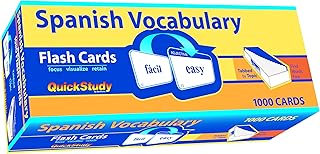
Spanish Vocabulary 1000 Flash Cards: a QuickStudy Reference Tool
Best For:
Committed Spanish learners, adult classroom instructors, professionals needing wide vocabulary (travel, hospitality, healthcare).
The QuickStudy Spanish Vocabulary 1000-card set is for learners who want a comprehensive, reference-style resource that can grow with their proficiency. If you plan to move beyond survival phrases into a broad working vocabulary—useful for study, travel, or professional contexts—this set offers depth without the need to assemble multiple smaller decks.
This is a reference-first tool: cards typically present the Spanish term with an English equivalent and may include brief notes about usage. The format works well for organized review sessions: sort cards by topic (food, business, travel) and set clear weekly goals. For self-directed learners, the depth of the deck becomes a systematic syllabus you can work through at your own pace.
Compared to app subscriptions or smaller themed packs, the 1000-card QuickStudy set reduces the friction of finding and printing your own materials. It’s also more durable and distraction-free than a phone. Teachers who run adult classes or intensive workshops can use this pack to create targeted handouts and drills quickly.
Realistic ways to use the deck include: daily five-card written drills focusing on varied topics, conversation prompts where each student draws a card and speaks for one minute about the concept, and role-play where verbs and nouns are paired to build sentences. If you travel frequently or need sector-specific vocabulary (medical, hospitality), this deck serves as a long-term reference.
Buying considerations: a 1,000-card set is bulky—check storage and portability options. If you need audio or interactive pronunciation help, plan to supplement with a pronunciation app or tutor. For committed learners who want a comprehensive physical archive, this set offers excellent value.
Pros
- Very comprehensive—1,000-card coverage
- Organized reference suitable for long-term study and classroom use
- Durable, distraction-free alternative to digital tools
Cons
- Bulky and less portable than smaller decks
- No built-in audio for pronunciation
Check the latest price on Amazon.
Go Together Flash Cards for Kids & Adults – 50 Realistic Matching Picture Cards for Speech Therapy, Dementia Activities, ESL, Autism Learning, Memory & Language Development, Classroom & Home Use

Best For:
Caregivers, speech therapists, adults with dementia, ESL learners seeking associative practice, and autism support contexts.
Matching cards—pairs that belong together—are deceptively effective for associative learning, and this 50-card Go Together set is tailored to that approach. Each card features realistic photography of everyday items arranged in logical pairs (shoe + sock, spoon + bowl). That associative format accelerates semantic linking, which is especially helpful in speech therapy, dementia care, and early-language intervention for adults.
What makes these cards practical is their adaptability. In a therapy session, you can use them for naming drills, sorting tasks, memory matching games, and conversation prompts. For dementia caregivers, the familiar, realistic images can trigger autobiographical memories and encourage communication without demanding abstract reasoning. In ESL classrooms, pairing nouns reinforces conceptual connections that are more durable than rote memorization.
Users who prefer interactive learning will like turning the cards into simple games—timed matching, scavenger hunts (find the real-world item that matches the card), or sentence-building where paired items are used together in short dialogues. Compared with single-word photo decks, the paired format deepens relational understanding: it’s not just the word you remember, it’s how items relate.
Buying considerations: the set’s limited size is great for short sessions but insufficient for comprehensive vocabulary building. If your goal is building a large lexicon, use these cards alongside a broader noun or verb set. Card durability and corner protection matter if you’ll use them frequently in group settings.
Who should buy: caregivers, therapists, and adults who learn best through association and active games will find this format particularly effective.
Pros
- Encourages associative and relational learning
- Realistic photos suit memory and therapy work
- Versatile—useable in games, therapy, and classroom drills
Cons
- Limited to paired items—not a broad vocabulary solution
- Smaller set requires supplementation for comprehensive study
Check the latest price on Amazon.
Final Verdict
Choosing the right set of flashcards for adults depends on your learning goal. For targeted therapy and short attention spans, compact 50-card photo decks or matching sets offer manageable sessions and quick wins. For adult beginners building functional language, a 500+ Spanish deck that includes verbs and conjugation hints bridges recognition to production. If you want exhaustive coverage for long-term study or teaching, the 1,000-card QuickStudy reference provides depth and structure.
Physical flashcards remain a powerful complement to digital tools: they reduce distraction, encourage active recall, and are ideal for group and therapy contexts. When selecting a set, balance portability with comprehensiveness, check card quality, and plan a routine—short daily reviews and spaced repetition maximize retention. Combine a robust reference set with compact, theme-based packs for therapy or travel to get both depth and convenience.
No single deck is perfect for everyone, but the five sets reviewed here cover the most common adult needs: therapy-focused visuals, Spanish verb practice, compact noun building, broad reference coverage, and associative matching. Pick the one that aligns most closely with your goals, and pair it with a consistent study approach for best results. Check the latest price on Amazon.
Conclusion
These Best Educational Flashcards for Adults picks are trending now and offer great value and variety. Check the links above for latest prices and reviews.
As an Amazon Associate, I earn from qualifying purchases.
Tags:
flashcards for adults, vocabulary flashcards, ESL flashcards, Spanish flashcards, speech therapy cards, dementia activities, language learning cards
