Office Accessories Creators Use for Workday Resets
As an Amazon Associate, I earn from qualifying purchases. This article may contain affiliate links, which means we may receive a commission at no extra cost to you.
If you spend your day making, editing, or coordinating creative work, the margin between distraction and flow often comes down to small rituals — a quick reset, a clear task list, a visible reminder on your monitor. That’s where simple office accessories designed for realistic workday resets become invaluable. They don’t promise radical productivity hacks or complex systems; they deliver bite-sized ways to refocus, plan the next hour, and keep ideas from vanishing into tabs and sticky notes.
As an Amazon Associate, I earn from qualifying purchases. This article may contain affiliate links, which means we may receive a commission at no extra cost to you.
Below you’ll find a curated set of five practical tools creators use to reset mid-day: two notepads (daily and weekly), three monitor/desk memo solutions (sticky memo boards and a glass whiteboard with a wireless charger and storage). I focus on real-life use cases like resetting after meetings, reorganizing priorities between sprints, or taking a 15-minute creative breather. Each product section explains who benefits most, what problems it solves, practical scenarios where it shines, and pros and cons to help you decide quickly.
Buying Guide
When choosing accessories for midday work resets, prioritize clarity over complexity. Look for tools that are low-friction: undated pages so you can pick up where you left off, compact sizes that live next to your keyboard, or transparent memo boards that don’t fight your monitor view. Consider three practical factors:
1) Format and frequency: Daily notepads with dedicated sections (top priorities, pomodoro slots, notes) help with quick resets. Weekly pads give a broader view — useful if you switch contexts several times a day but want to track commitments across the week.
2) Placement and visibility: Monitor-side memo boards and adhesive panels keep short reminders in your sightline without adding noise. Transparent or slim designs preserve screen real estate; magnetic or adhesive mounts matter if you change desks or travel.
3) Multi-function vs. single function: A glass desktop whiteboard with storage and an integrated wireless charger replaces multiple items (sticky notes, phone stand, charger) but costs more and takes space. Single-purpose pads are cheaper and portable, ideal if you like analog tools that travel.
Other buying considerations: paper weight and tear-off quality for notepads, number of sheets (52 sheets is a good year’s supply for weekly use), size (A4 or smaller to fit most desks), and whether the product supports dry-erase markers or reusable surfaces. Think about who you are: a remote content creator who switches tasks fast will value compact, visible notes; a studio designer juggling many projects may prefer a weekly pad plus a monitor memo board.
Compare these choices to software solutions: digital task apps are searchable and sharable, but physical notes beat them for quick cognitive offloading and mid-task resets. If you frequently move locations, pick lighter, portable options; if you mostly work from one desk, a sturdier desktop organizer with charging capabilities can simplify layout and reduce friction.
Taja To Do List Notepad – To Do List Notebook for Work with 52 Sheets, 9.8" x 6.5", Undated Daily Planner Perfect for Daily Tasks and Goal Setting, Notepad Suitable for Office, Home & School – Greenery Sway

Best For:
Creators who want a compact, undated daily reset tool for quick priority setting — ideal for writers, freelancers, and content creators.
The Taja To Do List Notepad is a compact, undated daily planner built for creators who want a no-nonsense way to reset between bursts of work. At 9.8" x 6.5" with 52 tear-off sheets, it’s small enough to sit beside a laptop but large enough to capture a day’s priorities, micro-goals, and quick notes. The undated format is a practical choice: it prevents wasted pages if your schedule shifts and lets you pick up the system whenever you need it.
Where this pad stands out is in its simple layout tailored to daily resets. Instead of a full calendar, the Taja pad focuses on immediate priorities, time-block suggestions, and a tiny section for wins — the kind of short feedback loop creators rely on to maintain momentum. Use it after a meeting to distill action items, during a 10-minute reset to list the next three tasks, or at the end of the day to capture ideas for tomorrow.
Compared to standard spiral notebooks or generic sticky notepads, the Taja daily layout nudges you to prioritize without the overhead of complex planners. The paper weight is typical for tear-off pads, so use a medium-point pen for best results and expect clean perforations for easy removal. Customers who prefer digital reminders should view this as a quick cognitive offload rather than an archive — although you can photograph pages for longer-term tracking.
Who should buy this: freelance writers, social media creators, and product managers who need a consistent, actionable daily snapshot. Who may not need it: people who rely exclusively on shared digital task boards or those who prefer large, bound planners for longform project planning.
Buying considerations include the pad size (fits most desks and laptop trays), the undated 52-sheet count (about a year of weekly daily use), and the simplicity of its sections. Practically, the Taja pad is ideal for creators who want a fast reset tool that stays out of the way until needed. Check the latest price on Amazon.
Pros
- Compact size fits small desks
- Undated 52 sheets prevent wasted pages
- Simple layout that encourages prioritization
Cons
- Not ideal as an archival system
- Paper thickness is standard (use medium-point pens)
Check the latest price on Amazon.
Joyberg 3PCS Monitor Memo Board, Memo Board for Computer Monitor, Monitor Memo Board Computer Monitor Sticky Note Holder, Office Desk Accessories

Best For:
Creators and remote workers who want visible, disposable reminders on the edge of their monitor for fast, low-friction resets.
Sticky reminders tucked off-screen are easy to forget; the Joyberg 3PCS Monitor Memo Board keeps short notes, phone numbers, and micro-checklists right where you’ll see them. These memo boards attach to the side of a monitor and act as a quick mounting surface for sticky notes, index cards, or small sketches. The pack of three gives you flexibility — dedicate one for daily priorities, another for a running ideas list, and the third for quick reference items like meeting links or shortcuts.
For creators who reset frequently, Joyberg’s memo boards reduce friction. Instead of minimizing a window or switching apps, you glance right at the edge of your screen and realign your next step. This is especially useful after a disruptive meeting: paste the top three follow-ups to the board and start working without hunting for details. The transparent or semi-transparent finish preserves part of your monitor’s bezel while still making notes readable.
Compared to full-size monitor mounts or sticky note stacks, these panels are lighter and less intrusive. They won’t replace a paper planner, but they complement it by offering immediate visibility. If you shift between standing desks or different monitors, check the attachment method and compatibility — adhesive and clip designs vary and can affect repeated repositioning.
Who should buy this: digital creators, editors, and developers who keep many tabs open and need visible, disposable reminders. Who may not need it: people who use large multi-monitor rigs where the panel could block critical information, or those who prefer fully digital notification systems.
Practical observations from users point to a low learning curve: peel and stick, or clip and go. Keep your most urgent items on the panel and archive older notes to a weekly pad to avoid clutter. Check the latest price on Amazon.
Pros
- Keeps notes in sightline
- Pack of three allows role-based organization
- Lightweight and easy to apply
Cons
- Attachment method varies by monitor
- Can accumulate clutter if not regularly cleared
Check the latest price on Amazon.
Weekly To Do List Notepad with 52 Undated Sheets(8.5"×11")- Undated Weekly Planner Notepad for Office Desk Accessories and Supplies – Midnight Lilac

Best For:
Creators and managers who need weekly visibility across projects — suited for designers, podcasters, and small team leads.
If your workflow spans multiple projects and you need a mid-day reset that considers the bigger picture, a weekly notepad is a practical choice. This Weekly To Do List Notepad measures 8.5"×11" and includes 52 undated sheets — enough to map an entire year of weekly planning without being tied to specific dates. The Midnight Lilac design is a subtle, professional alternative to more generic pads and fits well on studio desks or beside a drafting table.
Weekly pads change the rhythm of resets. Instead of rewriting daily priorities, you check off tasks across the week and reorganize based on shifting deadlines. For creators who switch between concept work, client calls, and production, the weekly format keeps deliverables visible without micromanaging each hour. Use it at the start of the week to block time, then glance at it during a midday reset to reallocate the next focused block.
Compared to daily pads, weekly notepads give better context but slightly less specificity. They’re great for designers balancing multiple client projects, podcasters scheduling episodes, or small studio leads who need a quick view of the week during sprints. The larger page size also allows space for short notes, sketches, or links — handy when you want to drop a fleeting idea without opening a project management app.
Practical buying tips: check paper quality if you like using markers or brush pens, because some weekly pads have thinner stock. The undated 52-sheet count is ideal for rollover weeks and flexible planning. If you travel often, consider pairing this pad with a compact daily notepad so you can keep high-level planning at the desk and take bite-sized lists on the go.
Who should buy this: designers, small team leads, and creators who juggle several projects and need weekly visibility. Who may not need it: people who prefer minute-by-minute hourly planners or exclusively digital calendar systems.
For a calm, organized desk flow that supports mid-day reprioritization, a weekly pad is a low-friction, paper-first solution. Check the latest price on Amazon.
Pros
- Large 8.5"×11" layout for multiple projects
- Undated 52 sheets for flexible planning
- Aesthetically subtle design fits studio desks
Cons
- Paper thickness varies for markers
- Less granular than daily planners
Check the latest price on Amazon.
NEXTLUXE Glass Desk Whiteboard with Wireless Charger – Desktop Whiteboard with Storage, Weekly Planner, Dry Erase Pad, Organizer Drawer for Home, School, Office Gadgets – White
Best For:
Creators with a fixed desk who want a centralized hub for planning, charging, and quick notes — ideal for remote workers and studio setups.
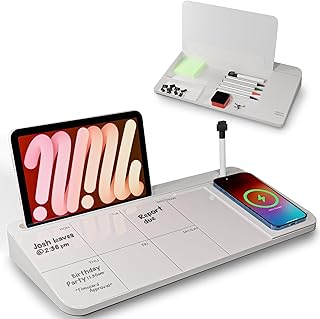
The NEXTLUXE Glass Desk Whiteboard is a multi-functional desktop organizer that brings several reset tools into one footprint. This glass whiteboard doubles as a weekly planner and dry-erase pad, and it integrates a wireless charger plus a small organizer drawer for markers, cables, or sticky notes. For creators who want to minimize clutter and centralize quick reset actions, this product is positioned as a hub: jot a one-line plan, charge your phone between sprints, and tuck away loose items.
Glass as a writing surface feels cleaner and more durable than plastic counterparts. The dry-erase finish wipes easily, making it perfect for rapid mid-day changes — sketch a wireframe, note a link, erase and reuse. The included wireless charger turns the board into a power station for Qi-enabled phones, which is convenient for people who use their phone as a reference during work. The organizer drawer keeps small tools accessible but out of sight, contributing to a cleaner visual field that helps creative focus.
Compared to simple pads or monitor panels, the NEXTLUXE unit consolidates multiple features and has a more permanent desk presence. That’s great for a dedicated home studio, but it might be overkill if you need portability or minimalist setups. Consider desk depth and available real estate: the unit requires a flat surface and is best for stationary desks rather than mobile laptops or hot-desking.
Who should buy this: studio creators, remote workers with a fixed desk, and people who appreciate a neat, integrated solution that blends planning, charging, and storage. Who may not need it: minimalist commuters or anyone who prefers lightweight, portable notepads.
Practical observations from buyers note that cable routing and charger alignment matter; test placement for reliable charging. The glass surface resists ghosting better than cheap dry-erase boards, but strong markers may still require a thorough clean. If you want a permanent centerpiece that supports rapid resets and reduces clutter, this is a strong option. Check the latest price on Amazon.
Pros
- Durable glass surface with easy erase
- Integrated wireless charger and storage drawer
- Combines planning and organization in one unit
Cons
- Takes desk space and is less portable
- Charger alignment and cable management require setup
Check the latest price on Amazon.
Office Desk Accessories 2pcs Multifunction Computer Monitor Memo Board – Transparent Computer Side Panel Memo Creative Monitor Side Panel Suitable for Office Home Desktop

Best For:
Aesthetic-focused creators and streamers who want subtle in-view reminders without cluttering the desk.
These transparent monitor side panels are a minimalist approach to keeping quick cues in view. The 2-piece set slides alongside a monitor or clips to the side of a screen, creating a narrow surface for short notes, fast sketches, or index cards. For creators who like a nearly invisible system — no large boards, no colorful sticky note clouds — these panels keep reminders visible without dominating the workspace.
In practice, use one panel for workflow checkpoints (e.g., "Next: Edit 10 mins, Render 20 mins") and the other for reference bits like RGB codes, account passwords, or meeting times. The transparency lets you place notes without losing the overall look of your setup — a benefit for creators who present their desk on video calls or maintain a clean visual brand.
Compared to bulkier monitor memo boards, these panels are subtle and travel-friendly (they’re easy to detach and pack). However, their narrow width limits how much you can pin at once; they’re best for essential, single-line reminders rather than long lists. Attachment methods vary — some clip designs work well on thin-bezel monitors but can be awkward on thicker bezels or curved screens.
Who should buy this: creators focused on aesthetics and minimalism who still need in-eye reminders — photographers, lifestyle streamers, and designers who often show their workspace on camera. Who may not need it: heavy multitaskers who need room for many sticky notes or those using large, multi-monitor setups.
Practical buying considerations: confirm compatibility with your monitor bezel thickness and test adhesive strength if included. Keep a small stack of index cards or thin post-its handy to rotate content quickly. For low-profile visibility that supports quick, clean resets, these transparent panels are an elegant option. Check the latest price on Amazon.
Pros
- Minimal, nearly invisible footprint
- Easy to detach and carry
- Great for single-line reminders and codes
Cons
- Limited writing space
- Attachment may not fit all monitor types
Check the latest price on Amazon.
Final Verdict
Small, purposeful tools can meaningfully change how creators handle midday resets. If you favor analog clarity and low-friction transitions, combine a daily notepad for immediate focus (Taja) with a weekly pad for context (Weekly To Do List Notepad). Add a monitor-side memo solution (Joyberg or the transparent panels) for visible, disposable reminders. If you have a dedicated home desk and want to consolidate, the NEXTLUXE glass whiteboard with wireless charging offers a neat all-in-one hub.
Think about how you reset naturally: do you sketch and erase, or do you jot and archive? Do you need visibility on screen or a clean desktop centerpiece? Match the product’s function to that habit. For creators who move frequently, favor the lightweight pads and clip-on panels. For stationary studio setups, the glass whiteboard’s multifunction approach can reduce daily friction.
Each product here solves a common problem: losing track of the next step, letting ideas evaporate, or letting small tasks accumulate into distraction. A small ritual — write the next three tasks, stick a reminder to your monitor, charge your phone while you regroup — can transform a chaotic midday into a calm reset. Check the latest price on Amazon.
Conclusion
These Office accessories creators use during realistic workday resets picks are trending now and offer great value and variety. Check the links above for latest prices and reviews.
As an Amazon Associate, I earn from qualifying purchases.
Tags:
workday resets, monitor memo board, weekly planner notepad, desktop whiteboard, creator desk accessories, daily to do list, wireless charger desk, transparent monitor panel
