Desk Gadgets for Productive Mornings: Timers & Planners
As an Amazon Associate, I earn from qualifying purchases. This article may contain affiliate links, which means we may receive a commission at no extra cost to you.
As an Amazon Associate, I earn from qualifying purchases. This article may contain affiliate links, which means we may receive a commission at no extra cost to you.
Mornings that actually produce results usually don’t come from motivation alone — they come from systems. The right small tools on your desk can shape a realistic, repeatable routine: a visible timer that keeps sprints honest, a simple notepad that keeps your brain from hoarding tasks, and a weekly layout that stops context-switching before it starts. In this guide I round up five practical desk gadgets—two rotating Pomodoro-style cube timers and three different planning notepads—selected for real-world morning workflows. Each product section explains who it’s best for, real-life use cases, features to notice, and practical buying considerations. This is geared toward people who want to get more done without adding fiddly apps or complicated setups.
Buying Guide
How to choose desk gadgets for realistic productivity mornings
Start with your pain point: are you losing time to vague tasks, or do you struggle with hyperfocus and losing track of breaks? Timers are best when your challenge is pacing and accountability; paper planners and notepads are best when your challenge is capturing, prioritizing and tracking progress.
Timer considerations
– Presets and custom modes: If you like classic Pomodoro, presets such as 25/5 are useful. Look for a device with extra presets (5, 10, 50) if you do micro-sprints or longer focus blocks. Custom modes let you fine-tune durations without fiddling.
– Feedback options: audible alerts, vibration, and mute modes matter depending on your environment. Vibration is helpful for open offices or roommates; mute and visual cues are better for quiet spaces.
– Activation and ergonomics: Gravity-sensor or rotating cubes are intuitive — flip to start. Choose a finish (white, wood grain) that fits your desk aesthetics and doesn’t feel like clutter.
Notepad/planner considerations
– Paper layout: Daily hourly sheets help if you schedule by time. If you prioritize tasks, look for focus areas or top-three sections. Undated pages give flexibility; weekly pads offer planning at a glance.
– Size and tear-off design: Desk pads that tear off provide a clean queue for the week and keep your desk tidy. Portable smaller pads work for commuters or short-term lists.
– Page count and longevity: 50–60 sheets last a season for heavy users; weekly planners with 54 weeks are better if you want year-round structure.
Who should buy what
– If you need pacing and structure: choose a rotating Pomodoro timer with vibration and customizable volumes.
– If you need capture and prioritization: choose a notepad with clearly defined focus areas or an hourly layout.
– If you juggle ADHD or variable attention: combine a tactile timer (flip cube) with a simple daily notepad and an undated time-tracked sheet.
Practical tips
– Pair a timer with a single-page daily to-do: use the timer for your focus intervals and mark completed items on the page.
– Keep a sticky note for quick brain dumps to avoid derailing focus sessions.
– Try different sprint lengths for a week each — 25/5, 50/10 and 10/2 — and track which yields the best sustained output.
Buying considerations
– Avoid devices with confusing buttons if you want a low-friction morning.
– Paper quality matters if you use pens or highlighters daily; thicker paper reduces bleed and improves the tactile experience.
– Think about desk clutter—choose sizes and colors that complement your workspace so they become part of your routine rather than visual noise.
Rotating Pomodoro Timer 5, 25, 10 50 Minutes Preset, Desk Productivity Flip Timer, ADHD Tool Cube Countdown Stopwatch, Vibration/High/Low Volume/Custom Modes, for Work, Study, Back to School, White

Best For:
Remote workers, students, and people with ADHD who want tactile, low-friction Pomodoro pacing with vibration and multiple volume modes.
If your mornings sputter because you either hyperfocus or get distracted every ten minutes, a tactile Pomodoro cube like this rotating Pomodoro timer can bring structure without another app. This white desk timer offers multiple presets (5, 25, 10, 50 minutes) and custom modes so you can set short micro-sprints or longer deep work sessions. The cube design uses a flip-to-start action: tilt or rotate the cube to the face with your desired duration and the countdown begins. That physical interaction — turning the cube — is a small ritual that signals your brain it’s time to focus.
This unit is built for flexible feedback. It has vibration, high and low volume settings, and a custom mode if you want a duration that isn’t listed on the faces. For people who need low-disruption cues, vibration or low volume provides a private nudge. For those in communal spaces, the higher volume (or a visible countdown) ensures you won’t miss the end of a sprint. Another practical touch: the display is simple, large enough to read from across a desk, and the controls are intentionally minimal so you spend less time configuring and more time working.
Compared with phone timers or software, a physical cube removes the temptation to check social apps when a notification pops up. Compared to complicated digital Pomodoro timers, this keeps things tactile and minimal. Customers who use it most often pair it with a one-page daily list or a weekly pad, turning individual sprints into a predictable morning routine.
Who should buy this: people who want an easy, tactile Pomodoro tool and prefer physical devices over apps — freelancers, students, remote workers, and people with ADHD who benefit from discrete vibration cues.
Who may not need it: those who rely entirely on digital calendars with integrated timers or people who prefer silent visual-only timers.
Real-life use case: Use a 25-minute face for focused writing blocks, flip to 5 minutes for email triage, and the 50-minute option for teaching prep or longer deep work. The compact white finish suits minimalist desks and doesn’t draw visual attention.
Practical observation: The flip-to-start mechanism is satisfying and reduces friction. Battery life depends on usage of vibration and volume settings; if you use vibration frequently, expect to replace batteries sooner.
Check the latest price on Amazon.
Pros
- Flip-to-start cube makes starting intervals quick and ritualistic
- Multiple presets plus custom mode for flexible sprint lengths
- Vibration and volume controls suit quiet or shared spaces
Cons
- Physical device means occasional battery changes
- Might be redundant if you prefer integrated digital timers
Check the latest price on Amazon.
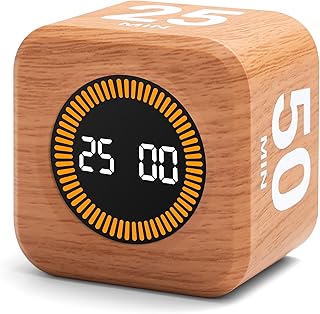
Rotating Productivity Timer 5, 25, 10, 50 Minutes Preset, Desk Cube w/Gravity Sensor for ADHD, Mute Functions, Ideal for Work, Study, Kitchen, Back to School (1, Wood Grain Finish)
Best For:
People who want a subtle, decor-friendly timer with mute functions — creatives, students, and shared-space dwellers.
This wood grain-finish rotating productivity timer is essentially a sibling to the white flip cube but with some nuance in design and feedback that suits certain desks and use patterns. The gravity-sensor activation means you don’t need to press buttons — rotate the cube to the chosen time and the countdown begins. The wood grain aesthetic helps it blend into home offices, living rooms or kitchen counters where a plastic-looking gadget might feel out of place.
Functionally it covers the main sprint lengths (5, 10, 25, 50 minutes) and has mute functions for quiet settings. The mute mode is especially helpful if you do early-morning work while others sleep or if you teach or attend meetings later in the day. Because it focuses on minimalism, it avoids complex menus; the simplicity is a strength when you want to start a session without thinking.
This timer works well as part of a mixed-strategy morning: spend a 10-minute sprint on inbox triage, switch to a 25-minute block for concentrated task work, then use a 5-minute reset to stretch or make coffee. Compared with phone timers this cube reduces distraction risk: there’s no lock screen temptation or notification trail.
Who should buy this: people who want a discreet, attractive desktop timer that matches interior decor — ideal for creative professionals, students in shared living spaces, and anyone who wants a low-visual-disruption tool.
Who may not need it: power users who want advanced analytics or smartphone integration; those who prefer visible digital countdowns on large screens.
Real-life use case: Place it on a kitchen island for focused meal prep sprints, move it to your desk for writing sessions, or use it during study drills. The wood grain finish hides fingerprints and makes it feel less like a gadget and more like a piece of the workspace.
Practical observation: The gravity sensor is forgiving — it starts reliably with a casual flip — and the mute function is genuinely useful for early hours. It’s lightweight, so consider a non-slip mat if your desk surface is slick.
Check the latest price on Amazon.
Pros
- Attractive wood grain finish blends into home decor
- Gravity-sensor activation is low-friction and reliable
- Mute function ideal for quiet environments
Cons
- No advanced tracking or phone integration
- Lightweight build may slide on smooth desks
Check the latest price on Amazon.
Taja To Do List Notepad – To Do List Notebook for Work with 52 Sheets, 9.8" x 6.5", Undated Daily Planner Perfect for Daily Tasks and Goal Setting, Notepad Suitable for Office, Home & School – Greenery Sway

Best For:
People who want a compact, undated daily list to prioritize top tasks and use alongside a Pomodoro timer.
The Taja To Do List Notepad is a compact, undated daily planner built for simplicity. At 9.8" x 6.5", it’s portable enough to tuck beside a laptop or slip into a bag for meetings. The pad contains 52 sheets — roughly a working quarter of daily pages if you use one per workday — and focuses on capturing prioritized tasks, top goals, and quick notes rather than forcing a rigid hourly plan.
What makes this pad useful in realistic productivity mornings is its minimal friction: you don’t need to decide which template to use or set up a new document. Each page is an encouragement to pick the top three priorities, list tasks, and mark progress. That single-page focus discourages overloading your morning with too many objectives and gives you a satisfying end-of-day ritual — tear off the page, close the book and leave the rest for tomorrow or the weekly review.
Compared to larger planners, the Taja pad is lighter and easier to use on the run. Compared to digital to-do apps, the tactile act of crossing off tasks provides a small dopamine hit that many people find motivating. It’s particularly useful for people who want to combine short sprints (timed by a cube timer) with a compact list of immediate priorities.
Who should buy this: people who like single-page daily lists, those who need a portable notepad for meetings or commutes, and anyone who benefits from an undated, no-pressure layout.
Who may not need it: people who want hourly time-blocking or a full-year planner with week-by-week structure.
Real-life use case: Use a page to outline three daily outcomes before your first sprint, then check items off as you complete each Pomodoro. Bring a page to stand-up meetings to capture action items or use it as a daily habit tracker for short routines.
Practical observation: Paper quality is adequate for gel pens and standard highlighters; if you prefer fountain pens, test bleed-through on a corner sheet. The greenery design adds a calm visual touch that can make your desk feel less clinical.
Check the latest price on Amazon.
Pros
- Compact, portable size perfect for desks and bags
- Undated pages reduce pressure and allow flexible use
- Simple layout encourages prioritization without overplanning
Cons
- Limited number of sheets for heavy daily users
- Not designed for detailed hourly scheduling
Check the latest price on Amazon.
Weekly Productivity Planner – 8.5" x 11" Dashboard Desk Notepad Has 6 Focus Areas to List Tasks for Goals, Projects, Clients, Academic or Meal-Organize Your Daily Work Efficiently, 54 Weeks, Green

Best For:
People who prefer a weekly overview for projects, meal planning, or multi-client work—useful for those who plan by outcomes rather than hourly blocks.
For people who benefit from a broader weekly view rather than a single daily page, this Weekly Productivity Planner desk notepad provides structure across projects, clients, meals or classes. The 8.5" x 11" format gives you enough space to lay out priorities and spread them across days, while the dashboard-style design includes six focus areas so you can label sections by project, client, or personal category.
This pad is designed to be a visual anchor on your desk: each tear-off sheet becomes a reference for the week and a clean slate to replace. With 54 weeks, this pad effectively covers a full year of weekly planning for most users, which is helpful if you want a consistent analog habit without reordering mid-year. The green color theme is muted and unobtrusive, making the pad suitable for professional environments.
Compared with daily single-page pads, a weekly pad helps you move from reactive work to planned progress. It’s especially effective when paired with a Pomodoro timer: plan blocks for each day on Monday morning and then use timers to execute subtasks without losing the big-picture plan.
Who should buy this: project managers, consultants, freelancers, parents planning meals and school activities, and students balancing multiple classes.
Who may not need it: people who strictly prefer digital calendar integrations or those who only need a short-term daily capture tool.
Real-life use case: Use Mondays to fill the dashboard with the week’s top outcomes, assign sprints to specific days, and keep the pad visible during your morning routine. Tear off each sheet at week’s end to file or discard as part of a weekly review.
Practical observation: The larger surface makes it easy to move items around and jot quick notes; however, if desk space is tight you may prefer a smaller daily pad. The paper holds markers and highlighters well with minimal bleed.
Check the latest price on Amazon.
Pros
- Large 8.5×11 format gives room for detailed weekly planning
- 54 weeks covers year-round planning without reordering
- Dashboard layout with six focus areas encourages organization
Cons
- Larger size may crowd small desks
- Not ideal for strict hourly scheduling
Check the latest price on Amazon.
Task Planner & Activity Log Notepad – 60 Page Undated Daily & Hourly Planning Pad, To-Do List, Checklist, Track Time & Tasks, ADHD Tracker – Organize Workday, Boost Productivity – 8.5 x 11 Tear Sheets Life Charge

Best For:
People who need hourly time-blocking plus activity logging—ideal for those tracking productivity, ADHD patterns, or balancing meetings with focused work.
This Task Planner & Activity Log notepad combines both daily and hourly planning on an 8.5" x 11" tear-sheet format. With 60 undated pages you get a balance of longevity and flexibility; this format is aimed at people who want to track time blocks, log activities, and keep a running checklist in one place. The inclusion of hourly time slots makes it a solid choice if you alternate between time-blocked work and checklist-driven tasks.
A practical advantage here is the activity log section — a quick way to record what you worked on during each block. For people tracking productivity or debugging their routines (for example, testing whether 25- or 50-minute sprints are more effective), having a written log provides valuable context you won’t get from a timer alone. The pad also highlights areas for top priorities, a simple checklist, and sometimes an ADHD-friendly tracker to note mood, distractions, or medication timings — useful for people who are actively optimizing focus.
Compared with the single daily pads, this notepad is more detailed and suited to people who time-block their day. Compared with full planners, the undated tear-sheet design keeps it lightweight and avoids commitment to a calendar layout.
Who should buy this: people who want hourly time blocking plus task tracking, productivity trackers, clinicians’ patients monitoring attention patterns, and professionals balancing meetings and focused work.
Who may not need it: those who want minimal capture or prefer a compact pocket-sized notepad.
Real-life use case: Start your morning by blocking the most important 2–3 hours and labeling them on the hourly grid. Use the activity log to note interruptions, then analyze which blocks were most productive at week’s end. Combine with a flip cube timer for consistent sprints and a Taja daily pad for quick capture when away from your desk.
Practical observation: The page layout supports reflective practice — it’s easy to spot patterns when you maintain the log for several weeks. Paper weight is adequate for ballpoint and gel pens; if you use heavy markers expect some show-through.
Check the latest price on Amazon.
Pros
- Hourly grid plus activity log supports detailed time tracking
- Undated tear-off pages offer flexibility
- 60 pages provide a balance of longevity and portability
Cons
- Bigger footprint than pocket pads
- Some users may find the layout too detailed for simple lists
Check the latest price on Amazon.
Final Verdict
Small, well-chosen desk tools can turn a chaotic morning into a reliable routine. Timers — especially tactile rotating cubes — help you commit to focused sprints without digital distractions; notepads and planners convert those sprints into meaningful outcomes. If you struggle with start-stop mornings, pick one timer and one paper system: a flip cube for pacing plus a daily or weekly pad to capture priorities. Combine modes (vibration for discreet alerts, mute for quiet hours) based on your environment. For people juggling ADHD, the combination of a physical timer and an undated activity log is particularly effective because it reduces friction and creates a record you can learn from.
If you want a minimal, decorative solution, choose the wood grain timer and pair it with the weekly dashboard pad to plan high-level outcomes. If you prefer compact capture and simple daily focus, the Taja notepad plus the white rotating Pomodoro timer is a low-cost, low-friction setup. For time-trackers and those who want to analyze their routine, the Task Planner & Activity Log provides the structure to do that work.
These are tools, not cures: the benefit comes from consistent use and small, repeatable rituals. Start small — one timer, one page each morning — and iterate. Make the tools part of the ritual and they’ll help turn your realistic productivity mornings from hopeful intentions into dependable results.
Check the latest price on Amazon.
Conclusion
These Desk gadgets people use during realistic productivity mornings picks are trending now and offer great value and variety. Check the links above for latest prices and reviews.
As an Amazon Associate, I earn from qualifying purchases.
Tags:
pomodoro timer, desk gadgets, productivity planner, ADHD tools, work from home, daily planner, time blocking, study aids
