Sustainable Organizers for Tidy Bedrooms
As an Amazon Associate, I earn from qualifying purchases. This article may contain affiliate links, which means we may receive a commission at no extra cost to you.
Keeping a bedroom tidy is less about frantic cleaning and more about smart systems. If you want a calmer, more organized space, a small investment in the right storage pieces can change the way you live in your room. As an Amazon Associate, I earn from qualifying purchases. This article may contain affiliate links, which means we may receive a commission at no extra cost to you.
This guide focuses on sustainable, fabric-forward organizers and space savers that creators—minimalists, small-space dwellers, and dorm decorators—often recommend. The selections below aim for durability, breathable storage, and modularity so you can reorganize without adding plastic clutter. Each product section explains real-life uses, who should buy it, realistic limitations, and practical tips gleaned from product specs and customer feedback. Whether you’re fitting a wardrobe into a tiny closet or corralling baby clothes in a dresser, these organizers can help you reclaim surface space and keep things accessible.
Buying Guide
What to look for when choosing sustainable bedroom organizers
1) Materials and build: Look for breathable, woven fabric or canvas construction with reinforced stitching and a stable base. Fabric organizers are lighter and often more sustainable than single-use plastic bins; heavyweight canvas or polyester blends resist sagging and last longer than thinner fabrics.
2) Size and modularity: Measure your closet shelves, dresser drawers, and under-bed clearance before buying. Modular sets and stackable drawers allow you to create a custom system—buying several smaller bins often fits shelves and drawers better than one oversized container.
3) Collapsible vs. structured: Collapsible bins and foldable dividers save storage space when not in use. However, if you need rigid support for folded sweaters or books, choose units with a reinforced bottom or a stackable drawer design that keeps form when loaded.
4) Handles and access: Front handles, clear label pockets, or cutouts make retrieval easier. Drawers and pull-out fabric bins are great for frequently used items; open-top bins work well for seasonal gear or infrequent use.
5) Weight capacity and load: Fabric organizers are ideal for clothing, linens, toys, and small accessories; they are not a substitute for hard-sided storage when stacking heavy items. If you plan to store shoes, tools, or books, choose reinforced options.
6) Aesthetic and sustainability: Neutral tones like beige, grey, or natural canvas integrate with bedroom decor and look less disposable. When sustainability matters, prioritize durable construction and multifunctional pieces so you won’t need frequent replacements.
7) Compare to standard alternatives: Plastic tubs are rigid and waterproof but take up more storage when not in use and can feel more disposable. Wooden drawers offer permanence and load capacity but are heavier and less flexible. Fabric systems strike a balance—lightweight, breathable, and easy to reconfigure.
Buying considerations: measure twice, pick neutral colors for longevity, mix drawer organizers with open bins to balance accessibility and tidy appearance, and prioritize sets that let you scale the system over time.
AMKUFO 6 Pack-Closet-Organizers-and-Storage, Magic-Hangers-Space-Saving-for-Clothes, Closer-Organizer-for-Closet-Organization, Space-Saver-Hanger-Organizer-for-Multipurpose, Dorm-Room-Essentials

Best For:
Small closets, dorm rooms, renters, or anyone looking to add hanging capacity without furniture.
If your closet is a daily battle between hangers and overflow, cascading or "magic" hangers like this 6-pack from AMKUFO can cut the chaos fast. These multi-tier hangers are designed to make the most of vertical hanging space: instead of lining garments side-by-side on a single rod, you link several hangers vertically so multiple items occupy the footprint of one. That simple shift often frees up shelf space and makes outfit selection feel less frantic in the morning.
What makes this kind of organizer attractive for sustainable-minded shoppers is its simplicity: it’s a low-energy, low-material fix that reduces the need to buy additional storage furniture. Creators and students living in dorms frequently pick these for closet edits because they’re lightweight, easy to install, and instantly increase capacity without drilling or assembly.
Practical scenarios: use them to rotate seasonal clothing (hang multiple shirts, skirts, or lightweight jackets on a single cascade), organize outfits by day-of-week, or group matching sets (top + scarf + layer). They’re also handy in shared closets where split vertical space keeps each person’s items visually separated.
Limitations and considerations: cascading hangers work best with shirts, dresses, and lightweight jackets. Heavier winter coats or very bulky sweaters can pull on the clip or bar and cause slippage. Some users note that if hangers are overstuffed, clothing can become tangled—so aim for a modest load per tier. If your closet rod is shallow or positioned oddly, double-check clearance so tiers can hang freely.
Who it’s best for: renters, students, minimalists, and anyone with a short rod or crowded closet who wants to increase hanging capacity without built-in shelving. Not ideal for those storing heavy outerwear or items that require rigid spacing.
Pros: space-saving vertical design; easy to install and reconfigure; great for dorms and shared closets. Cons: not ideal for heavy coats; tiers can tangle if overpacked.
Find it on Amazon — Check the latest price on Amazon.
Pros
- Frees up hanging space by using vertical capacity
- Lightweight and easy to install—no tools required
- Good for organizing outfits and seasonal rotation
Cons
- Not ideal for very heavy coats or bulky items
- Can tangle if overpacked
Find it on Amazon — Check the latest price on Amazon.
Homsorout Fabric Storage Bins for Organizing – 6 Pack Large Trapezoid Collapsible Storage Bins with Front Handle, Closet Organizers and Storage for Bedroom, Home Shelves, Small Spaces, Beige

Best For:
Open shelving, linen closets, and small-space renters who want breathable, attractive bin storage.
Collapsible fabric bins are a staple for creators who want clean shelves without a bulky footprint—and Homsorout’s 6-pack trapezoid set leans into that promise. The trapezoid shape helps bins tuck neatly into shelves with an angled front that makes reaching items easier than a tall box with a deep lip. Front handles speed access, and the collapsible nature means you can fold them flat during the off-season or when moving.
These bins are a good compromise between rigid plastic tubs and open-top baskets. Fabric is breathable, which makes the set suitable for sweaters, linens, or delicate items that benefit from airflow. The neutral beige tone is intentionally low-profile so your storage looks intentional rather than temporary.
Real-world uses: line a linen closet with these to separate sheets and pillowcases, create a rotating seasonal shelf for scarves and beanies, or keep a bedroom shelf tidy with bins for charging cables, belts, and small accessories. In small apartments, use them on top of a wardrobe to store off-season shoes or slimmer boxes of keepsakes.
Buying considerations: fabric bins are less rigid than plastic, so heavier items may cause sagging—reinforced bottoms (or a cardboard insert) can help maintain shape. They’re a strong option if you want a lightweight, foldable system that looks good on open shelving and simplifies visual clutter.
Who it’s best for: people who want breathable, attractive shelf storage—creative professionals, renters, and small-space dwellers who need collapsible, easy-to-move solutions. Those needing a load-bearing, stackable system for heavy items should consider sturdier alternatives.
Pros: collapsible for easy storage; neutral aesthetic that suits many interiors; front handles for quick access. Cons: less structural support than hard bins; fabric may sag with heavy loads.
Find it on Amazon — Check the latest price on Amazon.
Pros
- Collapsible for compact storage when not in use
- Trapezoid shape improves reachability on shelves
- Neutral color integrates with many decor styles
Cons
- Less rigid than plastic—may sag under heavy weight
- May need inserts to hold shape over time
Find it on Amazon — Check the latest price on Amazon.
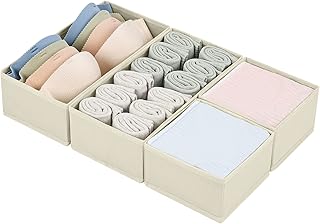
DIMJ Drawer Organizers Clothes, Dresser Organizer Bins for Baby Clothes,Underwear and Sock, Fabric Closet Organization and Storage Boxs, Drawer Dividers for Nursery, Clothing, Tie – 4 Pack, Beige
Best For:
Nurseries, dresser drawers, and anyone needing neat compartments for small garments and accessories.
Drawer clutter is a common source of morning frustration—small organizers can make a surprising difference. DIMJ’s 4-pack of fabric drawer organizers is aimed at corralling small items: underwear, socks, baby clothes, ties, and accessories. Each divider-style bin fits into standard dresser drawers and creates neat compartments so everything stays visible and easily reachable.
The fabric construction offers enough breathability for clothing and is gentler than rigid plastic, which helps avoid snags on delicate textiles. Because they’re foldable, you can remove them for laundering or rearrange when your needs change—handy for growing families or seasonal swaps.
Use cases: organize a nursery dresser with separate bins for onesies, socks, and bibs; keep a teenager’s sock and accessory drawer tidy; create a dedicated drawer for workout gear and undergarments. For people who rotate clothing frequently, drawer organizers reduce the time spent searching and refolding.
Limitations: these are not heavily reinforced boxes, so they work best for lightweight items. If you store denser objects (shoes, heavy linens), you’ll notice less shape retention. Also, if your drawers are unusually deep or narrow, check dimensions—fabric bins sometimes shift around in oversized drawers.
Who it’s best for: parents organizing baby or toddler clothing, people who prefer the look of fabric inside wooden drawers, and anyone who wants to keep small clothing items tidy. Not recommended if you need rigid drawer inserts for heavy items or precise compartment sizing.
Pros: lightweight and breathable; foldable for easy laundering or storage; ideal for small clothing and nursery organization. Cons: limited structure for heavy loads; may shift in oversized drawers without inserts.
Find it on Amazon — Check the latest price on Amazon.
Pros
- Keeps small items visible and separated
- Foldable—easy to remove and wash
- Gentle fabric won’t snag delicate clothing
Cons
- Not rigid—limited for heavy items
- May move around in very deep or wide drawers
Find it on Amazon — Check the latest price on Amazon.
DIMJ Drawer Organizer Clothes, 12 Pack Dresser Organizer, Foldable Closet Organizers and Storage, Fabric Dresser Bins, Drawer Dividers for Nursery, Baby Clothes, Underwears, Sock (Beige)

Best For:
Households and families who want a coordinated, room-wide storage solution across dressers and shelves.
A 12-piece set of fabric organizers is the kind of purchase that sets up a system for an entire room rather than a single drawer. DIMJ’s 12-pack gives you multiple sizes and repeated pieces so you can standardize storage across dressers, closets, and shelves. Having matching bins simplifies maintenance—when everything has a home, tidying takes minutes instead of hours.
This set typically includes small compartments ideal for socks and underwear, medium bins for baby clothes or folded tees, and larger bins for scarves or linens. The fabric is lightweight and breathable, making it a sensible choice for clothing storage, while foldable design allows for compact storage when the units aren’t in use.
Practical scenarios: outfit a a nursery where you need separate bins for different baby items, build a uniform closet shelf system for a matching look, or stock multiple drawers in a family home so each family member has identical compartments. Creative users also repurpose these bins for craft supplies or as travel organizers inside suitcases.
Buying considerations: while a large pack is economical if you plan to outfit several storage areas, consider whether you’ll actually use all pieces—some buyers prefer a mix of drawer organizers and stackable fabric drawers for a layered approach. Adding cardboard or thin plastic inserts can increase structural support if you plan to store heavier items.
Who it’s best for: families, multi-person households, and anyone who prefers a coordinated storage system across multiple drawers and shelves. If you only need one or two organizers, a smaller pack may be a better fit.
Pros: comprehensive set with multiple sizes; consistent, cohesive aesthetic across a room; foldable for off-season storage. Cons: may include pieces you don’t need; fabric needs reinforcement for heavy items.
Find it on Amazon — Check the latest price on Amazon.
Pros
- Large variety of sizes to standardize storage
- Cost-effective way to outfit multiple drawers and shelves
- Neutral look that keeps a uniform aesthetic
Cons
- You may not need all 12 pieces if outfitting a small space
- Not rigid—add inserts for heavier storage needs
Find it on Amazon — Check the latest price on Amazon.
Homsorout Stackable Storage Drawers – Collapsible Storage Bins with Drawers, 4 Pack Closet Shelf Organizer Basket, Fabric Pull Out Organizer for Bedroom, Living Room, Dorm, Beige

Best For:
Renters, dorm rooms, and anyone seeking drawer-style storage without permanent furniture.
If you want the tidy look of drawers without installing furniture, collapsible stackable fabric drawers are an elegant workaround. Homsorout’s 4-pack offers pull-out fabric drawers with a frame that helps them retain shape and glide out like shallow drawers—ideal for shelf-to-shelf systems or inside larger closets.
These units bridge the gap between open bins and solid furniture. They’re particularly useful when you want privacy (closed drawers hide clutter) and easy access (the pull-out front means you don’t have to reach deep into a shelf). The collapsible design makes them easy to store or reposition, and neutral beige keeps the look classic and adaptable.
Real-life uses: create a nightstand substitute by stacking a set beside your bed to hold pajamas and nighttime essentials; use a column of drawers on a closet shelf to store belts, hats, and folded tees; place a set in a dorm room for an instant dresser alternative. Because they act like drawers, the system is helpful for frequently accessed items you want out of sight.
Limitations and considerations: fabric drawers can support moderate weight but aren’t designed for heavy books or dense objects. Over time, fabric can stretch, especially in the front panel; occasional reinforcement with cardboard or a thin base insert helps maintain crisp lines.
Who it’s best for: renters, students, and anyone who wants drawer-like access without heavy furniture. Not suited for those who need load-bearing, long-term shelving for heavy objects.
Pros: pull-out drawer convenience without furniture; stackable and collapsible for flexible setups; hides clutter while keeping items accessible. Cons: limited weight capacity; may need reinforcements to maintain shape under heavy use.
Find it on Amazon — Check the latest price on Amazon.
Pros
- Pull-out drawer function for easy access
- Stackable system creates an instant dresser alternative
- Collapsible for simple storage or relocation
Cons
- Not intended for very heavy items
- Fabric fronts may stretch over time without reinforcement
Find it on Amazon — Check the latest price on Amazon.
Final Verdict
Creating a calm, tidy bedroom comes down to selecting the right tools for your space and habits. Fabric organizers—bins, drawer dividers, stackable drawers, and cascade hangers—offer an adaptable, low-impact way to create order without buying heavy furniture. They’re breathable, lightweight, and often collapsible, which suits renters, students, and anyone who moves frequently.
If you want maximum hanging capacity with minimal fuss, the AMKUFO magic hangers add vertical storage in seconds. For open shelves, the Homsorout trapezoid bins keep a neat, curated look while remaining collapsible for off-season storage. DIMJ’s drawer organizers (both the 4-pack and 12-pack) are practical when you need consistent compartmentalization across dressers and nurseries. And if you like the idea of drawers without the commitment, Homsorout’s stackable fabric drawers give you pull-out access and a neater silhouette.
Before buying: measure your spaces, think about weight and frequency of access, and mix open bins with drawer solutions for a balanced system. If sustainability and reduced clutter are priorities, invest in neutral, durable fabric pieces that can be reused and rearranged for years.
Whether you’re outfitting a tiny dorm closet or streamlining a master bedroom, these options provide flexible, practical ways to tidy your space. Check the latest price on Amazon.
Conclusion
These Sustainable organizers creators use for tidy bedroom setups picks are trending now and offer great value and variety. Check the links above for latest prices and reviews.
As an Amazon Associate, I earn from qualifying purchases.
Tags:
bedroom organizers, sustainable storage, closet organization, space-saving solutions, fabric bins, drawer organizers, dorm storage
