Top Middle School Science Workbooks Reviewed
As an Amazon Associate, I earn from qualifying purchases. This article may contain affiliate links, which means we may receive a commission at no extra cost to you.
As students move through middle school, science shifts from simple facts to bigger concepts and skills: analyzing data, designing experiments, and connecting ideas across biology, chemistry, and earth science. Choosing the right workbook can make that transition smoother—helping students build confidence, reinforcing classroom lessons, and offering targeted practice for tricky topics. Whether you’re a homeschool parent, a teacher looking for supplemental materials, or a student trying to bring up a grade, the right workbook should feel like a guide: structured, approachable, and practical.
This guide focuses on five standout titles that cover core middle school needs—from focused units on states of matter to hands-on forensic investigations and broad review guides. I researched curricula alignment, page design, activity types, and real customer feedback to highlight who each book serves best and what to expect in daily use. Below you’ll find a buying guide to help match the workbook to your goals, followed by in-depth descriptions, realistic classroom and at-home use cases, and clear pros and cons to simplify picking the best fit.
Buying Guide
What to look for in a middle school science workbook
Grade alignment and scope: Middle school spans grades 6–8, but student ability varies. Look at the listed grade range and scan the table of contents. A good workbook shows the breadth (units on cells, matter, forces, ecosystems) and depth (explanations, diagrams, progressive problems). If you need remediation or enrichment, choose a title with leveled exercises or extension activities.
Standards and curriculum fit: Many workbooks indicate alignment with state standards or NGSS. That’s helpful for teachers and homeschoolers who want direct reinforcement of classroom topics. If the book doesn’t claim alignment, check that it covers the key concepts your student is studying.
Types of activities: Middle school learners benefit from a mix—fill-in-the-blank and multiple choice for recall, short answers for reasoning, and open-ended labs or investigations for application. Workbooks that include mini-labs, data analysis, or case studies help develop inquiry skills rather than rote memorization.
Answer keys and teacher support: An answer key is essential for independent learners and parents. Bonus features—graded rubrics, assessment pages, teacher notes, or reproducible worksheets—make a workbook more classroom-friendly.
Visuals and layout: Clear diagrams, labeled illustrations, and page layouts that chunk information reduce cognitive load. Look for bold headings, summary boxes, and practice sets at the end of each unit.
Durability and extras: If the book will be passed between students, a durable softcover and quality printing matter. Extras such as online resources, reproducible pages, or suggested experiments add long-term value.
Price considerations: Workbooks range from single-topic practice books to comprehensive review guides. If you need to strengthen one topic (e.g., states of matter), a focused workbook is cost-efficient. For end-of-year review, a comprehensive guide might be better value.
Who should buy which style: Choose focused workbooks for targeted remediation, case-based or lab-style books for hands-on learners, and big review guides for students preparing for exams or wanting a single reference. The five titles below represent a mix of those approaches so you can pick what matches your goals.
Changes in States of Matter Physical Science Workbook Middle School: Homeschool Science Workbook for Kids 8-12, Science Workbook Grade 7, Science … for Matter (Middle School Science Workbooks)

Best For:
Students needing focused practice on states of matter; homeschool parents and teachers wanting a short, standards-focused unit.
If your student is grappling with solids, liquids, gases, and the behavior of matter, this focused workbook tackles those topics in a clear, step-by-step way. The Changes in States of Matter workbook is designed for upper-elementary to middle school learners who need concentrated practice on one core idea: how matter changes state and why. The e-book and print layouts for similar titles typically include short lessons followed by practice sets, progressively moving from basic vocabulary and definitions to data interpretation and simple lab observations.
What sets a single-topic workbook apart is depth without distraction. Rather than skimming many topics, it digs into molecular explanations, phase diagrams, energy transfers, and real-life examples such as melting points, condensation processes, and the role of pressure. Pages are usually formatted with quick-read sections, labeled diagrams to support visual learners, and a variety of exercises—matching, multiple choice, short written responses, and applied problems that ask students to analyze experimental results or predict outcomes.
Real-life classroom use: Teachers can use individual units as a two-week module—introduce concepts with short reading pages, conduct a simple hands-on demo (ice melting, boiling water at different pressures), and assign workbook practice as formative assessment. Homeschool parents will appreciate the straightforward sequencing: lesson, practice, check answers. The workbook often includes an answer key or quick-check section so parents can monitor progress without becoming a science expert.
Why it’s valuable: Focused workbooks like this one are efficient for remediation, test prep, or targeted enrichment. For students who struggle when multiple new topics are introduced simultaneously, the deep-dive approach helps build mastery. Compared with broad review books, this title saves time and reduces cognitive overload by concentrating on one measurable set of standards.
Who should buy it: Ideal for homeschool families, intervention groups, and students preparing for a unit test on matter. It’s also useful as a supplement in classrooms that need extra practice pages or take-home assignments. Those who want cross-disciplinary projects (e.g., extended labs or interdisciplinary STEM challenges) might prefer a workbook with more hands-on labs or a companion teacher’s guide.
Practical observations: Look for clear labeling of skills, a simple answer key, and practical lab suggestions that use household items. If your child responds well to visuals and bite-sized lessons, this focused workbook will likely produce measurable improvement.
CTA: Interested in dedicated practice on states of matter? Find more details and pick up a copy on Amazon.
Pros
- Deep dive into a single, commonly challenging topic
- Clear diagrams and progressive practice sets
- Ideal for targeted remediation or short unit modules
Cons
- Narrow scope—covers one topic rather than broader science concepts
- May need supplemental hands-on lab materials for full inquiry experiences
Find more details and pick up a copy on Amazon.
Mark Twain Forensic Investigations Workbook, Using Science to Solve High Crimes Middle School Books, Critical Thinking for Kids, DNA and Handwriting Analysis Labs, Classroom or Homeschool Curriculum

Best For:
Students who enjoy hands-on, investigative learning and teachers seeking project-based supplemental materials.
Mark Twain’s Forensic Investigations workbook brings applied science to life with case-based learning. Rather than a conventional chapter-by-chapter workbook, this title frames lessons as mini-investigations: students analyze evidence, interpret results, and apply science concepts—often spanning biology, chemistry, and observational skills. It’s an engaging bridge between textbook learning and real-world application that appeals to curious middle schoolers who prefer puzzles and mysteries.
The content covers practical labs like fingerprinting, handwriting analysis, and basic DNA concepts explained at an age-appropriate level. Each case walks students through collecting observations, forming hypotheses, comparing data, and explaining conclusions. The activity structure encourages critical thinking and builds scientific habits: asking testable questions, controlling variables, and communicating findings. The mix of reading passages, guided lab sheets, and reflection questions supports both visual and kinesthetic learners.
Classroom and homeschool use: Teachers often use this book for short units, enrichment centers, or as a supplemental project-based option. A week-long forensic unit can include introductory lessons on observation and measurement, hands-on lab stations (fingerprinting, chromatography strips for ink separation), and culminating case reports where students defend their conclusions. For homeschool families, the book provides ready-made labs and a narrative structure that keeps students motivated.
Why it’s valuable: Where standard workbooks focus on repetition of facts, forensic-style activities cultivate reasoning and transferable skills. Students practice evidence-based thinking in ways that exams don’t always capture—skills that benefit science fairs, debate teams, and STEM clubs. Compared to purely workbook-style practice, forensic investigations are more memorable and often lead to higher engagement.
Who should buy it: Choose this workbook if your student is interested in applied science, enjoys mysteries, or needs activities that encourage higher-order thinking. It’s excellent for teachers who want project-based learning without creating their own materials. If you need a comprehensive review resource covering all middle school science topics, this book is better as a supplement rather than a standalone curriculum.
Practical observations: Look for reproducible lab sheets, clear safety notes, and suggestions for low-cost materials. Many educators praise its ability to hook reluctant learners; parents report students completing extra activities because they enjoyed the investigative format.
CTA: Want to spark curiosity with real investigations? Check the book’s details and order through Amazon.
Pros
- Engaging case-based format that teaches scientific reasoning
- Hands-on labs using low-cost materials
- Great for enrichment, clubs, or cross-curricular projects
Cons
- Not a comprehensive curriculum—best used as a supplement
- Some labs require supervision and extra materials
Check the book’s details and order through Amazon.
Carson Dellosa The 100 Series: Biology Workbook—Grades 6-12 Science, Matter, Atoms, Cells, Genetics, Elements, Bonds, Classroom or Homeschool Curriculum (128 pgs)

Best For:
Teachers needing quick, reusable practice pages and parents wanting short daily lessons for middle school biology.
The Carson Dellosa 100 Series Biology workbook is designed as a concise, high-utility resource for grades 6–12—useful for middle school students who need a compact review or extra practice. At roughly 128 pages, it hits core biology topics such as cells, genetics, classification, and basic ecology with straightforward explanations, clear diagrams, and short practice sets. Its concise format makes it popular in classrooms for fast reinforcement and as a take-home review for absent students.
Unlike large comprehensive textbooks, this workbook emphasizes repeated practice. Each page typically contains a small lesson followed by several targeted problems—perfect for daily bellwork, homework, or quick formative checks. The “100 Series” approach is deliberate: concise, repeatable practice that can be completed in short time blocks. Teachers appreciate how easily pages can be assigned without requiring long lesson planning.
Use cases: In the classroom, use these pages for morning work, station rotations, or quick quizzes. Homeschoolers will find them convenient for short daily lessons—20–30 minutes of focused study that builds retention over weeks. For remediation, the workbook’s bite-sized sections allow focus on trouble spots like cell structure or Mendelian genetics without overwhelming the student.
Why it’s valuable: The strength of this workbook lies in its manageability. Many parents and teachers report that students are more willing to complete short pages regularly, leading to steady improvement. Compared with sprawling study guides, the Carson Dellosa format is less intimidating and easier to integrate into busy schedules.
Who should buy it: Best for teachers looking for reproducible, short practice pages and parents who want a compact resource for daily study. It’s also suitable for students preparing for chapter quizzes who need focused practice rather than broad review.
Practical observations: Check whether the edition includes an answer key; some classroom buyers appreciate teacher editions with reproducible pages. If you need in-depth labs or extended reading, pair this workbook with a lab manual or a more comprehensive reference.
CTA: Need concise, repeatable biology practice? See current details and order on Amazon.
Pros
- Compact, manageable pages ideal for daily practice
- Covers essential biology topics without overwhelming detail
- Easy to integrate into classroom routines or homeschool schedules
Cons
- Limited depth—not a substitute for full-length textbooks or lab manuals
- Some editions may not include a full answer key
See current details and order on Amazon.
Everything You Need to Ace Science in One Big Fat Notebook: The Complete Middle School Study Guide

Best For:
Students who need a concise, visual study companion for middle school science and parents seeking a single-reference guide.
The Big Fat Notebook series is built around a student-friendly study-first approach: clear summaries, visual notes, memory tricks, and practice questions that condense an entire subject into a single reference. Everything You Need to Ace Science compiles key middle school science concepts—life science, physical science, and earth science—into an illustrated, conversational format that’s both approachable and fun to read.
Rather than a strict workbook with repetitive drill, this guide blends explanation with quick checks, margin notes, and doodle-style diagrams that make complex ideas easier to remember. It’s especially useful as a semester-long companion: students can use it to review before quizzes, look up facts while doing homework, or study for end-of-year assessments. The layout emphasizes study strategies—how to summarize, how to recognize important facts, and how to connect ideas across topics.
Use cases: In study halls and at-home review sessions, the Big Fat Notebook functions like an interactive cheat sheet: students flip to a topic, read a short summary, then practice with the accompanying quick questions. For teachers, the book is a great resource to recommend to students who need an alternative explanation or a visual rephrasing of classroom lectures. Homeschoolers can use it as a main reference alongside hands-on experiments to provide context and reinforce concepts.
Why it’s valuable: It’s a versatile all-in-one study tool that reduces the need for multiple reference books. Compared to typical workbooks that prioritize repetition, the Big Fat Notebook is designed to build understanding and recall through visual learning and structured summaries. Many students report that the series makes studying less intimidating and more effective.
Who should buy it: Ideal for students who prefer visual summaries and study aids, those who need a single go-to reference, and parents looking for a supportive study companion. If you want rigorous, page-by-page practice problems, you might pair this book with a dedicated workbook to get more exercises.
Practical observations: The conversational tone and bold visuals are great for reluctant readers. For advanced learners looking for college-prep depth, this is more of a refresher than a deep dive.
CTA: Want a single, student-friendly study guide for middle school science? Check it out on Amazon.
Pros
- Comprehensive, student-friendly summaries across science topics
- Visual aids and study tips that boost retention
- Great as a single reference for homework and test prep
Cons
- Less practice-driven than dedicated workbooks
- Not a substitute for hands-on lab experience
Check it out on Amazon.
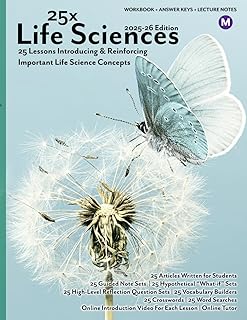
25x: Life Sciences – Middle School – 25 Mini-Lessons To Introduce, Reinforce, and Highlight the Importance of Life Science Topics: 25 Articles, 25 … (25x High & Middle School Science Series)
Best For:
Teachers needing low-prep, ready-to-use mini-lessons and homeschoolers seeking short, focused life science readings.
This collection of 25 mini-lessons is built for teachers and busy parents who need short, ready-to-use lessons that introduce or reinforce life science topics. Each mini-lesson typically includes a short article, discussion prompts, and quick activities—designed to fit into a single class period or a focused homework session. The format is well-suited to bellwork, warm-ups, enrichment packets, or independent reading assignments.
The book’s strength is accessibility: concise, well-written articles cover a range of life science themes—cells, ecosystems, genetics, evolution, and human body systems—without overwhelming students. Because each lesson is compact, teachers can easily mix and match topics to fill gaps in a pacing guide or provide supplemental reading for struggling students. The content encourages literacy in science by combining short expository passages with vocabulary checks and brief comprehension questions.
Use cases: In classrooms, these mini-lessons are perfect for starter activities, quick review days, or substitute plans. Homeschool parents can use them to break up longer projects or provide a steady stream of short science readings. The format also works well for flipped-classroom strategies—students read a mini-lesson at home, then complete a short lab or discussion in class.
Why it’s valuable: Compared with full-length workbooks, mini-lesson collections save prep time and provide flexible insertions into any curriculum. They’re especially helpful for building reading comprehension in science and for students who benefit from short, focused exposures rather than long units.
Who should buy it: Teachers needing low-prep supplemental content, homeschooling families who want short lesson bursts, and students who need reading-based reinforcement. If you prefer extensive practice problems or long-form labs, you’ll likely pair this collection with a workbook that offers more exercises.
Practical observations: Look for reproducible formats or printable versions if you plan to distribute copies. Feedback from educators often highlights how useful these lessons are for quick differentiation and filling coverage gaps.
CTA: Want quick, classroom-ready life science lessons? View the listing and purchase on Amazon.
Pros
- Short, flexible lessons ideal for bellwork or supplements
- Builds science literacy and comprehension
- Easy to integrate into varied pacing guides
Cons
- Limited practice problems—best paired with a workbook
- Not a replacement for hands-on labs or extended projects
View the listing and purchase on Amazon.
Final Verdict
Choosing the right middle school science workbook depends on your goal. If you need targeted practice on one subject—like states of matter—the focused Changes in States of Matter workbook offers depth without distractions. For students who learn by doing and enjoy puzzles, the Mark Twain Forensic Investigations workbook brings scientific reasoning to life with practical labs and case studies. Teachers and parents who want short, daily practice will appreciate the Carson Dellosa 100 Series for its bite-sized pages. If you prefer a single, friendly study reference that helps with homework and review, Everything You Need to Ace Science in One Big Fat Notebook is a versatile choice. And if you need low-prep, reading-based materials to fill gaps or start class discussions, the 25x Life Sciences mini-lessons are a time-saving fit.
In practice, many households and classrooms benefit from a combination: use a Big Fat Notebook or the Carson Dellosa series as a reference and daily practice tool, supplement with focused workbooks for remediation, and add investigative or mini-lesson titles to boost engagement and critical thinking. Consider your student’s learning style—visual, hands-on, or repetition-based—and pick the primary resource that matches that style. Then add one supplemental title to cover labs or reading practice.
Whichever you choose, these selections represent practical, classroom-tested approaches to strengthening middle school science skills. Check the latest price on Amazon.
Conclusion
These Best Educational Science Workbooks for Middle School picks are trending now and offer great value and variety. Check the links above for latest prices and reviews.
As an Amazon Associate, I earn from qualifying purchases.
Tags:
middle school science workbooks, homeschool science, middle school biology workbook, science practice books, forensic science for kids, science study guide, life science mini-lessons
