Best Educational Daily Routine Charts for Kids
As an Amazon Associate, I earn from qualifying purchases. This article may contain affiliate links, which means we may receive a commission at no extra cost to you.
As an Amazon Associate, I earn from qualifying purchases. This article may contain affiliate links, which means we may receive a commission at no extra cost to you.
Helping young children learn daily habits is one of the most practical gifts you can give a family. Daily routine charts turn abstract expectations into visible steps—brush teeth, get dressed, pack a backpack—making mornings less frantic and evenings more predictable. In this long-form buyer’s guide, I look at five of the best educational daily routine charts available for preschoolers and early elementary kids. Each pick focuses on teaching independence through visual cues, tactile interaction, or reward-based motivation. You’ll get clear pros and cons, realistic use cases, and buying considerations so you can match a chart to your child’s age, learning style, and family routine.
Buying Guide
Why use a routine chart? Young children think in pictures and sequences. A good routine chart reduces verbal nagging, provides consistent expectations, and helps kids internalize habits through repetition. When shopping, consider three core questions: is the chart age-appropriate and engaging, does it match your home’s workflow, and will you realistically use the features (magnets, stickers, sliding indicators) every day?
Types of charts and how they help:
– Wooden tactile charts: Durable and tactile boards encourage hands-on interaction. They’re great for younger toddlers who need concrete pieces to move and attach.
– Magnetic or dry-erase boards: Flexible and reusable; ideal for families who change routines often or want to write notes like “bring instrument tonight.”
– Card-based visual schedules: Good for special needs and autism-friendly planning because they allow clear sequencing and personalization.
– Sliding or checklist charts: Simple visual progress markers that give immediate satisfaction and are especially helpful with ADHD or kids who need short-term goals.
Key features to evaluate:
– Visual clarity: Are icons large and self-explanatory? Do stickers or cards reflect your child’s routine realistically (bath, pajamas, teeth, story)?
– Durability and materials: Wooden charts last longer, magnetic boards resist stains, and laminated cards are easy to clean.
– Customizability: Can you rearrange days or swap tasks? Multi-lingual or blank sticker sheets are valuable for bilingual households.
– Reward systems: Built-in reward slots or token systems convert daily compliance into measurable progress without over-relying on candy or screen time.
Who benefits most: Parents of preschoolers (ages 2–6), caregivers working with routine development, teachers setting classroom schedules, and families supporting neurodiverse children. Who might not need one: older kids who already manage their own routines or households that prefer purely verbal systems.
Practical buying considerations:
– Wall space versus portable options: A wall-mounted board anchors a routine while a portable magnetic chart travels to grandparents’ houses.
– Setup time: Choose a product you’ll actually set up—tiny pieces or complex systems discourage follow-through.
– Age labeling: Some charts advertise ages 3+, but consider skill level rather than strict age.
Below are five picks that cover tactile learning, visual schedules, Montessori-style boards, and budget-friendly sliding systems. Each section includes real-life usage scenarios and who should pick it.
Melissa & Doug My Daily Routines Chart, Wooden Daytime and Nighttime Habit Tracker with Multi-Lingual Stickers, Hands-On, Screen-Free Preschool Toys for Girls & Boys Ages 3+ – FSC Certified

Best For:
Families who want a durable, tactile, and screen-free routine board for preschoolers (ages 3–6) that doubles as an educational toy.
This Melissa & Doug wooden routine chart is a classic tactile solution for families who prefer screen-free, hands-on learning. The board is divided into daytime and nighttime columns and includes a set of multilingual stickers to label common tasks—brush teeth, get dressed, tidy toys—with simple pictograms that preschoolers can easily recognize. The wooden construction feels sturdy and intentional; it’s FSC certified, which appeals to buyers who prioritize sustainably sourced materials.
What makes this chart stand out is its combination of durability and simplicity. The magnetic or peg-style tokens (depending on the edition) encourage little hands to take ownership of their routine. Instead of erasing or rewriting tasks, kids physically move a marker or attach a sticker, which creates a satisfying, repeatable ritual. Many reviewers note that the visual split between morning and night helps reduce bedtime resistance, as children can see when story time or teeth brushing is expected.
Real-life use cases: This board works well in a dedicated morning nook, near a child’s bedroom door, or by the bathroom. For families who share caregiving responsibilities, the multi-lingual stickers allow both parents and grandparents to use icons in the language that best suits the child. It’s particularly useful for ages 3–6, where fine motor skills are developing and children respond well to tactile play. In daycare or preschool settings, it can anchor a group’s daily flow without relying on screens.
Buying considerations and comparatives: Compared with wipe-clean magnetic boards, the wooden chart prioritizes longevity and aesthetic appeal but offers less flexibility for last-minute changes. If you need a chart that you can update daily with written notes (e.g., dentist appointment today), a dry-erase alternative might be preferable. However, for families focused on habit-building through consistent, repetitive action, the wooden board encourages routine ownership.
Who should buy this: Parents who want a durable, attractive chart that feels like a toy and supports independent habit-building in preschoolers. Who may not need it: families wanting highly customizable, writable boards or parents of older children who don’t rely on pictorial cues.
Practical observations: The stickers are a highlight but can be small—reserve a box of backup stickers if you plan to reuse the board frequently. The mount or stand should be positioned at eye level for the child to promote independent use.
Check the latest price on Amazon.
Pros
- Sturdy FSC-certified wooden construction
- Clear daytime/nighttime layout with pictograms
- Hands-on interaction encourages independence
Cons
- Less flexible than writable magnetic/dry-erase boards
- Stickers may wear with heavy reuse
Check the latest price on Amazon.
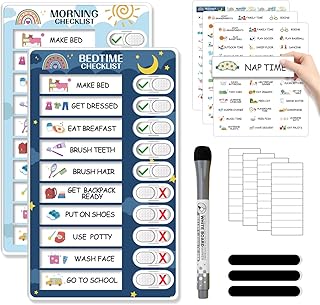
2 in 1 Bedtime/Morning Routine Chart for Kids Toddlers, Magnetic Chore Chart for Kids, Cute Visual Schedule for Kids Schedule Board for Home, Kids Checklist to Do List ADHD Tools for Kids
Best For:
Parents needing a flexible, portable magnetic chart for shifting routines, travel, or multi-caregiver households.
This 2-in-1 magnetic routine chart is designed for flexibility and frequent updating. With separate morning and bedtime sections, the chart uses colorful magnetic icons and a checklist layout that parents can rearrange as needed. The magnetic system is particularly handy for busy families who shift schedules—sports practice, dentist appointments, or weekend variations—because tasks can be moved without damaging the board.
The board’s bright visuals are appealing to toddlers and young kids, and it includes multiple magnets representing common actions: brush, dress, eat, potty, and story. For children with ADHD or those who need tangible progress markers, the act of moving a magnet from “to-do” to “done” supplies immediate reinforcement. Reviewers often praise the portability: the magnetic tiles can be taken to grandparents’ houses or placed on stainless-steel surfaces like refrigerators.
Real-life use cases: Stick this chart on the fridge for breakfast and backpack prep, or mount it near the bathroom for toothbrushing and hair combing routines. It’s a good pick for blended households where routines change across caregivers, because the magnets are easy to swap and re-order. For children who resist bedtime, the separate nighttime column visually cues the shrinking list of tasks before lights-out.
Buying considerations and comparatives: Compared to wooden tactile charts, this magnetic option wins on customizability and portability. However, magnetic pieces can be lost if not monitored, and very young toddlers may be tempted to put small magnets in their mouths—supervision and a secure storage solution are important. If you prefer a visually elegant, long-lasting item for a nursery or child’s room, a wooden board might be more decor-friendly.
Who should buy this: Families who need a flexible, portable routine system—especially those managing variable schedules or who travel between homes. Ideal for toddlers to early school-age kids, and helpful for ADHD management strategies.
Practical observations: Keep spare magnets in a labeled pouch to maintain set integrity. Use the magnetic board alongside verbal prompts for the first few weeks until routines stick.
Check the latest price on Amazon.
Pros
- Highly customizable with rearrangeable magnetic pieces
- Portable and fridge-friendly
- Separate day/night sections for clear sequencing
Cons
- Magnets can be lost or pose a small-choking risk for very young children
- May feel less premium than wooden designs
Check the latest price on Amazon.
Large Visual Schedule for Kids Chore Reward Chart,Bedtime Routine Chart for Toddlers,Double Side Weekly Planner Board with 109 Cards for Home School Planner,Autism Learning Materials.

Best For:
Families, homeschoolers, and educators seeking a large, detailed visual planner with many cards and a reward system—excellent for autism-friendly routines.
This large double-sided visual schedule is built for families who want a comprehensive, classroom-style approach. One side acts as a weekly planner while the other functions as a daily routine and reward center. The kit usually includes a wide selection of cards—often more than a hundred—covering chores, self-care tasks, school-related items, and reward tokens. That breadth makes it an excellent option for homeschooling parents or caregivers working with children who benefit from granular step-by-step instructions.
The board’s large size and card-driven interface make sequencing and planning straightforward. For children on the autism spectrum or those who thrive on consistent visual structure, the ability to lay out an entire day or week and attach reward tokens creates a clear, low-conflict system for behavior and transition management. Teachers and therapists appreciate that the cards can be reused and organized into categories, which supports predictable routines across environments.
Real-life use cases: Mount the board in a central family space to plan school mornings, afternoon homework, and evening wind-down routines. Use the weekly planner side to map extracurriculars and meal prep needs, while the daily side helps younger children complete a stepwise morning or bedtime routine. The reward tokens can be earned and banked for larger privileges—a powerful tool for shaping behavior over time.
Buying considerations and comparatives: Compared with compact magnetic charts or wooden boards, this large schedule is more of a household command center. It’s terrific when you want a single, visible source of truth for multiple children or tasks, but it can feel overwhelming if you only need a simple morning checklist. The quality of cards and how they attach (velcro, magnetic, or slot-in) is important—choose a model with sturdy fastenings suited to frequent handling.
Who should buy this: Parents, homeschoolers, or educators who need a robust, multi-day planning tool that supports detailed routines and reward systems. Also well-suited for children with autism who benefit from explicit visual structure.
Practical observations: Plan a short orientation session with your child—show them how to move cards and earn tokens. Keep duplicate favorites in a safe pouch so you can quickly replace any lost pieces.
Check the latest price on Amazon.
Pros
- Comprehensive kit with many cards for varied tasks
- Double-sided layout supports daily and weekly planning
- Strong choice for structured, autism-friendly routines
Cons
- Large format may be overkill for simple morning checklists
- Requires careful storage to avoid losing many small cards
Check the latest price on Amazon.
Wooden Toddler Routine Chart Ages 3-6 – Daily & Bedtime Routine Chart for Toddlers, Visual Schedule Board for Kids, Montessori-Inspired Visual Schedule for Kids Daily Routine

Best For:
Families and caregivers who favor Montessori-style learning and want a low-stimulation, attractive routine chart for ages 3–6.
This Montessori-inspired wooden routine chart focuses on simplicity and independence. Typical to the Montessori approach, the design emphasizes realistic illustrations and a straightforward sequence of tasks that young children can follow without excessive coloring or cartooning. The materials are usually natural wood and laminated cards or tokens, giving the chart a calm, intentional aesthetic that blends well in bedrooms and playrooms.
The structure of the board supports learning through repetition and self-correction. Children aged 3–6 can move picture cards from a “to-do” rail to a “done” slot, cultivating a sense of accomplishment without needing adult praise for every step. The visual cues are deliberately minimal—this is helpful for kids who become overstimulated by flashier designs or for parents who prefer a less commercial look.
Real-life use cases: Best placed at child height in a bedroom or dressing area, the chart helps kids practice morning prep (wash, dress, eat) and bedtime rituals (pajamas, teeth, books). It’s a solid pick for Montessori households or parents who want their home environment to reflect a learning philosophy that prizes independence and flow. It also works well in small group childcare settings where calm, consistent cues matter.
Buying considerations and comparatives: Compared to the Melissa & Doug board, this Montessori variant trades playful stickers for restrained visuals and a strong focus on independence. It may not appeal to children drawn to bright colors or novelty pieces, but it excels at reducing distraction and fostering routine mastery. If you want a chart that looks like part of your home decor and subtly teaches sequencing, this is a strong option.
Who should buy this: Parents following Montessori principles, caregivers who want low-stimulation visuals, and families wanting a beautiful, long-lasting routine tool for preschoolers.
Practical observations: Because the design is understated, invest time in introducing the chart through modeling—walk through each step together for several days until the child internalizes the sequence.
Check the latest price on Amazon.
Pros
- Calm, Montessori-inspired visuals support independent learning
- Durable wooden construction with child-height accessibility
- Encourages self-directed completion of tasks
Cons
- Less visually stimulating for children who want bright, playful designs
- May require more initial adult coaching to establish use
Check the latest price on Amazon.
Aleric 4 Pieces Chores Chart for Kids Chore Chart, Sliding Routine Chart to Do List, My Chores RV Checklist Task Planning Board for Kids and Adults, ADHD Tools Routine Visual Schedule Reminder

Best For:
Small-space households, RV travelers, and parents seeking a compact, low-maintenance routine tracker—good for ADHD-friendly binary feedback systems.
The Aleric sliding routine chart is a compact, low-tech system that uses sliding panels to mark progress through a set of tasks. Because it’s made from several slim boards, it’s also easy to mount in tight spaces like RV kitchens, small apartments, or beside a bunk bed. The sliding mechanism gives immediate visual feedback—slide a tab from left to right to indicate completion—making it especially effective for kids who need clear, binary feedback for each step.
This chart is marketed as an ADHD tool and a compact chore tracker, and many parents appreciate its straightforward mechanics: no magnets to lose and no small stickers to peel. The sliding strips usually have pictorial cues for common chores and routines, making them intuitive for younger children. For older kids or adults, the boards can be repurposed as a minimalist to-do list or packing checklist.
Real-life use cases: Use this board in transitional spaces where you want to minimize clutter—entryways for shoe and coat routines, bathrooms for morning hygiene steps, or in travel setups like RVs and camper vans. The lightweight design is perfect for families who move between spaces frequently or who prefer a tidy, low-profile routine tool.
Buying considerations and comparatives: Compared to larger magnetic or card-based systems, the Aleric sliding charts are simpler and less customizable, but they win for portability and clarity. If you need a reward system or many interchangeable tasks, a larger card kit might be better. For small spaces or quick daily checklists, sliding strips hit a sweet spot.
Who should buy this: Families living in small spaces, RV owners, or anyone who needs a compact, durable routine tracker. Also a good option for kids who benefit from binary, tactile feedback and minimal maintenance.
Practical observations: Mount the boards at the child’s eye level and consider combining with a small token jar for earned treats. Because the system is simple, it’s especially effective when paired with consistent verbal cues during the first weeks of use.
Check the latest price on Amazon.
Pros
- Compact, low-profile sliding design
- No small magnets or peel-off stickers to lose
- Works well in tight or mobile spaces (RVs, apartments)
Cons
- Less customizable than large card-based planners
- Limited number of tasks per board
Check the latest price on Amazon.
Final Verdict
Choosing the right routine chart depends as much on your family’s daily life as it does on the product’s features. If you want a durable, toy-like solution that looks polished, the Melissa & Doug wooden chart is a reliable classic. For families needing portability and frequent changes, the magnetic 2-in-1 board offers flexible, fridge-friendly organization. If you need an all-in-one household command center or a classroom-style planner, the large double-sided visual schedule with 109 cards gives you breadth and structure. Montessori households will appreciate the understated, child-led design of the wooden Montessori chart, while small-space families and RV travelers will love the Aleric sliding charts for their compact, no-fuss functionality.
No single chart will solve every morning or bedtime struggle overnight, but these tools reduce stress by turning routines into visible, achievable steps. Pair any chart with consistent modeling, short daily reminders, and small rewards for effort (not perfection). If you’re unsure where to start, pick a system that matches your top constraint—space, customizability, or durability—and introduce it with a calm, short coaching period.
As an Amazon Associate, I earn from qualifying purchases. This article may contain affiliate links, which means we may receive a commission at no extra cost to you.
Check the latest price on Amazon.
Conclusion
These Best Educational Daily Routine Charts picks are trending now and offer great value and variety. Check the links above for latest prices and reviews.
As an Amazon Associate, I earn from qualifying purchases.
Tags:
daily routine chart, kids chore chart, visual schedule for kids, magnetic routine chart, Montessori routine board, ADHD tools for kids, bedtime routine chart
