Best Educational Storytelling Games for Kids & Families
As an Amazon Associate, I earn from qualifying purchases. This article may contain affiliate links, which means we may receive a commission at no extra cost to you.
Storytelling games are a wonderful bridge between imagination and practical learning. They combine language development, social skills, memory, and creativity into sessions that feel more like play than study. Whether you’re a parent looking for screen-free activities, a teacher building classroom literacy centers, or a family seeking richer dinner-table conversation, the right storytelling game can transform how children and adults practice vocabulary, narrative structure, and emotional expression. This guide collects top-rated options—card sets, domino-style prompts, sight-word tools, and family conversation packs—that work across ages from preschoolers through teens. I’ve drawn on product specs, educator recommendations, and user feedback to highlight how each title performs in real home and classroom settings.
Buying Guide
Choosing a storytelling game depends on age, learning goals, and the context you’ll use it in. For preschoolers and early readers, tactile and image-driven pieces help build word recognition and sequencing. Look for products that include clear visuals, chunky pieces that stand up to little hands, and gameplay that reinforces matching or repetition—these features help with early language acquisition and attention span. For school-age children, consider tools that introduce character, setting, and plot prompts to support creative writing and oral storytelling. Games with sight-word or vocabulary focus are especially useful for emergent readers who need repeated exposure in playful contexts. Social-emotional learning (SEL) prompts, reflective conversation cards, or cooperative mechanics are valuable for family and therapy settings where communication and empathy are goals. Practical considerations: check recommended age ranges, the number of prompts or cards (more variety extends replay value), portability for travel, and whether the set requires reading or can be used with nonreaders. If you’re a teacher, durability and multi-player flexibility matter more; if you’re a parent, look for short play cycles that fit between chores or during car rides. Finally, compare these storytelling tools with standard alternatives like blank journals, basic flashcards, or digital apps: card and tile games encourage face-to-face interaction and spontaneity in ways a screen or worksheet rarely does. Below are five carefully selected products that cover early literacy, imaginative play, family conversation, and creative writing.
ThinkFun Zingo Bingo Award Winning Preschool Game for Pre-Readers and Early Readers Age 4 and Up – One of the Most Popular Board Games for Boys and Girls and their Parents (97700)

Best For:
Preschoolers and early readers (ages 4+), parents, preschool teachers, speech therapists
ThinkFun Zingo Bingo is a tactile, fast-paced matching game that was designed for pre-readers and early readers who are building vocabulary and visual recognition. Instead of traditional bingo numbers, Zingo uses illustrated tiles that slide out of a chunky, easy-to-use Zinger device. Players match picture tiles to cards, practicing object and word recognition in a low-pressure, playful way. The rules are simple—slide to reveal tiles, call out what you see, and try to complete a row—but the setup encourages social interaction, turn-taking, and quick visual scanning. Many educators and parents appreciate that Zingo’s format scales with ability: nonreaders can match pictures, while early readers can focus on the printed words beneath many tiles. This dual approach supports differentiated play when siblings of different ages are playing together.
Practical use cases are plentiful. In a preschool classroom Zingo works well as a literacy center activity where multiple children rotate through short games; for home use it’s a popular choice for rainy afternoons or as a calm alternative to screens. It’s also handy for speech therapists and literacy coaches who need an engaging way to present vocabulary or practice nouns and sight words in short, repeatable sessions. Compared with basic flashcards, Zingo’s game mechanics add urgency and excitement, which helps children stay engaged longer and reinforces learning through repetition.
Buying considerations: the physical tiles and the Zinger mechanism are designed for small hands, but families should supervise younger players to keep tiles together. If you’re seeking a portable storytelling tool, this is better for short tabletop sessions than on-the-go play. Overall, Zingo Bingo is best for parents and educators who want a playful, proven way to move children from picture recognition toward confident early reading.
Pros
- Tactile, child-friendly components ideal for small hands
- Supports both picture matching and early word recognition
- Fast rounds keep attention and encourage repeat play
Cons
- Not designed for long-form storytelling or older kids
- Tiles can be misplaced if not stored carefully
Find it on Amazon here: https://www.amazon.com/dp/B01DY818JG?tag=theideaofart-20 — Check the latest price on Amazon.
ThinkFun Zingo Sight Words Award Winning Early Reading Game for Pre-K to 2nd Grade – Toy of the Year Finalist, A Fun and Educational Game Developed by Educators for Boys and Girls

Best For:
Emergent readers (Pre-K to Grade 2), reading specialists, ESL learners, homeschoolers
ThinkFun Zingo Sight Words adapts the original Zingo mechanics for early reading practice by introducing high-frequency words and sight vocabulary. The set replaces or supplements picture tiles with word tiles that help children recognize common sight words quickly—a core skill for becoming a fluent reader. The approachable game format reduces the anxiety many young learners feel about reading aloud by turning recognition into a playful competition: slide tiles, identify the word, and fill a row. Because sight words often don’t follow regular phonetic rules, repeated exposure in a game setting helps imprint these unpredictable words into memory.
This product shines in classrooms and homeschooling settings where teachers and parents want a structured but lively way to reinforce word lists. It’s particularly helpful for emergent readers in Pre-K through second grade and for English language learners who benefit from repeated, contextualized exposure to common words. Compared with standard flashcards or drill worksheets, Zingo Sight Words adds social interaction and a rhythm that encourages multiple quick repetitions without boredom.
Real-life scenarios include quick 10- to 15-minute practice sessions before or after school, small-group literacy centers where three to six students rotate turns, or targeted intervention time with a reading specialist who needs an engaging tool for repetition. Considerations: while the game focuses tightly on sight words, it’s not a complete reading curriculum—pair it with phonics practice and read-aloud time for balanced development. Also note that children who already read comfortably may find the game too simple; its real value is in bridging recognition to fluency for early readers.
Pros
- Targets high-frequency sight words through playful repetition
- Same accessible Zingo mechanics adapted for reading practice
- Great for small-group or individual intervention sessions
Cons
- Limited appeal for older or already-fluent readers
- Best used alongside phonics instruction for comprehensive literacy
Find it on Amazon here: https://www.amazon.com/dp/B008RU8GC4?tag=theideaofart-20 — Check the latest price on Amazon.
Educational Insights Storytelling Dominoes – Social Emotional Learning Activities, Interactive Story telling Toys for Kids, Create Your Own Story with Creative Prompts, Toddler Social Skills Games

Best For:
Preschool to elementary children, speech therapists, counselors, parents focusing on SEL
Educational Insights Storytelling Dominoes is a creative prompt-based set that uses domino-style tiles to spark narrative thinking, vocabulary expansion, and social-emotional conversation. Each piece typically features an image or prompt, and players connect tiles to build sequences or unexpected storylines. The domino format encourages children to think about cause-and-effect, sequencing, and how one idea leads to another—core storytelling skills. Because prompts can range from simple objects to emotions and actions, these dominoes are especially useful for guided play in therapy, SEL lessons, or mixed-age family playgroups.
In practical terms, Storytelling Dominoes works well in quiet classroom corners as an independent or small-group activity, or at home during family game time when you want to nudge kids toward descriptive language and imagination. Therapists and counselors often use visual prompts like these to help children express feelings indirectly—picking tiles about weather, facial expressions, or actions can open up conversations about moods and coping strategies. For travel or waiting rooms, the compact tile set gives parents a low-tech alternative to screens that still encourages dialog and creativity.
Compared with blank prompt cards or larger board games, the domino pieces add a tactile linking mechanic that subtly teaches narrative structure—what happens next—without requiring formal writing. The main considerations are durability and complexity: check that tiles are sturdy enough for repeated play and that younger players have simpler prompts while older children are challenged with abstract cues. If your goal is to strengthen storytelling, vocabulary, and SEL skills through short, repeatable activities, these dominoes are an excellent, flexible choice.
Pros
- Encourages sequencing and narrative thinking through play
- Flexible for therapy, classroom SEL lessons, or family use
- Compact and portable for on-the-go creativity
Cons
- Younger children may need adult prompting to get started
- Tile durability can vary with heavy use
Find it on Amazon here: https://www.amazon.com/dp/B0DVDW3Y4T?tag=theideaofart-20 — Check the latest price on Amazon.
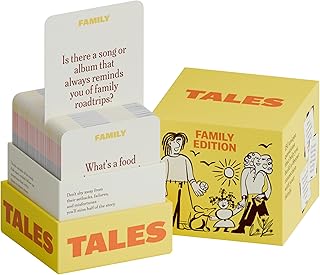
TALES Family Edition 150 Conversation Cards for Family Game Night, Adults, Teens, and Kids, Family Dinners, and Gatherings, Prompts for Meaningful Connections
Best For:
Families, teens, adults, teachers who want conversation-based storytelling, group facilitators
TALES Family Edition is a card-based prompt set designed around conversation, memory, and storytelling. With 150 prompts tailored to families, this deck aims to spark meaningful conversations at the dinner table, during road trips, or at game nights. Unlike games that focus purely on literacy mechanics, TALES is about connection—questions and prompts invite players across generations to share personal stories, favorite memories, imaginative answers, or hypothetical scenarios. This makes it a gentle, structured way to practice narrative skills and listening with intent.
Real-life uses include dinner-table warm-ups that get kids and adults talking without screens, icebreakers for blended family gatherings, and short reflection sessions after school. For teachers, these cards can be used as warm-up activities that develop speaking and listening objectives, or as journal prompts where students expand short responses into longer written pieces. Compared with competitive board games, TALES encourages turn-taking and deep listening rather than speed or right answers, which many families find refreshing.
Considerations: while the cards work well with teens and adults, younger children may need simplified prompts or a parent to translate a question into a story-building cue. The deck’s strength is in breadth—150 prompts provide variety—but effectiveness depends on a willingness to share. If your goal is bonding and conversational storytelling rather than literal word recognition drills, this set is a top choice. It’s also highly portable and requires no setup, making it an easy addition to backpacks for travel or classrooms for quick oral language practice.
Pros
- Generates deep conversation and cross-generational sharing
- Portable and requires no setup
- Large variety with 150 prompts to keep play fresh
Cons
- Younger children may need help engaging with some prompts
- Effectiveness depends on participants willing to share
Find it on Amazon here: https://www.amazon.com/dp/B0DT3P6M5Q?tag=theideaofart-20 — Check the latest price on Amazon.
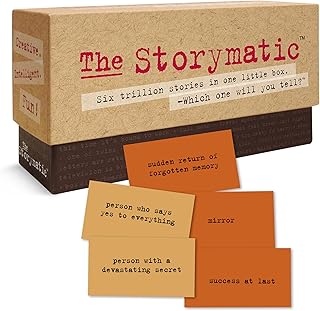
Storymatic Classic – Creative Writing Prompts and Story Games – Storyteller Cards – Teacher Tool
Best For:
Writers, teachers, teens, and families who enjoy creative writing and deeper narrative play
Storymatic Classic is a long-standing favorite among writers, teachers, and creative families who want robust prompts to jumpstart storytelling and creative writing. The deck-style game encourages players to draw character and situation cards and then weave a short piece—spoken or written—based on the combination. Because prompts can be whimsical or unexpectedly paired, Storymatic fosters originality and helps writers practice the craft of developing characters, conflict, and satisfying arcs. It’s used by creative writing teachers as a warm-up, by families for imaginative play, and by writers battling writer’s block.
In classroom settings, Storymatic functions as a timed-writing exercise, group storytelling activity, or assessment tool to see how students manage narrative elements under constraint. For home use, it’s excellent for family storytelling nights where older kids and adults enjoy collaborative creation. Compared with simpler prompt cards, Storymatic’s structure (character + situation) gives a scaffold that produces richer, more layered narratives, which is why many educators favor it for middle-school and high-school creative writing groups.
Buyer considerations: Storymatic is better suited to older children and adults who can handle abstract prompts and produce extended narrative responses; it’s not ideal for pre-readers or very young children without adult facilitation. If you want a product focused purely on vocabulary or sight words, pair Storymatic with a reading-centered tool rather than relying on it alone. For writers and teachers seeking to expand narrative skills, Storymatic Classic remains a flexible, high-value toolkit that sparks both solo and collaborative storytelling.
Pros
- Powerful structure for developing character and plot quickly
- Great for classroom warm-ups and writing workshops
- Encourages imaginative, original storytelling
Cons
- Less useful for very young children or nonreaders
- Requires some comfort with open-ended prompts
Find it on Amazon here: https://www.amazon.com/dp/B004PICKDS?tag=theideaofart-20 — Check the latest price on Amazon.
Final Verdict
Choosing the right storytelling game depends on age, learning goals, and how you plan to use it. For preschoolers building vocabulary and early reading skills, ThinkFun Zingo Bingo provides tactile matching and quick rounds that hold attention. If your focus is fluent reading and sight-word recognition, ThinkFun Zingo Sight Words adapts the same playful mechanics to boost word recall. For social-emotional development and sequencing practice, Educational Insights Storytelling Dominoes offers image-driven prompts to encourage narrative thinking and expression. TALES Family Edition is the go-to when your priority is conversation, memory, and cross-generational sharing. Finally, Storymatic Classic is a superb choice for older kids, writers, and classroom creatives who want structured prompts to craft deeper narratives. Each product meets a slightly different need—from early literacy drills to family conversations and creative writing. Consider your learners’ ages, attention spans, and whether you want a tactile, visual, or discussion-focused tool. All five options deliver replay value and are designed to make language practice feel like play, not work. As an affiliate, I’ve included links that will take you to the product pages if you’d like to learn more. Check the latest price on Amazon.
Conclusion
These Best Educational Storytelling Games picks are trending now and offer great value and variety. Check the links above for latest prices and reviews.
As an Amazon Associate, I earn from qualifying purchases.
Tags:
storytelling games, educational games, early literacy, family conversation, creative writing prompts, kids learning activities, social emotional learning
